Figures and Illustrations from the Domains
|
A. Brain stem and other brain parts.
Source: Cancer Research UK/Wikimedia Commons 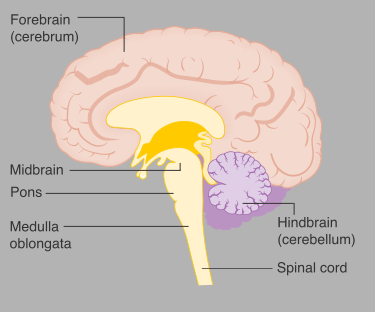

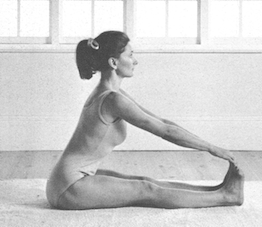
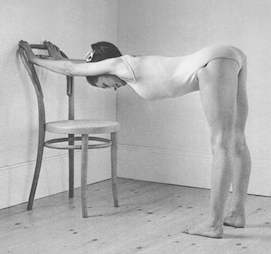
E. "less stretch" forward bend
|
|
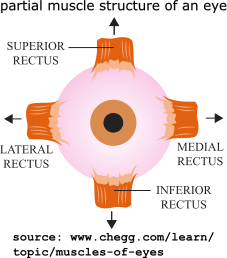
C. Eyes that look at objects
B. A game of ping pong
|


The sitemap is an organized list of projects published online since 1992. All projects are included in this website. All materials on the website are dedicated to the public domain.
There are multitudes of freedoms and each person has their own combinations and inventions. In this project, exercises of freedom revolve around muscular movements and related bodily feelings that occur while a person is brushing their teeth, preparing food in a kitchen, playing a game of ping pong, practicing a piece of music or performing a yoga routine. Such common exercises of freedom are grounded in personal experience of the body. I suggest that social, mental, economic and political exercises of freedom are developed from those of the body.
Choosing a snack in a food store is an exercise of freedom with important features that extend into other situations:
... A. Movements and feelings of animal bodies (actual life) ... .pdf version
... B. Contests (sports and games)
... C. Engineered organisms — eyes that look at objects ... .pdf version
... D. Music practice and performance
... E. Practices of bodily consciousness ... .pdf version... sitemap (organized list of prior projects) |
|
A. Brain stem and other brain parts.
Source: Cancer Research UK/Wikimedia Commons
E. "less stretch" forward bend
|
|
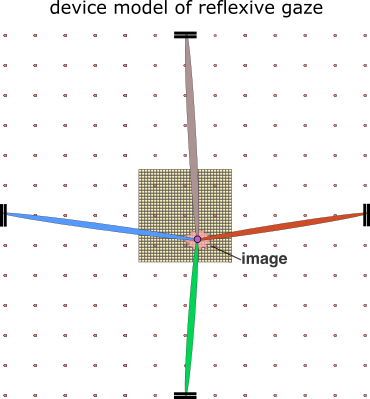
C. Eyes that look at objects
B. A game of ping pong
|
... sitemap (organized list of prior projects)
... 1. Actual life is the original domain of freedom.[Prior versions of materials in this domain were developed in the free-will puzzles project "How to solve free will puzzles and overcome limitations of platonic science" (2016) (as to §§ 1-4) and in the first part of the paradigms project, "Actual Time, Detached Time and Controlled Time: Physical Paradigms and Energy Constructions" (2018) (as to § 6). Please see the sitemap for descriptions and copies.]... 2. First investigations: wiping reflexes of decapitated frogs.
... 3. Progressive investigations of bodily freedom start with wiping reflexes, lead to itching and scratching and extend to habits in the home.
... 4. In initial psychological models, bodily habits are described by forms of movement that are based on properties of materials.
... 5. Extended psychological models include mental images that control exercises of freedom during routines of food preparation, changes in locomotion gaits and a choice of dinner from a restaurant menu.
... 6. Modeled by operations of an idealized holistic brain, multiple kinds of imagery (feelings, awareness, consciousness) participate in exercises of freedom of a competing athlete, performing musician and yoga practitioner.
God who gave Animals self motion beyond our understanding is without doubt able to implant other principles of motion in bodies which we may understand as little. Some would readily grant this may be a Spiritual one; yet a mechanical one might be showne, did not I think it better to passe it by.Isaac Newton in correspondence, concerning his theory of light.
My approach employs a process of construction. Initial elements are muscular movements and related feelings of animal bodies, especially my own movements and my own bodily feelings. Mental operations and social interactions come later. I use the phrase actual life to name a foundational domain of movements and feelings. Investigations of freedom in other domains, psychologies of freedom and anticipated engineered organisms are based on concepts drawn from actual life.
I presume that all four-limbed vertebrate animals (tetrapods) have an actual life that resembles my own as to touching and self-touching, locomotion, selective eating, digestion and sleep. More resemblances are found in social tetrapods that engage in sexual selection and have homes, families and communities. In neighborhood parks, birds, squirrels and children manifest common impulsive movements, e.g., squabbling over food and sudden collective running or flight.
In this approach, the common actual life of tetrapods is prior to concepts of objects in an environment or a mental image of reality — as a human infant is prior to an adult. The daily lives of adult human beings generally incorporate an external reality that is organized around permanent objects and locations, anticipated events and personal relationships. Here, in contrast, investigations focus on repetitive movements and bodily feelings that occur while a person is brushing their teeth, climbing a hill, practicing the violin or relaxing in stretched yoga positions.
The following paragraphs introduce the domain of muscular movements and bodily feelings in a broad, sweeping way. Investigations focus on specific situations, simple models and imaginative constructions rather than universal concepts. I presume that actual life has capacities for development and invention — creating new movements and feelings — that reach beyond universal concepts.
In this approach, the body of a tetrapod is moving all the time, even in sleep. Multiple kinds of movements occur at the same time; and different kinds of movement have independent means of production. Eyes, neck, limbs, fingers, mouth, gut, heart and lungs can all operate independently, within limits and with a supporting body and environment.
Muscular movements of a human being include whole-body movements such as walking, dancing and gardening; and also movements of body parts that often occur while the body is in a stationary position such as adjustments in posture, handling objects, speaking and gesturing, working at a desk. Movements of body parts can be coordinated through synchronized operations, e.g., movements during dinner of two hands, eyes and mouth. Whole-body movements are often based on innate or habitual forms such as sitting down or changing clothes.
Bodily feelings include: itch, stretch, heavy, ouch, ache, numb, limb positions, resting, relaxed, upright, unbalanced, tense, queasy, riding, working, hungry and tired. Bodily feelings occur inside the skin while objects outside the skin are perceived through sensory detections. Skin both feels inside and also perceives outside objects. In the mouth and throat, outside objects end up inside; surfaces in these body parts have high densities of multiple detectors that generate complex images. Closing the eyes in a quiet room can help to bring bodily feelings into the foreground of a person's consciousness. In ordinary life, during activities directed at external events, bodily feelings often fade away from a focus of awareness.
Each movement has a brief duration. Many activities involve functional repetition of movements, achieving a single purpose over and over, e.g., in tooth-brushing; but exact repetition of movements requires environmental constraints and training (e.g., movements of a pianist). More often in actual life, unique movements supersede each other during the ever-changing moment of now.
Bodily feelings that accompany ever-changing muscular movements generally have a brief duration. An original domain of actual life is thus constituted by a multitude of transient events occurring inside an animal body that is producing many kinds of movements and generating many kinds of feelings.
In this approach, external objects, persons, relationships and situations become part of actual life by gradually modifying and enlarging the original domain. This approach resembles that of psychologist Jean Piaget (1896-1980), who studied the development of intelligence in children beginning in infancy, as discussed below.
In many activities, movements and feelings are interactive — e.g., grasping, holding and carrying a water bottle; touching objects and self-touching. Pivotal examples revolve around itching and scratching. Feelings can cause, prevent, guide and otherwise influence movements. I suggest that primitive exercises of freedom occur during movements that are influenced by bodily feelings. In sum, the body of a tetrapod produces movements, generates bodily feelings and exercises freedom. I suggest that principles of freedom are grounded in the actual life of an animal body and extend, by means of modifications and enlargements, into mental life and social life.
... Index to part A
|
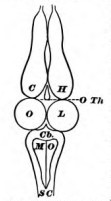
The adjacent image shows James' diagram of the frog brain. There is an ordered array of "different nerve-centres" in which the bottom parts are foundational.
The "SC" (spinal cord) stands at the bottom of the nerve-centres. The first step up leads to the "MO" (medulla oblongata); next comes the "Cb" (cerebellum). Above the cerebellum are the "OL" (optic lobes) and the "O Th" (optic thalami). At the top are the "CH" (cerebral hemispheres) that extend up to olfactory sensors. |
|
James concluded: "The acts of all the centres involve the use of the same muscles."
The same muscle, then, is repeatedly represented at different heights; and at each it enters into a different combination with other muscles to co-operate in some special form of concerted movement. At each height the movement is discharged by some particular form of sensorial stimulus. Thus in the cord, the skin alone occasions movements; in the upper part of the optic lobes, the eyes are added; in the thalami, the semi-circular canals would seem to play a part; whilst the stimuli which discharge the hemispheres would seem not so much to be elementary sorts of sensation, as groups of sensations forming determinate objects or things.Frogs that have been reduced to spines, without any of the higher nerve-centres, demonstrate wiping reflexes.
If, to take the stock instance, the right knee of a headless frog be irritated with acid, the right foot will wipe it off. When, however, this foot is amputated, the animal will often raise the left foot to the spot and wipe the offending material away.James appears to discern "conscious intelligence in the frog's spinal cord."If we suspend it by the nose, and irritate different portions of its skin by acid, it performs a set of remarkable 'defensive' movements calculated to wipe away the irritant. Thus, if the breast be touched, both fore paws will rub it vigorously.
. . .
The most striking character of all these movements, after their teleological appropriateness, is their precision. They vary, in sensitive frogs and with a proper amount of irritation, so little as almost to resemble in their machine-like regularity the performances of a jumping-jack, whose legs must twitch whenever you pull the string.. . .
The spinal cord of the frog thus contains arrangements of cells and fibres fitted to convert skin irritations into movements of defence. We may call it the centre for defensive movements in this animal. We may indeed go farther than this, and by cutting the spinal cord in various places find that its separate segments are independent mechanisms, for appropriate activities of the head and of the arms and legs respectively. The segment governing the arms is especially active, in male frogs, in the breeding season; and these members alone with the breast and back appertaining to them, everything else being cut away, will then actively grasp a finger placed between them and remain hanging to it for a considerable time.. . .
The spinal cord in other animals has analogous powers. Even in man it makes movements of defence. . . . Robin, on tickling the breast of a criminal an hour after decapitation, saw the arm and hand move towards the spot.
In a similar way Goltz ascribes intelligence to the frog's optic lobes and cerebellum. We alluded above to the manner in which a sound frog imprisoned in water will discover an outlet to the atmosphere. Goltz found that frogs deprived of their cerebral hemispheres would often exhibit a like ingenuity. . . . Goltz concluded from this that the hemispheres are not the sole seat of intellect in frogs."Important new features of the [wiping] reflex" were observed in the mid-twentieth century by a group of Moscow physiologists. [Mark L. Latash, Fundamentals of Motor Control (2012) at 183.]
In particular, the hindlimb of the frog produced a series of wiping movements targeting the same area of the back (where the stimulus was placed); individual movements within the series produced wiping of the back in different directions. This means that the movements were organized to wipe the same spatial location but at different angles. In other words, the spinal cord was able to organize a multi-joint coordinated action that preserved the location of the spot to be wiped ... while allowing the direction of the wiping movement to vary. Another important observation was made with the stimulus placed not on the back of the body but on a forelimb. Accurate wiping was observed for various positions of the forelimb . . . This implies that the spinal cord is "aware" of changes in body configuration and is able to use this information for movement production.The experiments show that the spine acting alone produces complex repertoires of movements — called "wiping reflexes." Attempts to model wiping reflexes with physical processes of nerves and muscles encounter formidable difficulties. A spot of acid on the skin presumably generates nerve signals that trigger other nerve signals that cause muscular movements of limbs. The movements specifically target the affected spot on the skin. Accurate targeting occurs despite a huge number of possible configurations of body parts and even when a secondary limb must be used or when a limb is burdened with weights.. . .
In [] loading studies, a heavy (lead) bracelet was placed on one of the distal joints of the hindlimb, thus changing dramatically the inertial properties of the limb. Movement kinetics was changed. Nevertheless, the hindlimb was able to wipe the target successfully at the first attempt. Successful wiping was also observed, also at the first attempt, when one of the hindlimb joints was blocked mechanically.
I suggest that wiping reflexes manifest primitive operations of a physical principle of freedomis called location selection. The principle of location selection is a foundational component in more highly developed kinds of freedom, e.g., picking a snack from a rack of many snacks in a food store. The principle is vaguely stated, serving as a starting point. This project investigates the principle in diverse situations tethered to actual life. I presume that what is actually happening may be beyond our capacities for understanding.
In the first reflexive example of location selection, a multitude of similar locations could have been targeted by the movement, but one particular location was selected. The process of selection was triggered by signals from the acid spot. During the selection process, many possible movements changed into a single actual movement. This is the germinal concept of freedom in this project, the beginning step in a course of development.
In the following investigations, I presume that my own spine produces repertoires of wiping movements, which are then adapted for itching and scratching. The principle of freedom (location selection) that was attributed to wiping reflexes is extended and developed for itching and scratching. Next, principles are further extended to habits in the home.
To start: guided by the feeling of an itch, my body first moves a finger to a location just above the targeted spot on my skin; and then the finger extends and performs scratching movements on the skin at that spot. Perhaps while I sit on a couch, a small elbow movement brings a hand to the face or to the chest; some small movements resemble wiping reflexes, apparently effortless and thoughtless.
Involuntary reflexive events often generate feelings that carry signifiers of external causes, e.g., a feeling of sharp pain or heat or an impact. Awareness or consciousness of the feeling arises after the movement has started, with a delay. The feeling does not cause or influence the reflexive movement; rather an external event causes both the movement and the feeling.
Suppose that a skin irritation causes an itch and that I feel the itch prior to actual movement. The feeling of an itch intervenes between the irritation and the movement. Alerted by the itchy feeling, my mind might stifle the scratching movement. "Nurse says do not scratch." As an advancement from an inalterable wiping reflex, an itchy feeling provides a point in the process where mind can control movement. This more advanced freedom might be called "free will."
Similar intervening feelings alert us to try to stifle a sneeze or to relocate to the nearest bathroom.
Wiping reflexes manifest a physical principle of freedom that operates on its own. The addition of feelings provides many opportunities for development. The itch is an example of a desire and scratching it provides satisfaction of the desire, sometimes at least. Reduced to a primitive psychological form, a feeling of desire causes the movement. A different feeling would cause a different movement. Different movements are caused by different feelings during exercises of freedom.
According to William James, "the mind is at every stage a theatre of simultaneous possibilities" and on "our mental stage Feeling always selects." I suggest that selections occur in the body before they occur in the mind and that all selections occur in biological materials regardless of location. (Quotation from a magazine article by James "Are we automata?" — see the free-will puzzles project)
An important residential/remote distinction guides further investigations in this domain and in the whole project. The distinction states that there are two different kinds of muscular movements and two different kinds of control systems, which are based in different regions of the central nervous system.
Residential movements are based in nervous structures that reside in and about the spine, progressively extending up through the brain stem and the cerebellum. Remotely-controlled movements are based in the cerebrum. Residential movements arise from and depend on physical properties and conditions of living bodies while remote movements can be controlled by principles of reason.
As discussed in the free-will puzzles project, the residential/remote distinction was originally articulated by William James and is congruent with his description of the frog brain that has different kinds of muscular control at different nerve-centres.
I suggest that the residential/remote distinction illuminates independence of mind and body in certain situations. At the gym, the body toils on a treadmill while the mind discusses social events on a cellphone. In connection with Habit, James related that "A musical performer will play a piece which has become familiar by repetition while carrying on an animated conversation" and that the innovative magician Robert-Houdin trained himself to read books while juggling balls.
Limited investigations of residential movements begin with a spinal focus, e.g., in movements of locomotion. Extended residential investigations involve the cerebellum, which contains most of the brain's neurons, about 70% by some estimates, while occupying only about 10% of the brain's volume. These imbalances are especially impressive since movement control is the sole function of the cerebellum while the minority of neurons in the cerebrum perform many diverse functions.
Neuronal groups in the cerebellum interact through multiple circuits with neuronal groups in vertebrae. I suggest that, metaphorically, a vertebral unit by itself is like a musical instrument called "panpipes" — a rudimentary harmonica made of a set of tubes of different lengths, each producing a musical tone. The cerebellum and spine together are like a pipe organ with multiple ranks of pipes, a variety of keyboard controls and many combinations of tones organized in flowing streams. I suggest that "training" and "practice" in athletics and music occur chiefly in the cerebellum and spine and that certain bodily consciousness practices discussed in part E occur in a "theater of bodily awareness" generated in the cerebellum.
Cerebral exercises of freedom in actual life, in contrast, commonly involve external events in a spatial field, permanent (or stable) objects, persons and forms. Parlor games provide many examples, e.g., game boards, dice and playing cards.
Investigations in this section (§ 3) and the following section (§ 4) are based on residential movements and controls. In § 5, certain mental or remote controls are added incrementally as cues, commands and choices. Final developments in § 6 lead to a holistic view of unified controls ("integrity of freedom") that produce movements of a competing athlete, performing musician or yoga practitioner.
Thus, investigations of bodily feelings beyond reflexive appearances depend on residential/remote distinctions. Functions of awareness of feelings are attributed to residential operations in the spinal cord, brain stem and cerebellum. Functions of consciousness of feelings are attributed to remote operations in the cerebrum. Holistic activities are attributed to unified residential and remote operations and unified consciousness and awareness. These attributions might be criticized as arbitrary and categorical; they are also provisional and modifiable.
In this view, awareness is internal, body-centered and self-centered, often with a whole-body character. An animal in a stationary position, alert and ready — a dog at home awaiting the owner's expected arrival — may have awareness even if no object engages its attention. Awareness can expand to include changes in the environment. Stationary awareness may be tethered to external objects but foundational bodily feelings arise internally on their own.
Consciousness, in contrast, is generally directed at or interacting with external objects, events and persons. Externally-directed consciousness constructs and re-constructs an individual's reality of people, places and things.
Consciousness can also be directed at internal bodily feelings that appear in awareness. Feelings are thereby objectified. Examples appear throughout the project, especially in practices of bodily consciousness discussed in part E. As a general method of investigation, I objectify feelings in this project.
In the following experiments, a person investigates residential/remote distinctions by means of different kinds of self-touching. In the experiments, the tip of one index finger touches the tip of the other index finger.
First experiment. In remotely-controlled fingertip touching, the eyes focus on a stationary left index finger. Then a moving right index finger enters into the field of view; and then the right fingertip approaches and touches the left fingertip under visual control.
Second experiment. In residential fingertip touching, movements are similar to those in the first experiment but the eyes are closed. The moving right fingertip approaches and touches the left fingertip under the control of functions called "proprioception," based in muscles and joints and configurations of body parts.
After practice, my chief observation is that remote and residential fingertip touching have distinctly different kinds of associated feelings. Feelings in the remote case are centered about the fingertips and eyes, which focus on the fingertips and follow their movements; eyes also generate the images used for control. Feelings in the residential case are grounded in the back of my body and extend through shoulders and arms with a culmination in the fingertips.
In the remote case, the controlled speed of movement slows down as the fingertips approach. A steady speed can be more easily maintained in the residential case.
Accurate touching is chancier in residential cases, compared to more assured accuracy in remote cases. This occurs even though my capacities for residential movements and feelings have been developed through various disciplines.
Further experiments. Change roles of right and left fingertips. Try various bodily configurations. Have both fingertips move. My conclusions: Much the same, right or left. Accuracy does not change much as configurations vary. Experiments with two moving fingertips present little added difficulty.
The foregoing observations are applied to whole-body itching and scratching that involves influential feelings. For example, a whole-body movement directs a finger to an itching foot — perhaps the foot participates by lifting to meet the finger. Accurate placement is achieved when the targeted spot is accessible to a finger regardless of the postural configuration of arms, legs, pelvis, chest and head.
I attribute the original start of a whole-body movement to a reflex; then, continuation of the movement takes place under more extensive controls that are activated by a wave spreading from the spinal origin through multiple spinal regions and extending over the entire spine. Perhaps scratching the face is entirely reflexive and operations are confined to thoracic vertebrae; but scratching the foot requires whole-body involvement and extensions of movement.
I suggest that, as more vertebrae become involved in a continuing movement, feelings arise and take on functions of guidance to the target. Complete execution of a whole-body scratching movement by a human being involves a wave of activity through the spine that spreads from the region of origin and culminates in the brainstem and cerebellum.
Recall that residential fingertip self touching included feelings that reached from the back through the shoulders to the fingertips. Much the same kinds of feelings appear in whole-body itching and scratching. A feeling of fingertip leading stands out. In a whole-body scratching movement, a trajectory of fingertip feeling is being aimed at the itch. Such a feeling of directed leading of a movement is a manifestation of an exercise of freedom that re-appears in diverse situations.
Next, the investigation extends to exercises of freedom performed by the body during simple self-touching movements with objects — such as scratching the back with a wooden stick, using a towel to dry off after bathing and tooth-brushing. In each case, an object is moved in specific ways at specific locations on body surfaces so as to generate specific feelings and produce specific effects.
In self-touching with objects, feelings of fingertip leading may be relocated to the part of the object that touches the body, e.g., to the tip of the backscratcher or the bristles of the toothbrush. Relocation of leading feelings to objects is an echo of what presumably occurs in the body, where operations of neurons in and about vertebrae and the brain are felt at fingertips.
Freedom of location selection is similarly exercised when a person puts cleaned dishes away, each dish in its reserved location in the cupboard. Conscious attention may be required to manipulate an object in a crowded space. Securing a dish in its proper place in the cupboard is like scratching an itch.
Extending the principle of freedom exercised during location selection, there are thousands of objects in the home, each with an assigned location. A person takes objects out of assigned locations for use and returns them afterwards. A person can put their fingers on nearly all the objects in their assigned locations, needing only the thought of an object to recall its assigned location and to direct the movement. Location selections in the domain of the home resemble those that occur in the domain of bodily feelings. Each domain is a domain of freedom. The home domain is enlarged and has greater capacities. A person can re-organize assigned locations of objects in the home. While living in the home, a person acquires objects that require new movements, further expanding the domain of freedom.
Definitions. In a bodily domain, movements of an animal are influenced by an environment and conditions of the body such as cold or sleep, by interactions with external bodies, and by internally-generated nerve signals and images. "Images" is used to model "subjective experience" and consists here of internal bodily feelings and external objects. Bodily feelings and objects have common features, e.g., location and duration. Here, objects are constructed elements in a developing mind but they are not yet part of a coherent "reality." There are no objects in initial constructions; they appear incrementally in § 5 as cues, commands and choices.
For purposes here, a psychology is a model of movements of an animal body. The model is constructed in a mental domain resembling a chalkboard. The elements of a psychological model can be verbal, symbolic or designs for devices. The mental construction domain of the model is distinct from the physical domain in which the body moves and from any mental domain of the organism. Certain movements of the model are representations of movements of the body.
A psychological model includes forms of movement. The simplest form of movement is a beat. A beat is a flow of repeated movements. Each beat has a tempo or rate of repetition, e.g., 85 repetitions per minute. The repeated movement in a beat is called the schema, plural "schemata." A schema can be a single stroke or a more complex pattern. Rests can intervene between separate iterations of the schema. Or the schema can repeat continuously in a cycle. Initially, the tempo and schema of a beat are fixed and then variations are used in development.
Representational movements of the model are controlled by the forms of movement. The forms can also control movements of the body; movements of the body that can be produced by use of the forms are thus based on the model. A body controlled by a beat repeats movements incessantly. The set of forms is readily expanded but can never reach all possible movements of the body.
Each psychology is restricted to a specific situation, which is an environment for movements with a defined space that contains certain fixed and movable objects and is otherwise unobstructed. Examples of situations are kitchens, sports fields, game boards, music rooms and exercise rooms. Only limited classes of movements are performed in a particular situation.
The foregoing definitions are my inventions. They are based on Piaget's psychological concepts and are also adaptable to engineering designs.
Repetition. In human infancy "there is a tendency toward repetition, or, in objective terms, cumulative repetition." (Piaget, Origins of Intelligence in Children, p. 33.) According to Piaget, a kind of pattern – the "Primary Circular Reaction" – appears in the first stage of development and includes behaviors that "are ordinarily called 'acquired associations,' habits or even conditioned reflexes." "The repetition of the cycle which has been acquired or is in the process of being acquired is what J. M. Baldwin has called the 'circular reaction.' " (47 - 49.)
Sometimes, desire not having been satisfied, completion of one cycle starts the next cycle. Movements may become self-perpetuating. "The sucking reflex . . . lends itself to repetitions and to cumulative use, is not limited to functioning under compulsion by a fixed excitant, external or internal, but functions in a way for itself. In other words, the child does not only suck in order to eat but also . . . he sucks for the sake of sucking." "The object sucked is to be conceived not as nourishment for the organism, but, so to speak, as aliment for the very activity of sucking, according to its various forms." (35, emphasis added.)
I suggest that, beginning in infancy, movements are often self-perpetuating and performed for their own sake. After three or four years, bodies that repeat movements for their own sake may be accompanied by minds that construct other reasons for such movements. An older child or adult will engage in lifestyle, social and mental activities in self-perpetuating ways and will sustain and deepen an activity by means of repetition — "doing it for the sake of doing it." I suggest that acting on one's own, deepening performance skills through repetition and "doing it for the sake of doing it" identify activities that manifest freedom.
The repetition element provides content for activities in domains of freedom. A kitchen routine incorporates linked sequences of repetitive circular actions in peeling, slicing and dicing a carrot. A musical composition is a highly repetitive structure of beats, rhythms, melodies and harmonies. Musicians and athletes repetitively practice movements in preparation for public events. In sports with perenniel leagues, a single contest gains significance as one of a series of repetitive events. Likewise, series of contests in courts and in electoral politics acquire governmental significance. Repetitive movements in yoga, taijiquan and karate nourish growth of seeds of consciousness.
Schema. Piaget sometimes uses the word "schema" and sometimes the word "scheme." I use the word "schema" and restricted definitions. The starting point is from Piaget & Inhelder, The Psychology of the Child (1969) at 4: "A scheme is the structure or organization of actions as they are transferred or generalized by repetition in similar or analogous circumstances."
Here are examples of simple schemata: drying the hands with a towel after washing; serving the ball in a game of tennis; singing the opening motif from Beethoven's Fifth Symphony (dit-dit-dit-dah); a forward bend in a yoga routine.
Piaget & Inhelder conclude that the presence of schemata ("action-schemes") in young children demonstrates the "existence of an intelligence before language."
Essentially practical – that is, aimed at getting results rather than at stating truths – this intelligence nevertheless succeeds in eventually solving numerous problems of action (such as reaching distant or hidden objects) by constructing a complex system of action-schemes and organizing reality in terms of spatio-temporal and causal structures. In the absence of language or symbolic function, however, these constructions are made with the sole support of perceptions and movements and thus by means of sensory-motor coordination of actions, without the intervention of representation or thought. (p. 4.)b. Psychology of bodily habits, with an application to tooth-brushing.
In tooth-brushing, an exemplar of bodily habits, a larger purposeful course of action includes a series of location selection processes, each such process targeting particular tooth surfaces. Perhaps the person's operative arm and hand are holding the toothbrush so that the bristles are rubbing against one particular tooth. The arm and hand are also engaged in a small cyclical movement that pushes the bristles in a repetitive brushing pattern. After a while, the arm and hand exercise freedom of location selection and shift the bristles to rub the next tooth in line, using the same cyclical movement.
As described by James, the nature of such habits is based on physical properties of materials. "The moment one tries to define what a habit is, one is led to the fundamental properties of matter." He quotes from a philosophical account on
how a garment, after having been worn a certain time, clings to the shape of the body better than when it was new ... A lock works better after being used ... It costs less trouble to fold a paper when it has been folded already ... The sounds of a violin improve by use in the hands of an able artist [giving] inestimable value to instruments that have belonged to great master ... Water, in flowing, hollows out for itself a channel, which grows broader and deeper.Development of habits recalls events "when a bar of iron becomes magnetic or crystalline ... or plaster 'sets.' " Habits are possible because of Plasticity, which "means the possession of a structure weak enough to yield to an influence, but strong enough not to yield all at once." Such plasticity accounts for strengthening of habits that are used daily, for variations of habits among animals of the same species and for changes in habits of an individual at different stages of life.
James concludes that "habit simplifies the movements required to achieve a given result, makes them more accurate and diminishes fatigue" and that "habit diminishes the conscious attention with which our acts are performed." Through practice, "habit economize[s] the expense of nervous and muscular energy." "Dr. Carpenter's phrase that our nervous system grows to the modes in which it has been exercised expresses the philosophy of habit in a nutshell."
In a simple case, "the impression produced by one muscular contraction serv[es] as a stimulus to provoke the next, until a final impression inhibits the process and closes the chain."
In an action grown habitual, what instigates each new muscular contraction to take place in its appointed order is not a thought or a perception, but the sensation occasioned by the muscular contraction just finished. A strictly voluntary act has to be guided by idea, perception and volition throughout its whole course. In an habitual action mere sensation is a sufficient guide, and the upper regions of brain and mind are set comparatively free.James' observations are readily incorporated in my psychological model of residential habits. Guidance of movements is by means of residential feelings based in the spine, brain stem and cerebellum, rather than by ideas, perceptions or volition based in upper regions of brain and mind. In primitive bodily habits, causation is presumptively muscular, with sensorial linkages.
I would add "engines" to the philosopher's list of things that operate more smoothly and economically after steady use during a "break-in period." Engines are devices and processes that convert energy from one form to another, including steam engines, internal combustion engines in automobiles and the biochemical engines that power animal muscles and nerves. Engines produce cyclical movements described by a beat.
In a psychological model of tooth-brushing, something like an engine produces a repetitive brushing movement, or stroke, e.g., up-and-down, side-to-side or round-in-a-circle. Movements of the arm and hand performing the stroke embody the schema of a beat in the model.
Unlike the strokes of an automobile engine, strokes of the tooth-brushing engine manifest individual exercises of freedom, e.g., as to the pressure of the bristles against the teeth and gums. With sensitive feelings, a range of possible pressures changes into a single actual pressure. A different kind of freedom is triggered by a feeling akin to satisfaction, which causes a shift of the brush from tooth to tooth. And then, yet another kind of freedom – the familiar freedom of location selection – is exercised when the muscles holding the brush actually perform the shift from tooth to tooth and when, in yet another version of the same freedom, the brush relocates to a different set of tooth surfaces, e.g., from outside surfaces to inside surfaces. Although the beat may be interrupted when the brush relocates, the beat quickly resumes at the new location.
In such a habit, movements depend on properties of bodies and materials, e.g., masses of parts, limb lengths, muscle strengths. Movements also depend on momentary positions and variable operations. Proposed engineered organisms discussed in part C illustrate the foundational character of material properties in primary definitional operations of devices. Variable operations are secondary and also depend on material properties. I suggest that, in animal bodies, properties of materials participate in control at all levels of movement.
There is also an accumulative character like that observed in well-played violins, in clinging garments, in grooved water channels and in engines that have had a proper break-in. Such accumulative character or memory resides in the moving parts of the organism.
The grooves of movement are definite but they are not determinate or fixed. An underlying readiness for change is the essence of original freedom. The grooves, like meandering rivers, will shift in time. In the next section, movement production is switched from one groove to another groove by means of signals from a mental domain — specified as cues, commands and choices.
A new kind of control is introduced in which one kind of repeated movement is replaced by another kind of repeated movement when a mental cue occurs. A series of mental cues controls production of a series of different repeated movements. The series adds up to a new kind of movement called a routine. A routine has a specific purpose and pre-arranged sets of repeated movements and cues. The description of a routine usually includes one or more of these features, e.g., peeling, slicing and dicing a carrot; performing eight repetitions each of six exercises prescribed by a physical therapist.
The course of development is thus progressing from wiping reflexes to itching and scratching to tooth-brushing to a routine in a kitchen or exercise room.
Such development involves simultaneous growth of complexity in two domains, the external domain where the results of new movements appear and the internal domain where new movements (schemata) are produced. As stated in Piaget's The Construction of Reality in the Child: "the increasing coherence of the schemata thus parallels the formation of a world of objects and spatial relationships, in short, the elaboration of a solid and permanent universe." (Introduction, p. xii.) The "universe" in Piaget's approach is a mental image that is being constructed.
An extended development begins with the beat form of movement, in which a single schema repeats incessantly. Development proceeds to construct structures of schemata. Suppose that a bare beat (a "click") continues for a number of repetitions and then stops – call that number "m." A circular movement (schema) immediately follows each beat. It repeats m times and then stops. After the first schema is stopped, a second beat and schema start, repeat a number of times and then stop – call that number "n." And so forth.
As part of development, the class of "schemata" is expanded to include the bloc of m repetitions and the bloc of n repetitions; they become identifiable movements. An original schema that follows clicks is called an elemental schema, while a larger schema made of elemental schemata is called a compound schema. Both an elemental schema and a compound schema are confined to a time period. Like an elemental schema, each compound schema has a production cycle that is independent from other production cycles. In a first-level compound schema, elemental schemata follow each other in a series. Then compound schemata follow each other in a series to make up a model of a habit, e.g., tooth-brushing.
In a routine, changes between compound schemata are triggered by signals, feelings or objects that are noticed mentally. A mental action of noticing and triggering is called a cue. The person notices the cue and responds by changing the compound movement. This model applies to a routine of peeling, slicing and dicing a carrot. This routine of food preparation can be developed to fit into larger routines, such as: first dice onions, then dice carrots, then dice celery.
Get cutting board from assigned location and put it in workspace. Get knife and peeler and put them on cutting board. Get carrot from refrigerator, wash and put on cutting board. Cut off top and root tip of carrot and discard pieces. The carrot is now ready for the routine. (This is a cue.)Such a routine can be acquired by way of imitation, or verbal instructions via teacher or via recipe. or invention. In this routine, the situation is my kitchen in which I have made many meals and where I keep objects in assigned locations, more or less. Having habitually diced carrots for many years, my body exercises freedom like an engineer — efficiently and economically. Although a verbal description of an action might specify only the end state and disregard details of posture or adjustments during performance, this is sufficient since the body has lots of practice and exercises freedom to complete the task. Each stroke of the peeler or the knife is an exercise of freedom with location selection as a foundational component.Peeling proceeds in two halves. For the first half, hold the carrot by the top end and peel the root end. Thus, holding the carrot in the left hand, stroke the surface of the carrot from middle to end with the peeler held in the right hand. Between successive strokes, the left hand rotates the carrot. There is a beat of stroke-rotate-stroke etc. Each stroke and each rotation require exercises of freedom as to location selection. Rotations and strokes aim to remove all of the skin and also to minimize any unnecessary removal. Another aim is to minimize the number of strokes needed to peel the carrot.
When skin at the root end has been completely removed (cue), flip the carrot and hold the root end with the left hand. Then, for the second half of peeling, repeat the first-half movements directed at the top of the carrot.
After the skin has been completely removed (cue), hold the carrot down on the cutting board with the left hand. Take the knife and slice the carrot lengthwise into narrow strips similar in size, stroking the main piece of the carrot with the knife to separate strips. Each succesive stroke involves exercises of freedom, including location selection. Depending on the carrot and on slicing patterns, initial strips may be cut into smaller strips.
When the carrot has been reduced to strips of the desired size (cue), proceed to dice. Gather the strips into a bundle held in the left hand and adjust strip ends near the left thumb to even up the stubs. With the knife held in the right hand, dice with successive forceful strokes by cutting off pieces of carrot from the bundle of strips, which are held down on the cutting board by the left hand, which also squirms backwards during the cutting so as to present fresh carrot to the advancing knife. Diced carrot pieces should be similar in size. Deposit them in the cooking pot or pan. Wash knife, peeler and cutting board and return them to their assigned locations.
Comparison of the carrot-dicing routine with tooth-brushing illustrates continuity of freedom from one stage of development to the next. Both activities are specific tasks. Both incorporate repetitive circular motions and linkage by steps that carry out a sequence of collective movements. Carrot-dicing proceeds by peeling, slicing and dicing; tooth-brushing proceeds tooth surface by tooth surface. In each case, there is a definite succession of movements that are produced according to a pre existing form. Production according to the form fulfills the purpose of the task. Each elemental circular motion and larger motions too require exercises of freedom that include location selection, tempo selection and pressure selection. Complete performance of the task can also be viewed as an exercise of freedom.
Contrasting features of the two tasks show development of freedom. In tooth-brushing, an orderly succession of movements can proceed solely by way of habit, without conscious attention. In contrast, careful visual attention is required when handling a sharp peeler or knife close to fingertips. As noted in experiments with fingertip touching, visual control is more accurate than control by bodily feelings.
In casual tooth-brushing, completion of a step is decided by a subconscious feeling of satisfaction. Completion of a step of carrot preparation is subject to visual cues, e.g., placement of the peeler to prepare for a stroke. Visual cues also control slicing and dicing movements so that resulting bits of carrot are uniform. In carrot preparation, perceived locations of cues and controls are in objects in the kitchen rather than feelings in the mouth, as in tooth-brushing. The new features participate in an external reality that extends to the grocery store and merchants of kitchen utensils. Potential for future development of freedom is much greater in the kitchen.
b. changing gaits of locomotion.
The capacity of an animal body to move from location to location — the power of locomotion —is a chief source of freedom. In human life, a world opens up for an infant who is learning to crawl; the world enlarges as the child learns to toddle, walk and run. Animal bodies try to escape or overcome confinement that restricts freedom of bodily locomotion.
For an adult, freedom of locomotion develops into walking tours of big cities and wilderness adventures. Many people walk for the sake of walking. I first became conscious of freedom during backpacking trips in the California Sierra.
From a perspective of the residential/remote distinction, it appears that primary drivers and controls of locomotion movements operate in the spine and that secondary controls operate in the head. In experiments with quadrupeds whose spinal cords have been severed above the lumbar vertebrae, coordinated locomotion movements of the rear legs can be maintained without control from the higher parts of the brain. The animal may need support to maintain an upright position; the rear legs cycle on their own on a treadmill.
Scientists conclude that:
many aspects of locomotor movement are achieved by unconscious control via local sensorimotor circuits operating at spinal (vertebrate) or thoracic ganglion (insect) levels.Undulating locomotion movements of lampreys and eels have the character of waves that travel along the spine. The whole spine operates as a unified system. Movements depend fundamentally on physical properties of the animal's body parts (masses, elasticities, viscosities) and interactions with the watery medium.Control . . . is thought to be mediated by networks of neurons called central pattern generators (or CPGs). Central pattern generators represent clusters of nerve cells located within the spinal cord of vertebrates or nervous system ganglia of insects that have rhythmic burst-generating properties. . . . The evidence for CPGs rests largely on experimental observations of animals in which coordinated movement patterns of the limbs (cats, turtles, cockroaches and locusts have been studied) or undulation of the body axis (lampreys and dogfish) can be initiated and maintained independently of any functional link to higher brain centers.
Andrew A. Biewener, Sheila N. Patek, Animal Locomotion (2018) at 183.
I suggest that movements of quadrupeds also have a whole-spine character in the coordination of forelimbs and hindlimbs in various gaits.
For purposes of a model, an animal's locomotion is made of cyclical whole-body movements with an accumulative result of transportation. Exercises of freedom occur during each cycle and in an ongoing way. Perhaps a quadruped stepped directly forward during its most recent locomotive cycle. The animal can repeat that cycle. Alternatively, in the next cycle, it can turn to the right or to the left. Forward steps can be bigger or smaller, faster or slower. The animal can stop, turn around and go back. Multiple possible routes to home may be available. Variations in terrain may require momentary adjustments of foot position.
Suppose that a first model of a swimming organism has only a single kind of wavy locomotion movement. A start-stop control is conveniently installed as the first working part in a separate command center located remotely in the head. A start command sends a trigger signal to the motor system; a stop command sends a halt signal. Start/stop signals resembles cues that switch from one repetitive pattern to another repetitive pattern. This resemblance suggests a further development in which a model has 3 different ways or modes to produce wavy movements (lazy, active, frenzied) and cue-like signals from the remote system trigger changes. Such commands are mode shifters and resemble gear shifts in motor vehicles.
A speed control and a steering control are added in the remote domain. The tempo of movements is controlled by a signal with a certain rate of pulsations. Faster pulses are converted into faster locomotion movements, and the reverse for slower pulses. The steering control has two pulsational signals, left and right. No more than one steering signal appears at any moment. If the left steering signal is active, steering is pulled to the left by an amount that depends on the rate of pulsations. Conversely for the right steering signal. If both steering signals are silent, locomotion proceeds in the forward direction.
The command center resembles the driver's seat of a motor vehicle. From another perspective, the driver's seat of a motor vehicle resembles the remote control system in a brain that controls human locomotion. A mind that directs legs in self-movement easily learns to drive an automobile if the controls have similar purposes.
In models of locomotion, one function drives repetitive cycles and other functions select variations between the last cycle and the next cycle. The driving function is chiefly residential but subject to remote control; selective functions can be residential or remote. Every cycle involves exercises of freedom. Foundational freedoms exercised by the residential system involve forceful interactions with the environment. Higher-level freedoms are exercised in the mind. Foundational exercises of freedom appear as motoric causes of movements while remote exercises of freedom appear as selective causes. (Residential selections occur but are not noticed, e.g., adjustment of a foot to a foothold.)
A motor/selector distinction appears in many domains. In a ping pong game (part B), the motoric cause of a stroke by a player is the need to move the paddle to meet a ball that is flying through the air — while the selection of a particular return stroke depends on mental judgment and skill. Technology models (part C) aim for a rhythmic motor cycle that includes a critical moment of Shimmering Sensitivity during which influences select an actual movement from multiple possibilities. The beat in music (part D) is a steady motoric movement that is foundational for varying artistic movements that depend on it. Deep breathing provides the motoric beat in nataraja yoga (part E) while pelvis and shoulders move spontaneously.
A construction of a rudimentary psychology for locomotion focuses on walking and jogging, examples of a class of gaits that also includes sprinting and skipping. Walking is a smooth or steady movement while jogging is a choppy or saccadic movement. Saccadic movements have a discontinuous character and appear in quick glances of eyes and fingers of typists. A stroke of a knife slicing a carrot is a steady movement; a stroke of a knife dicing a carrot is a saccadic movement. Investigations in parts C and E further explore steady and saccadic movements.
In walking, at least one foot is always on the ground; sometimes two feet are on the ground. Feet on the ground are stabilizing. In jogging, there is never any moment when two feet are on the ground; there is, at most, one foot on the ground and it does not hold to a stable position. Jogging is generally faster than walking but a fast walker can pass a slow jogger.
In this approach, the body has an equal capacity to produce either gait. I presume that the body is used to long jogging sessions. Transitions between gaits can occur in multiple ways. Walking after a habitual jogging session around a circular track involves a reduction in energy level accompanied by a feeling of easing. The transition can also be caused by a command from another person.
The reverse transition, from walking to jogging, usually involves an increase in energy level that requires a mental operation. A feeling of mental effort is converted into an increase in bodily energy consumption and bodily effort.
Suppose that the model is applied to an athlete who is building stamina on a self powered treadmill with an inclined pitch. The coach stands nearby and issues commands to the athlete: "faster," "slower," "walk," "jog." The athlete interprets and obeys each command. There is no pre-arranged order of schemata, as in the case of cues. Anticipating future development, there might be a large number of different commands that the coach can issue at arbitrary times.
c. choosing a dinner from a restaurant menu.
In a simple model of an exercise of freedom, the body maintains a structure of balances and it can easily move in multiple ways. The selection of a particular movement can be determined by a tiny influence, such as a feeling.
A progressive series of tasks serves to develop such a simple model into processes suitable for uses of reason in a community. Development began with cues that trigger switches between schemata that have a pre-arranged order of performance. Each cue shifts performance from one schema to the next schema. With commands, there is no inherent order of performance and the next schema can vary among possibilities or within ranges. In a cue-controlled situation, the only next step is a pre-arranged step. In a command-controlled situation, the next step can occur in multiple ways that are specified by particular commands.
Development next proceeds to choices: changes are subject to constraints and forms rather than to cues or commands. Instead of issuing from an external source, the next-step selection is based on an internal process that is tethered to one's own mental objects. In other words, multiple possible movements become objectified in multiple external objects, e.g., snack packages in a food store. You have a choice but it is subject to offerings of the store manager.
Choosing a snack is an example of selective eating, a fundamental freedom that is observed throughout the animal kingdom and exercised by all of its inhabitants. Even amebae and paramecia absorb some organic matter they encounter and reject other such matter. Large domains of personal freedom feature selective eating and personal appetites for food, along with diverse rules and judgments about food.
Restaurant menus provide well-defined examples. In the simplest case, the menu lists a number of dinners and the customer chooses one dinner from the list. Different choices are manifested as different utterances, e.g., "spinach ravioli" or "pepperoni pizza." In the simplest case, the only possible utterances are listed on the menu. You expect to order one dinner and no more.
The possibilities are objectified as printed descriptions of various dinners. The description may specify ingredients and include words and phrases that aim at arousing desires. The diner's mind imagines the dinner and considers different dinners on the list as possible objects of desire.
The choice incorporates constraints and forms. The possible culminating utterances are restricted to a list of items, which correspond to objects of the choice. Uttering one dinner-name on the menu necessarily excludes uttering any of the other dinner-names on the menu. During the selection process, the list of possibilities changes into a single actual utterance. Then the menu is put aside
In the simplest model, each possible movement or utterance stands equally with the others. Each movement or utterance would require about the same amount of energy and effort. Little energy or effort is required to shift from readiness for one possible movement to readiness for another possible movement. This aspect of the model is much the same for choices as for commands.
One difference is that, in the choice case, the change from possibility to actuality is triggered by an internal mental operation, rather than by an external event.
In other words, in the choice case, the selection between possible movements is caused by the person's feelings leading up to the change. The restaurant menu manifests the principle of freedom that different feelings cause different movements.
As an advance in development, the timing of a choice is innovative. In habitual tooth-brushing, the timing of a shift of the brush from tooth to tooth is presumptively based on physical properties and bodily feelings, e.g., a habitual number of strokes per tooth. Timing becomes objectified when cues are introduced —a movement is triggered by a sensation that is immediately noticed. The timing of a command also occurs in objective time. If cues or commands maintain a beat — e.g., an orchestra conductor's baton or commands of a drill instructor of a marching squad ("hup-two-three-four") — the body conforms to the beat and the body tends to maintain that beat during interruptions of the commanding beat.
A new kind of timing is introduced with the choice form. A choice is an exercise of freedom that often requires an extended period of time. Changes are quick during reflexes, cues and commands. In a restaurant, in contrast, the change from a list of possible utterances to a single actual utterance may require deliberation. There are various reasons to prefer ravioli or to prefer pizza. Perhaps a dinner companion might want to share? We are enjoying ourselves with clever remarks and the waiter is charmingly patient.
I call the new kind of timing detached timing and distinguish it from actual timing that is determined by properties and conditions of materials and by events in objective time. In detached timing, a variable amount of time changes into a specific amount of time — when the change occurs. The selection of an utterance, presumptively based on feelings, includes a selection of timing, also based on feelings.
Because a period of decision is often prolonged in a choice, it is possible to focus more sharply on the internal change. A cloud of mystery surrounds actual changes and productions of movement in animal bodies, beginning with wiping reflexes and becoming more complicated at each step of development. There has been no satisfactory explanation for the wiping reflex of the decapitated frog in which a skin irritation caused a targeted movement – in other words, for the exercise of freedom called "location selection." Investigations in the project have incorporated loction selection in more complex exercises of freedom but without insight into the original problem.
Observations of choices in actual life reveal a structure in time that helps to investigate location selection and more extensive classes of freedoms. The structure in time centers around a critical moment when the change occurs. Prior to the critical moment, multiple movements were possible; after the critical moment, one movement is becoming actual. The critical moment is much shorter than the period of time prior to the critical moment. Usually, changes occur so quickly that a person is not able to keep track of them, even if they desired to do so. According to William James, "The attempt at introspective analysis in these cases is in fact like seizing a spinning top to catch its motion, or trying to turn up the gas quickly enough to see how the darkness looks."
In part B, dealing with contests such as games and sports, the time structure of a choice is applied to an external public event of an athletic competition. The beginning of the competition is like the beginning of a choice from a menu where multiple objects are presented. In the menu case, multiple possible dinners change into a single actual dinner. In the game case, multiple possible winners change into a single actual winner.
Evidence from actual athletic competitions reveals multitudes of ways to change from initial possibilities to the final result. The course of changes from beginning to end is "the game" that people come to see. I suggest that a similar course of events occurs in the mind of a deliberating diner. In part C, engineering designs investigate similar changes in proposed quadnet devices. In anticipated operations of quadnet devices, a unique condition of shimmering sensitivity appears during a critical moment of change in a collective device — and illuminates the process of decision.
Investigations in subsequent domains in the project (contests, engineering, music, yoga) grow out of the prior development. Parallels between domains arise from the common origin and include unifying cross-references.
This section views anatomy as a guide to the physical (materials) foundation of all exercises of human freedom. The investigation relies on the following diagram of parts of the human brain with a focus on the residential nervous system.
| Residential nervous system and other brain parts.
Source: Cancer Research UK/Wikimedia Commons
| Presumptively, residential drives, controls and movements are based in the spinal cord, medulla oblongota, pons and midbrain — aspects of a single cylindrical body called the entire spine that operates in collective ways. Nerve fibers extend from the spinal cord into skeletal muscles and joints, participating with them in mutual adaptations. In further developments, operations of cerebellum and cranial nerves are integrated with those of the entire spine, greatly expanding repertoires of movement of the body. |
At the bottom, a whole spinal cord produces large repertoires of movements prior to control by means of other brain aspects or parts. I suggest that beats are generated in a spinal cord, beginning with fish and eels and progressing through wagging dogtails, rock music drummers and qigong practitioners. The beat is a topic of investigation in part D, the domain of Music Practice and Performance.
Layers of development are built on the foundation of the spinal cord alone. Each layer contributes additional capacities and controls. The medulla oblongata, pons and midbrain are collectively called the brain stem, unified with the spinal cord to make up a whole body of nervous structures that I call the entire spine.
I suggest that the entire spine — on its own and prior to control by the cerebellum or inputs from cranial nerves — produces complex repertoires of sustained movements with variable strengths and durations. I suggest that rudiments of feelings generated in and around vertebrae are unified in the entire spine into whole-body feelings that lead a fingertip to an itching foot.
The entire spine lacks a capacity for habitual activity. It lacks connections to the head and is yet oblivious to external objects perceived by the head. Feelings and movements are brief. Continuing effects from past events are important influences but through material modifications of bodies rather than signals on nerves. Ideally, memory should not limit or distort the repertoire of foundational spinal movements.
Further layers of development are attributed to the cerebellum, beginning with habits, a "plastic" form of material memory, to use James' term. Simple models suggest production of repetitive movements that are steady for multiple cycles — and then change into different repetitive movements that are steady for multiple cycles. James observed that, in their adaptations to repetitive movements, habits resembled properties of material bodies. In furtherance of this approach, microscopic examinations of nervous structures in the cerebellum suggest that habitual movements are based in properties of cell bodies and variable adjustments in interconnections of nerve fibers.
From the perspective of residential/remote distinctions, the entire spine (spinal cord and brain stem) and cerebellum constitute the chief residential parts. I suggest that general awareness arises therein to maintain the body in readiness for movements that can be produced in diverse special ways — and then to produce appropriate movements. A body limited to residential parts and movements is sensitive to touch and has repertoires of aversion, such as wiping at an irritant or squirming away. It has locomotion capacities greater than those of a chicken with its head cut off. I suggest that, through cerebellar adaptations, such a body can learn and repeat on its own certain movements that are initially imposed by external forces; such adaptations appear as a primal kind of obedience. The body lacks, however, other sensitivities to external objects, such as smell, vision or hearing. Presuming a supportive environment, such a body has actual life but of a very primitive kind.
In prior steps, development of external influences involved mental objects called cues, commands and choices. Such a mental object is an isolated event which is tethered to movements. More development of mental objects will be required to construct separate domains of "reality" or "mathematics" or "music."
In anticipation of further development, I construct an overarching class called images that includes bodily feelings, awareness, sensations of smell and taste, sensations of sight and sound, visual objects, forms, memories, thoughts, plans, arts, sciences, etc.
Consciousness is presumed to generate images that are tethered to objects based in actual external events (e.g., music) or based in imagination (e.g., mathematics). Major activities in these domains are attributable to the cerebrum.
Imagery also includes fantasies, whether generated on your own or from a screen and sound track. Anything you can name or imagine is an image. The class is open to new kinds of imagery.
Investigations in this project examine movements of a ping pong player, a pianist and a yoga dancer. Movements are presumed to require ongoing exercises of freedom that are sensitive to multiple influences, that occur in highly variable ways, that produce unified whole body movements and that achieve difficult goals as a result of years of practice. Such culminating activities are presumed to occur in a holistic brain that is generating unified imagery — including feelings in the brain stem, awareness in the cerebellum and consciousness in the cerebrum.
The cerebrum and the residential region have multiple means of interaction. It appears that cues, commands and choices generated in the cerebrum are channeled through the motor region of the cerebral cortex to trigger directed movements of the spine. Without contributions from residential controls and habits, cerebrally-directed movements are brief and simple, e.g., movements of fingers on keyboards.
In holistic modes, additional interactions apparently involve the central region in the diagram of brain parts above, a region that is bounded by the cerebrum, the brain stem and the cerebellum. This region contains a variety of structures, e.g., the thalamus and basal ganglia. I suggest that, during holistic operations, separate controls in spine-based residential structures and in remote cerebral structures are absorbed into more powerful structures based in the center.
In Neural Darwinism: The Theory of Neuronal Group Selection (1987) at 219, in a useful chapter titled "Action and Perception," Gerald M. Edelman distinguished "the different evolutionary stages of what appear to be similar movements" and concluded that "movements of different body parts ... have different evolutionary origins."
Rhythmic movements can be carried out in amphioxus [a rudimentary eel] without a vestibular system or cerebellum. By the time that cyclostomes [another kind of eel] had evolved, a much greater axial flexibility and adapatability was accompanied by evolution of vestibular nuclei and the cerebellum.Edelman's approach, like those of James and Piaget, presumes a developmental path, namely, development of a succession of species in darwinian evolution, similar to development of a succession of partially crippled frogs into an intact frog, similar to the growth of an infant into an adult. Constructions in this project aim for similar successions that culminate in holistic exercises of bodily freedom.. . .
Evolutionary changes in other areas involved in motor function far exceed those in sensory areas. ... the largest single evolution change between therapsid reptiles and mammals is ... in the relation of the basal ganglia to the cortex.. . .
The data indicate that axial motions based on central pattern generators [] are combined later with vestibular and cerebellar developments, and with enhancements related to cerebellar control of appendages, and finally, with the development of basal ganglia and lateral cerebellum as well as cortical areas for fine voluntary motion. Motion can be based upon any combination of axial, appendicular, and postural components that can carry out a given gesture. This implies varying contributions of reflexes, central pattern generators, and feedback as well as feed-forward loops.
... Index to part A
... sitemap (organized list of prior projects)
Here, investigations focus on specific forms of contest involving individual contstants, deferring discussions of teams that exercise freedom collectively. (Collective exercises of freedom are discussed below in connection with orchestral performances.)
At the beginning of an ideal kind of contest, two contestants have both an equal opportunity and an equal likelihood of winning. At the end of the contest, one contestant has become the winner and the other contestant has become the loser. The result depends on exercises of freedom by the contestants during the contest. In a more complex kind of contest, multiple contestants are ranked at the end: first, second, third, etc.
An ideal contest has a well-defined space in which movements occur, e.g., a race track, field of play or court in athletic competitions; a game board or card table in parlor games. Such a contest fills a period of time defined by a starting moment and a finishing moment. Confinements of space and time separate movements and feelings that occur during a contest from other movements and feelings. Contestants focus attention exclusively on events in the contest space and exclude or disregard other events.
A desire or need to become the winner of the contest is often the strongest feeling during a contest; movements are selected and produced for that purpose. Injury and fatigue are often disregarded. Uncertainty about the result is felt as suspense or anxiety and may extend into fear of losing or anger at the opponent. If, at a particular moment in the contest, uncertainty about the result is replaced by a firm expectation of the result, suspense and anxiety are replaced by pleasurable satisfaction if the result is favorable or by disappointment if the result is unfavorable.
The body has heightened physical activation during a contest, felt as possessing more acute sensitivity and producing more highly controlled actions. Actions often have clear consequences as to winning or losing — the play succeeds or becomes a blunder. If the contest occurs before spectators and has officials to enforce rules, stakes are greater than simple winning and losing, extending to reputation, career or prizes; feelings of a contestant are amplified and the contest becomes a memorable event. After many a contest — even an inconsequential contest — there remains a pleasurable nostalgic recollection of the exercise of freedom.
In an ideal form, a contest is a course of movement that is separated from other activities and that has a starting time and an ending time, at least in retrospect. The fully-realized contest is a social event, sometimes called "the game." It involves multiple persons – two or more contestants, authorities (rules and officials) and spectators. Rules of the contest are public and apply equally to all contestants. Neutral officials enforce the rules and declare the winner according to who first crosses a finish line, a numerical score or other objective standard.
At the beginning of the contest, each contestant has an equal opportunity to win but at the end of the contest there is one actual winner and one or more losers. In other words, there is symmetry between the contestants at the beginning of the contest, while at the end there is winner-loser polarity, recalling the North-South polarity of a magnet. Symmetry means that nothing is changed as to the final outcome if contestants switch places before the starting moment. After the starting moment, while the contest is taking place, symmetry changes to polarity. Polarity is manifested by the disappearance of possiblities and by the single actual winner. These changes outline an exercise of freedom. In the similar choice form of freedom introduced above, the change from multiple possible movements to a single actual movement is called a selection. In a contest form, multiple possible winners change into a single actual winner.
In a special ideal form of contest, contestants are equally matched when, at the beginning of the contest, each has not only an equal opprtunity to win but also an equal likelihood of winning. If equally-matched contestants compete in a series of contests, each will win an equal number of times. Contestants can be equally matched in gambling games that do not depend on skill. When skill is involved, equal matching depends on the pool of potential contestants.
Equal opportunities and equal matches are chief features of an ideal fair contest. Of course, matches are never exactly equal. Added to unequal likelihoods of winning, unfair features often occur in actual contests, e.g., one person gets better on-site support. Notwithstanding shortcomings in applications, fair contests stand as ideals that guide conduct. A fair contest tends to produce a result that depends only on what the contestants do during the contest. Winning is thus a result of talent, training and momentary opportunity — rather than where the game is played or influences based on money or politics.
There is often a shorter period of time that occurs within a contest event and during which the outcome is decided, called the critical moment. It is during the critical moment that possible results change into actual results. The highest levels of anxiety and suspense occur during a critical moment. A tied score and impending conclusion make up a situation ripe for a critical moment. In a footrace, there is often a point or "moment" at which bunched runners all put forth maximum effort and one runner opens up a lead.
Critical moments also occur in choices that resemble contests. When choosing a snack in a food store, a period of stationary indecision often precedes a critical moment that leads to decision and movement. During a jury trial, the judge instructs the jury to refrain from discussing the case or coming to a conclusion until all the evidence and argument has been presented and the jury is sent to the jury room to deliberate. A critical moment in the trial occurs during deliberations in the jury room when contending possibilities are expressed and members of the jury interact, leading to a single actual verdict.
During a critical moment, various influences can affect the outcome. There may be multiple influences that have varying strengths so that the outcome depends on which influences are strongest at the critical moment. There are two different kinds of causation: (1) driving causation based on the contest form that directs all the contestants through the critical moment and towards the finish line or concluding signal; and (2) selective causation based on influences at the critical moment that determine which contestant becomes the winner.
Equal opportunities and equal matches in a contest provide a basis for exercises of freedom occurring, e.g., when one runner overtakes another runner during a race. If 6 equally-matched contestants have equal opportunities to win, some 720 different outcomes are possible, with 6 equal possibilities for first place, 5 equal possibilities for second place, etc., fitting the mathematical factorial form. If there are no equal matches in the contestants (e.g., one contestant 18 years old, one 15 years old, one 12 years, 10 years, 8 years, 6 years), there is only one possible outcome. As in the choice of a snack in a food store, the more possibilities, the more freedom.
In the dynamical selection process, a bowl changes over time: at first, it is concave upward and thus restraining movement of the ball inside the bowl that is subject to the gravitational force g. Then the bowl flattens until, at the critical moment, the restraint vanishes and the ball acquires momentum p in one direction or the other according to opposing selective influences that are active during the critical moment. Both possibilities are shown in the image. At first, the difference beween the two cases is small, but as the ball's momentum grows, the difference becomes big. While the direction of movement can be reversed at the critical moment by a change in influences, soon thereafter the direction is irreversible. This is a mechanical process.
In the magnetic critical point process, a hot unpolarized magnet acquires a North or South polarity as it cools through the "critical temperature" or "critical point" — and the polarity can be set at the critical point by tiny competing magnetic influences (North or South). The critical temperature is a specific number that depends on the material composition of the magnet. When the body temperature is just below the critical temperature, a tiny change in influences can switch the weak polarity from North to South or vice-versa. When the body cools further, the polarity becomes strong and cannot be changed. This is a material process. The mathematical Ising model of statistical physics has been used to investigate the magnetic critical point process.
Changes that occur during the magnetic process are part of a larger class of phenomena of material bodies called phase changes. Phase changes are whole-body transformations of specific materials and occur when water vapor freezes into snowflakes, when red-hot steel is quenched in ice water, when food is cooked and when pottery is cured in a kiln. Invented examples include liquid crystal displays. Phase changes are manifested in unique ways in specific materials but helpful general principles can be extended into new domains.
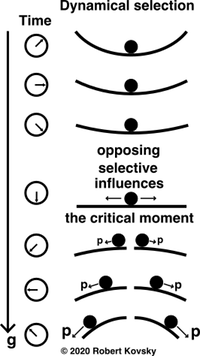
| 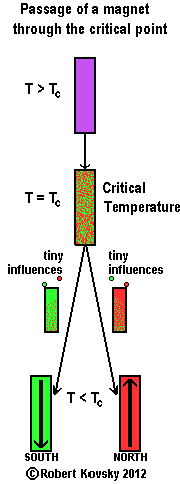
| 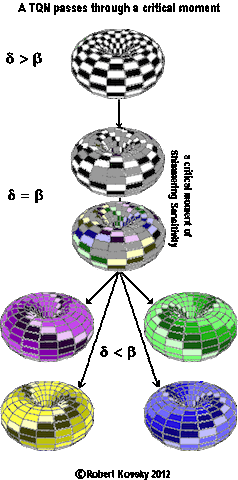
|
| I combine concepts of phase change and contest in the proposed Toroidal Quad Net (TQN) critical selection process by adapting features from mechanical, material and mathematical examples. A quadnet is a network of elemental devices that interact in a square pattern, as in the adjacent image. Each elemental device has individual operations; additional collective operations involve the whole quadnet. Each elemental device interacts with other elemental devices in the quadnet and can also be connected to devices in other quadnets or, more generally, to a variety of control modules. | 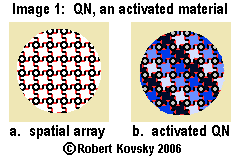
|
In the quadnet critical selection process, a TQN goes through a critical moment of Shimmering Sensitivity. Before the critical selection process starts, at the the top of the image, the TQN is in a steady condition of alternating pulsations called "checkerboarding," where there is a rhythmic beat and elements switch from black to white and vice-versa at a rate set by the beat.
After the critical selection process is over, at the bottom of the image, the TQN is carrying a wave of pulsations that has a particular direction. Four possible directions are shown. In contrast, there is no direction in a checkerboarding condition.
In the central part of the TQN critical selection process, the device is producing co-existing and competing fragments of waves that manifest a unique condition called Shimmering Sensitivity. In other words, the co-existence of competing fragments is manifested in a shimmering condition in which fragments are easily changed into each other; fragments coalesce into coalitions; competing coalitions rise and fall in surges; and fragments and coalitions shift in shape and in space. Which coalition becomes the final wave pattern can depend on competing tiny influences or impulses that are active during the critical moment when the system is most sensitive; and the final wave selection becomes irreversible as the critical moment passes and the process runs to conclusion.
I propose an engineered system containing a large number of TQN's and other quadnet devices. Activated for a specific task, multiple interconnected TQN's pass through a critical moment together and a single condition of Shimmering Sensitivity occupies all of the TQN's. A single selection integrates all the signals and selections of movements. I suggest that such an integrated quadnet critical selection process incorporates an exercise of freedom. I suggest that during the critical moment in such a process, as a result of a phase change of material bodies, the system generates something like flickers of feelings. A string or circular array of such systems generates a stream of feelings. In certain processes, different feelings identify different outcomes of a selection and can guide a selection.
The TQN critical selection process is driven by changing values of β and δ, which are timing intervals that control collective operations of the TQN. Changes in the quadnet model are changes in timings and movements — instead of changes in states and positions that occur in standard physics paradigms.
As a model, the TQN critical selection process has certain significant purposes and shortcomings. The chief purpose is to model and embody a minimal physical process that passes through an indeterminate phase-changing condition to select a final condition that is fixed for an extended period . The TQN process is adaptable to a variety of time forms, e.g., pushing rapidly through the critical moment to the final result, like jumping to a conclusion; or moving sedately towards and pausing at the critical moment before proceeding, after such deliberation, to the final result; or cycling up and down, repeating the critical moment, adjusting and revising and smoothing the final result.
There are many shortcomings in the TQN approach. The model is chiefly to be used as a stepping-stone. At most, it embodies only a single aspect of actual life. Selections by an animal incorporate material properties of the animal's cells and body; and I presume that such material properties color each movement and feeling. Selections by one animal interact with those of other animals. Interactions with animals of the same species are often different from interactions with another species. Interacting movements of human beings give rise to panics, commute traffic and wars. Such matters are beyond the reach of current engineering conceptions.
Notwithstanding the shortcomings, I suggest that something like a critical selection process occurs in our spines and brains. Such a process incorporates an exercise of freedom in the form of a contest in productions of movements that are caused and guided by feelings. Parallels and support for this approach are provided by the occurrence of the many external contests such as sports and games that are also social events. I suggest that a shared contest form operates in the bodies and brains of all human beings, including contestants, officials and spectators of the ever-occurring game.
[Materials in this section are adapted from projects discussed on web pages (...) Approaching Freedom: unified paradigms of choice in psychology, physics and technology and (...) How to solve free-will puzzles and overcome limitations of platonic science.]
... .pdf version
|
The figure shows the initial design for an engineered organism "Wriggler I." A separate ... web page discusses the Wriggler Projects.
Movements of engineered organisms are intended to resemble movements of animals, with multiple kinds of movements occurring simultaneously and with repertoires of movements that respond to momentary bodily and sensory influences. Distant goals include engineered organisms that exercise freedom according to the principle of Shimmering Sensitivity, as discussed in part B of the website (contests). |
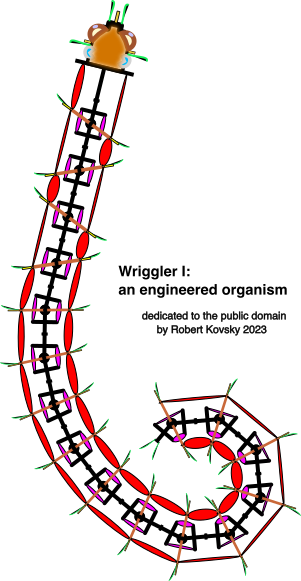
|
Constructions in this project mimic certain reflexes in the form of stimulus and response , e.g., "wiping reflexes" of headless frogs aimed at a drop of acid on the skin and even suggesting itching and scratching. (See part A of the website). A stimulus can appear at any location in a sensorial field and trigger responsive movements targeting that location.
I suggest that: when an object appears in the visual field, eyes reflexively aim their gaze at the object. In other words, eyes look at objects "on their own." Locations of objects in head-centered space can be mapped by means of reflexive muscular movements of eyes and the signals that produce the movements.
Projects are constructed in imaginary Virtual Energy domains using "kits of parts," where the parts are "energy conversion devices" that run on "Virtual Energy." The approach resembles that of electrical circuit designs.
Virtual Energy (VE) is an abstract invention crafted so as to model a presumed "actual energy" that occurs in nature, with concepts similar to those used to describe and sometimes to control movements of steam engines, audio loudspeakers and animal bodies. In steam engines, energy in chemical bonds in fuel is converted into heat energy stored in steam; then heat energy in steam is converted into work. Electro-mechanical energy conversions occur in audio loudspeakers. In animal bodies, energy in chemical bonds in sugar delivered through the bloodstream is converted into forceful movements of muscles and electro-chemical signals in nerves and brains. VE designs aim to model or mimic energy conversions in animal bodies using simple imaginary constructions.
... 1. The final constructions: device models of reflexive gaze... 2. Constructions start with a primal model of stimulus and response.
... 3. The primal model is adapted for use with a rotating joint.
... 4. VE movers illustrate the "kit of parts" method.
... 5. Four movers operate in a VE model of gaze-directing movements of eyes.
... 6. Bundled movers produce denser repertoires of movements.
... 7. In a fast simple design, a quadnet device in a sensorial body controls reflexive movements of models.
... 8. Modeling methodsA 20th-century scholar (Curt Sachs) wrote that, prior to such innovations, "The music did not try to achieve illusion." However:9. Virtual Energy (VE) and VE conversions in devices
10. Projections and channels are active devices that carry flows of VE.
11. Pulsers
12. Timing devices
13. Movers and bursters
14. Quadnet devices
1. The final constructions: device models of reflexive gaze
The adjacent figure shows four "rectus" muscles that partially control movements of a human eye, rotating the eyeball to the left or right, or up or down. As a result of such movements, the gaze is directed in a particular direction, often at an object in the visual field. VE models of reflexive gaze follow a principle of "stimulus and response"— the appearance of an object in the visual field is a "stimulus" and eye movements that direct the gaze at that object are "responses."
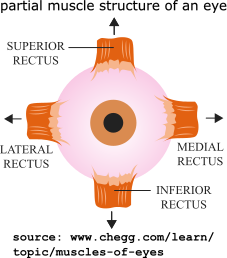
In a device model of reflexive gaze shown in the figure below, four "movers" resemble rectus muscles. Movers have variable lengths and produce contractile forces. The fixed "sensorial body" resembles a retina in an eye. Movers shift the position of the mobile "control point," shown in a resting position at the center of the sensorial body. Movers F and G control the position of the control point by pulling to the left and right, movers J and K by pulling up and down.
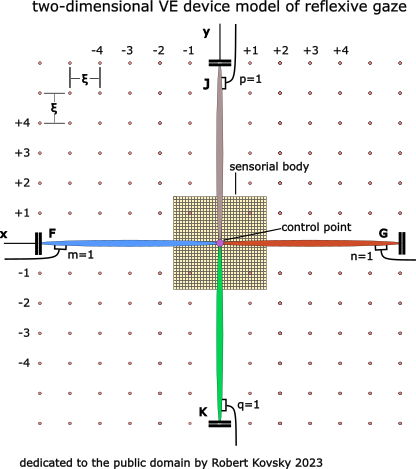
The figure below shows the model in the gazing position that is investigated in the final designs in this project. First, as a stimulus, an "image" of an object appeared on the sensorial body; responsive changes in mover forces then shifted the control point to a position close to the center of the object-image.
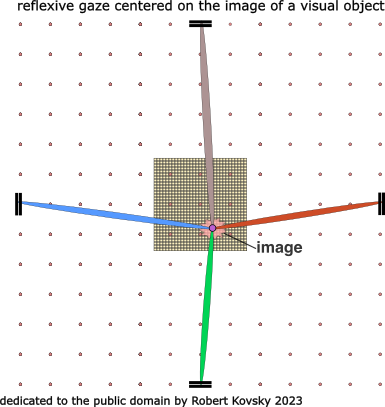
In the model, the control point moves and the sensorial body is fixed. In an eye, both the aiming pupil at the front center of the eye and the retina at the rear are parts of the eyeball and both the pupil and the retina move. However, movements in the model are readily shown to correspond to those of an eyeball, with adjustments as needed.
The figure incorporates a systematic deformation. In a more accurate version (like one constructed below), sensor elements in the sensorial body have curved edges and compressed dimensions, rather than the square elements in the figure. The deformation is readily correctible and simpler square elements are used here.
This project proceeds by a series of stages starting with a "primal model." Development of movers occurs during the first stages. Then attention shifts to development of the sensorial body, sensors and additional control devices. These constructions emphasize functions of device parts and modules.
Further constructions are to be set forth in a separate project (in preparation): a formal Virtual Energy (VE) model, including VE definitions for operations of devices and modules used in this project.
... Index to part C)
2. Constructions start with a primal model of stimulus and response.
In the "primal model of stimulus and response" shown in the figure below, muscle-like left and right "movers" operate in opposition to each other and with variable forces set by "drive signals." Each mover is connected to a fixed "post" at one end and to a shared mobile "response indicator" at the other end. A change in drive signals produces a change in position of the response indicator. Positions are steady between changes. A steady position of the response indicator matches the location of the most recent stimulus.The "sensorial body" will be developed below into a collective device resembling an integrated circuit in which individual elements are laid over a common uniform substrate. Individual devices in the sensorial body are subject to collective control, e.g., being turned on and off. In this first version, the sensorial body contains seven "sensorial sectors" at "locations" numbered "1" through "7." A "stimulus" targets a single sensorial sector and triggers the "sensor" therein to transmit a "burst signal" to the "repeating bursters module," which controls drive signals.
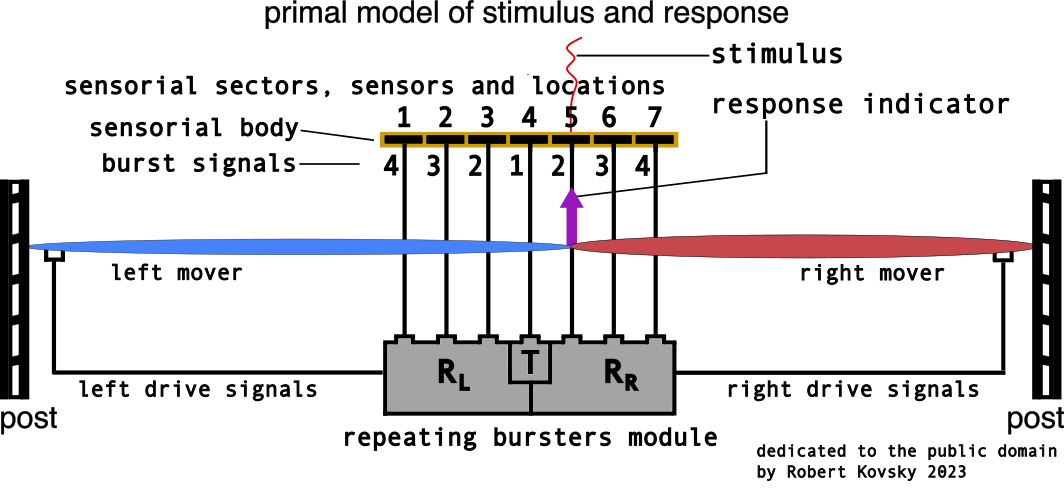
Inside a mover, multiple force fiber devices produce forceful twitches that collectively exert a steady force. Twitches of force fiber devices resemble twitches of muscular fibers in animals. During a twitch, a fiber produces a contractile force. In steady mover designs, multiple overlapping twitches add up to steady forces. Details in the formal VE model will resemble designs in Wriggler projects.
Elemental signals are made of pulses generated by VE control devices, such as the repeating bursters module. In idealized designs, a pulse is a uniform packet of Virtual Energy. In the bursters module, timing of operations is controlled in the part labeled "T." Bursters in the control module (labeled "R") generate short pulse bursts that are sent as drive signals to movers. Repetitive streams of pulse bursts in drive signals produce repetitive streams of twitches that result in steady forces.
More about pulse bursts and timing of repetitive operations
Initial VE models of movements and sensations are built from twitches and pulses. Interacting systems of devices generate streams of transient events that participate in momentary activities.
In early designs, there is a single underlying flow of time that is generated and controlled by devices. Initially, a "Master Clock" sets a single beat that entrains all operations. Development starts with primitive concepts where unified time moves continuously at a fixed rate from earlier to later. In more complex arrangements, independent modules have various modes and rates of time.
Pulses travel on projections between VE devices, shown in the primal model as lines for burst signals from sensors to the bursters module and as drive signal lines from bursters to movers. In idealized VE designs, a pulse lasts for only an instant. Pulses, like electrical signals, travel instantaneously from the origin to the destination. Pulses on projections also resemble signals on nerves, namely action potentials (traveling energy spikes), with a constant shape and one-way travel.
The adjacent figures show the pulse burst signals used in this project. The top figure shows a time element, called a "tick." The duration of a tick – "τ" – is a design feature and can be variable. Construction starts with a "slow tick," e.g., τ = 0.1 second. A "fast tick" is also used, e.g., τ = 0.01 second. A pulse burst signal lasts for exactly one tick, including both the first and last instants of the tick. A pulse starts the tick and defines the first instant of the burst signal. If more than one pulse is in the burst, the final pulse occurs at the last instant of the tick. Any additional pulses are spread evenly throughout the tick.
These definitions of pulse bursts are constructed for easy production and handling by devices. The different pulse burst sizes produce different forces in a mover, with more pulses producing a stronger force.
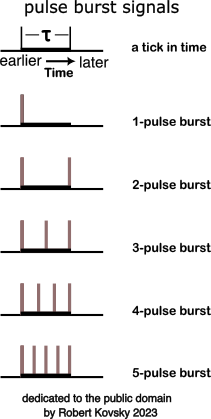
Devices in the primal model operate in cycles, with 8 ticks in a cyclical period. Each device has an action pattern — a schema — that is tethered to the 8-tick cycle. Through operations synchronized by the Master Clock, devices can maintain coordinated repetitive action patterns or schemata (plural).
repertoire and elements of the primal model
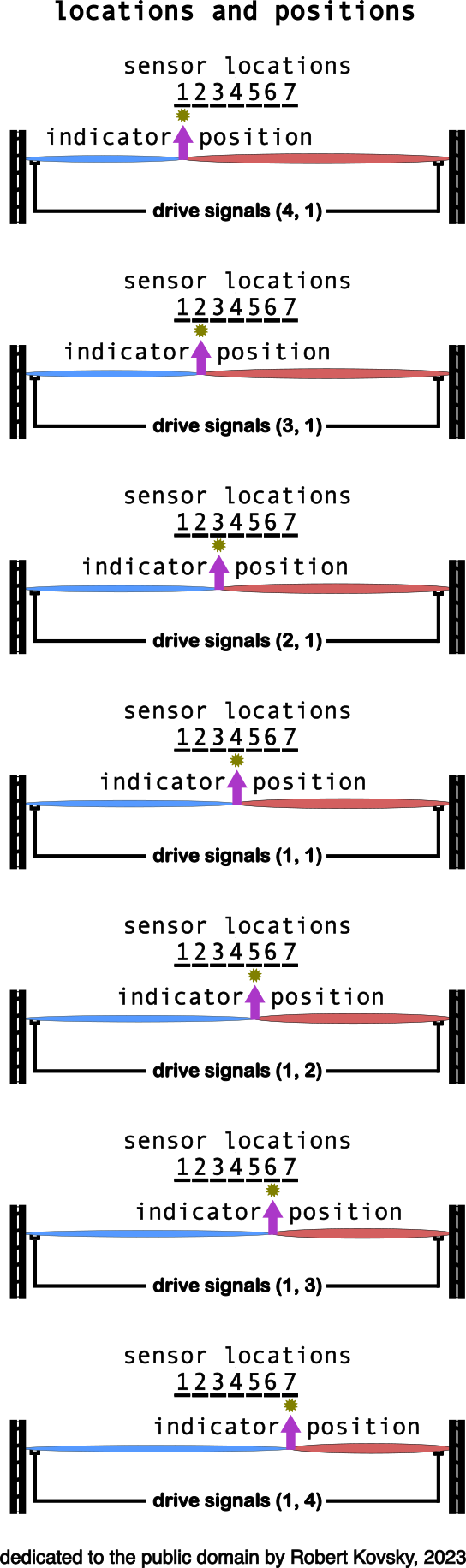
The figures on the left show the sensor locations and indicator positions of the primal model, along with the drive signals that produce the positions. Positions and locations coincide and have a simple one-to-one relationship.
The figures below show repetitive drive signals used in the primal model. The first figure also names parts of the design: (1) movers that produce contractile forces; (2) projections that carries pulse bursts (each burst sets the force for the next mover cycle); and (3) receptors that connect projections to movers. [The primal model does not use 5-pulse bursts.]
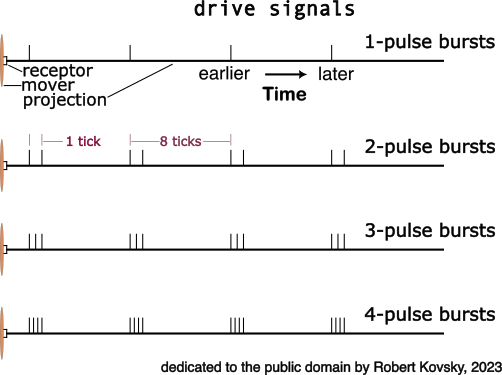
The figures above incorporate charts of pulse signals: a projection also serves as a time line for representation of signals, with "earlier" signals to the left and "later" signals to the right. Linear "Time" matches a measure of space in the chart.
Each pulse burst fills one tick. Eight ticks intervene between successive pulse bursts. An 8 tick cycle governs operations of twitching movers and pulsating bursters.
... Index to part C
3. The primal model is adapted for use with a rotating joint.
VE designs are readily adaptable to deformations and other modifications.
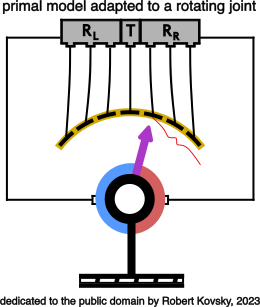
The adjacent image shows a modified version of the primal model — re-organized around a rotating joint, which is shown as a black circle wrapped in blue and red movers. Here, movers have shapes defined as arcs of a circle. One end of each mover is attached to the shared post and fixture and the arcs of the two opposing movers add up to a whole circle. The indicator arrow moves in a range of motion of 90° or one quarter of a circle. Other than the rotating joint and the different shapes of the movers and of the sensorial body, there is not much difference between the original primal model and the rotating joint version. Operations of sensors and the control unit are identical in the two versions, as are sensorial signals and drive signals.
The figures below show the seven steady positions of the rotating joint model and corresponding drive signals. These correspond directly to the seven indicator positions of the linear version.
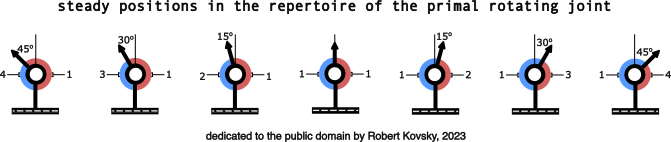
Correspondences between linear and circular models are maintained in subsequent constructions. Thus, two-dimensional (flat) VE movements constructed later in this project correspond to movements of a spherical eyeball.
Stimulus-response designs serve as illustrative constructions in Virtual Energy domains. A construction starts with a particular situation based in hardware features such as the posts in the primal model and the rotating joint in the circular model. Hardware features enable and constrain movements of movers much like a skeleton and joints enable and constrain movements of muscles.
Hardware features of a rotating joint are described in the figures below.
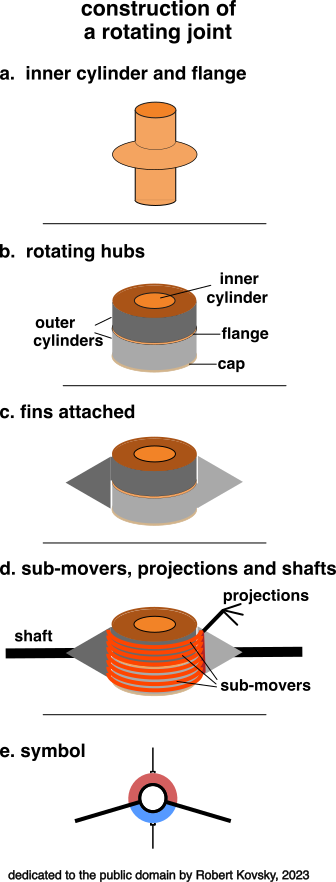
As shown in Fig. a, the core of the rotating joint is a solid, rigid piece of plastic, metal etc. in the shape of an inner cylinder encircled around the midpoint by a disc or flange. In idealized designs, the flange provides a rigid frictionless surface that supports movements of hubs rotating around the core. Rotating hubs are shown in Fig. b as outer cylinders that rotate freely and without friction around the inner cylinder. Hubs rotate independently, separated by the flange. A cap secures the lower hub. A cap might also fit over the top of the joint.
Fins are thin plates made of the same rigid material as the hubs; they are incorporated in the hubs, as shown in Fig. c. Fins limit the range of motion of the hubs but do not interfere with movements in that range.
Sub-movers are attached to the fins in Fig. d. Each sub-mover runs from one fin to the other fin, serving to pull the two fins towards each other and thus rotating the joint. A sub-mover rests on an outer cylinder but slides easily on its surface. Multiple sub-movers operate synchronously, distributing forces over the entire fin.
Another set of sub-movers is attached to the other sides of the fins (they are "hidden" in Fig. d) and the two sets of sub-movers operate in opposition.
As shown in Fig. d, shafts and projections round out the construction. The design is represented in Fig. e by an iconic symbol.
... Index to part C
4. VE movers illustrate the "kit of parts" method.
Detailed descriptions of mover operations are to be set forth as part of the general VE model. For purposes here, a mover is a Virtual Energy force production device that aims to mimic animal muscle. Elemental movers are force fiber devices, which produce contractile twitches. Holding twitches are designed to work in combination and to maintain steady forces. Another device produces saccadic twitches, where strong forces are concentrated at the start of each twitch.Combinations of force fiber devices make up collective movers, e.g., bundles of multiple force fibers that twitch synchronously or in sequence and bundles of duets that produce finer gradations and larger repertoires of steady forces (see § 6 below).
Constructions apply a method of "kits of VE parts." To start, VE designs use VE devices (parts) that are connected by projections; and parts have defined operating characteristics and features. The approach resembles that of electrical circuit designers and engineers who use copper wires to hook up components they have selected from "kits of electrical parts." Later investigations focus on VE currents flowing in sensorial bodies (perhaps resembling integrated circuits).
An example of an electrical kit of parts is one with various kinds of "resistors." Resistors are used to control flows of electrical currents. A typical resistor has two conducting wires sticking out from a small unit of manufactured material that has a suitable "electrical resistance." Resistors are classified according to certain specifications, namely: (1) the material constitution (e.g., whether made of carbon composition or metal film or wirewound); (2) power rating (e.g., ½ watt, ¼ watt, 25 watt); (3) resistance (e.g., 100 ohm, 68 kilohm, 2.2 megohm); and (4) precision (e.g., allowing for discrepancies in the resistance of 20%, 10%, 5%). A resistor is completely defined by stating its specifications.
Similar specifications for a kit of parts of movers are: constitution (hardware features), force equation, schema (action pattern of operations), maximum length L0, elemental force unit F1 and dissipation factor j. In a full design, such a device contains a certain-sized Virtual Energy Store (VES) and specified VE conversions, but discussion of these specifications can be deferred.
The initial steady mover has two holding force fiber devices, which make up a duet. During a cycle, one force fiber device, the leader, twitches immediately in response to a pulse burst signal. Meanwhile, the second force fiber device, the follower, is resting; but it then continues the twitch started by the leader — while the leader is resting and becoming ready to twitch again. Alternating twitches overlap and add up to a steady force that can be set by means of the drive signal.
A full kit of steady mover parts would include various elemental forces (Fi) and various sizes of maximum mover length L0, perhaps ranging from a fraction of an inch or centimeter to many inches or centimeters. The momentary length L of a mover changes during operations under the influence of drive signals and external forces. The elemental force F1 and the dissipation factor j of a mover are fixed during operations. Movers in such a kit could, e.g., move a limb or an eyelid.
The following Formula 1 states the steady contractile force F produced by a single steady mover in the initial design, while it is being driven by a repetitive stream of pulse bursts with n pulses each:
Formula 1: F = n×F1 – j×ΔL.As noted above, the elemental force F1 and dissipation factor j are constant during operations of these movers. The pulse number n refers to drive signals; n belongs to a set of integers, e. g, {1, 2, 3, 4, 5}. The variable term ΔL denotes the momentary shortening of the mover: ΔL = L0 – L (maximum length minus momentary length). As stated in Formula 1, the force diminishes when the mover contracts or shortens from its maximum length, even while the pulse number stays constant. In a shortened mover, energy that might have gone into a twitch is lost or dissipated.Figures below show operations of a single mover. This is the first step in a course of construction that has some features different from the primal model, e.g., use of 5-pulse bursts.
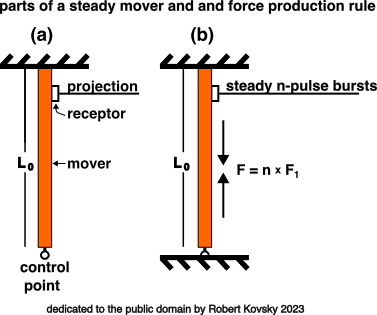
Fig. (a) shows parts of a steady mover in a relaxed condition. The mover is fixed at the top end while the bottom end has a "control point" that can be used in different ways. In Fig. (a), there is no drive input, the mover is passive and the control point is mobile but steady. Fig. (b) shows the control point attached to a fixture; thus, the mover is maintained at its maximum length. A steady stream of pulse bursts maintains a steady contractile force. Because ΔL=0, net forces are F1, 2F1, 3F1, 4F1 and 5F1, corresponding to 1, 2, 3, 4 or 5 pulses in the bursts.
Fig. (a) below shows the mobile mover from the prior Fig. (a); n=0 denotes an absence of a drive signal. Next, as shown in Fig. (b), a drive signal n=1 is applied, along with a guiding hand that slows and controls the movement. The contractile force shortens the mover. As the mover shortens, the force diminishes. Referring to Formula 1 (also shown below the figures), when the shortening reaches a certain point – when j×ΔL = F1 – the force falls to 0 and the mover comes to rest as indicated in Fig. (b). That is, a steady zero-force position is maintained with pulse bursts n=1 and contraction ΔL=F1/j. A full mover step is equal to F1/j, which is called "ξ." Successive increases in n lead to successive increases in ΔL. ΔL = n×ξ identifies the zero-force positions of the mover.
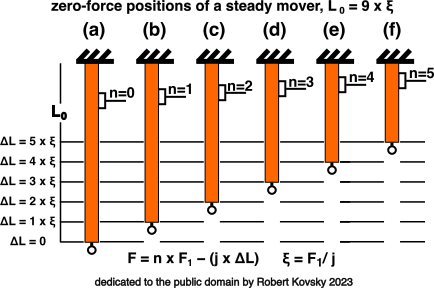
The mover shown in the above figures has a maximum length of 9×ξ. That length is suitable for both linear and circular arrangements, as shown below. In the circular version, the mover is an arc of a circle with a radius R. The n=0 mover extends over 270°. ΔL = R×n×30° identifies the zero-force positions of the mover. A step of 30° in the circular version corresponds to a step of ξ in the linear version.
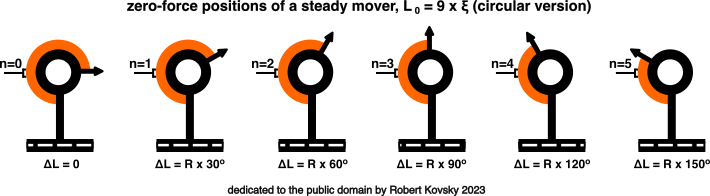
The figures below show the construction of opposing movers in zero force positions. To distinguish the two drive signals, the left mover is driven by a stream of bursts with pulse number "m" and the right mover is driven by a stream of bursts with pulse number "n."
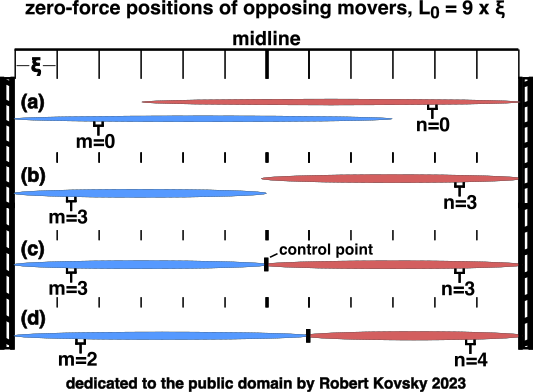
In Fig. (a), movers are full length and drive signals are absent. Midline is defined by symmetry.In Fig. (b), movers maintain symmetical zero-force positions at midline with m = n = 3.
The movers are joined with a mutual control point in Fig. (c). The control point can hold tension – although no tension is present here.
Another zero-force position is shown in Fig. (d), where m=2 and n=4. The full set of zero-force positions in this design is: (m,n) ∈ {(5,1), (4,2) (3,3), (2,4), 1,5)}.
The figures below show tense movers, in which forces and tensions are produced by gravity acting on weights. (Gravity is convenient for this construction but is otherwise absent from the imaginary domain of this project.) Tense movers carry an internal tension that can impose or oppose an external force.
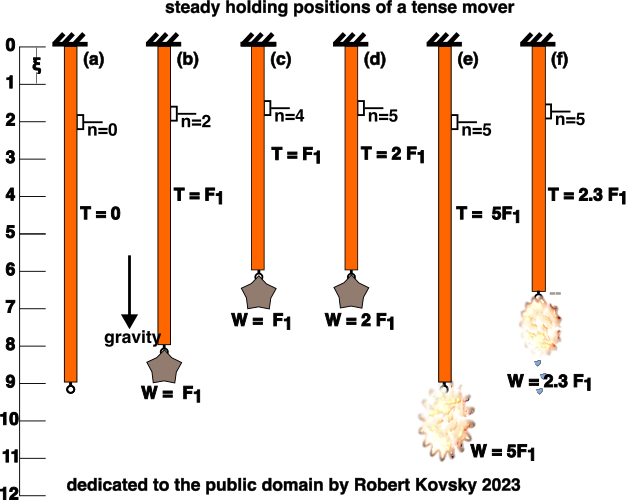
Fig. (a) starts with the prior zero-force position of a single mover with drive signal n = 0. The weight of the mover is disregarded.
In Fig. (b), with drive signal n=2, one unit of weight W produces a gravitational force of F1 and the mover shortens by ξ. That is, applying Formula (1) above: F = 2×F1–j×ξ = F1, which suffices to hold the weight at that position. As indicated in Fig. (b), a tension T = F1 is held throughout the mover from the weight up to the fixture.
With further examples, a general equation emerges for the length L of a single steady mover (L0 = 9×ξ) that is driven by n-pulse bursts and that is holding a weight of W units at a steady position, namely:
L = [(9–n) + (W/F1)]×ξ. Two more examples are shown in Fig. (c) and Fig (d).
In Fig. (e), a piece of ice with weight of 5F1 is attached to the control point. A drive signal of 5-pulse bursts is required to hold the weight at the maximum length. As the piece of ice melts, its weight declines; while drive signals remain constant, the length of the mover shortens, as shown, e.g., in Fig. (f), where ΔL = 2.7×ξ.
Next, tension is incorporated in opposing movers, as shown in the figures below. In Fig. (a), individual movers are shown in zero-force positions with 4-pulse bursts driving both movers. Next, in Fig. (b), a constant stretching force of strength F1 is applied to each mover, similar to the force of gravity in prior figures. Each mover stretches 1ξ, at which point the internal force or tension equals F1, balancing the external force. In Fig. (c), the two movers are joined with a mutual control point that holds tension, T = F1, which extends through the two movers to the posts.
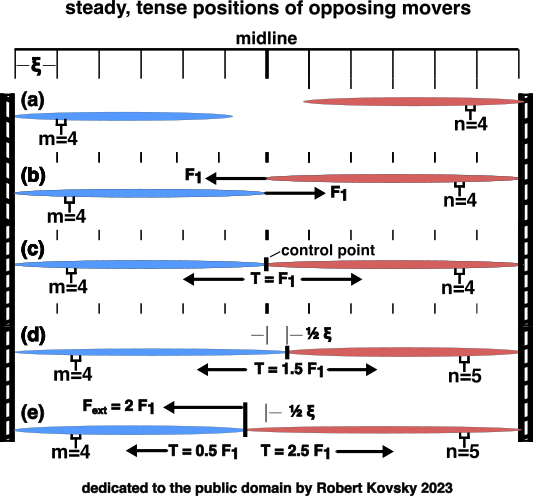
In Fig. (d), the drive signal to the right mover is increased to 5 pulse bursts. The stronger right mover shifts each mover by ½ξ, a total shift of 1ξ. The added F1 in the right mover is shared with the left mover, adding 0.5F1 to both internal tensions. In Fig. (e), the control point in Fig. (d) is subject to an external force Fext=–2F1 (directed left). A new steady position is reached, with a step of 1ξ to the left from the position in Fig. (d). Internal tensions in Fig. (e) include a jump of 2F1 across the control point. Together, the movers pull to the right with a net force of 2F1 that balances the external force.
Suppose that the control point is held at a certain position and certain drive signals are applied and then the control point is released. The control point does not move when it is in the unique steady position produced by such drive signals. Otherwise, the control point will move to that unique steady position. In this project, movements are slow, with negligible momentum.
Certain features of movers resemble those of a simple "spring" or harmonic oscillator (SHO) that is described by Hooke's Law F = –k×Δx. For example, both operate with linear balancing forces. Differences include: movers dissipate energy while a simple spring conserves energy; movers produce zero forces at multiple positions while a spring produces a zero force only at a single position; springs both push and pull while movers only pull.
Previous examples are readily extended to a set of steady positions (with no external forces) that are arranged around midline and that are identified by the drive signals that produce them: (5,1) at 2ξ left of midline; (5,2) at 1½ξ left of midline, (5,3) at 1ξ left of midline, (5,4) at ½ξ left of midline, (5,5) at midline — and mirror positions for drive signals (5,5), (4,5), (3,5), (2,5) and (1,5).
A similar set of steady positions is produced by the circular version. A shift of ½ξ in the linear version corresponds to a shift of 15° in the circular version. With the same set of drive signals as those in the linear version, steady positions in the circular version make up a set of deflections from midline: {0°, 15°, 30°, 45°, 60°}.
The foregoing opposing movers model has many parallels with the primal model, chiefly in duplicates of held positions. The opposing movers model produces extreme positions (e.g., using drive signals (5,1)) that do not appear in the primal model. Chief differences between the two models involve drive signals. In the primal model, drive signals (1,1) produce the midline position. In the opposing movers model, at least (3,3) is needed to produce the midline position and drive signals (1,1) have no use.
To change the opposing movers model into the primal model, modifications are incorporated in both mover design and drive signals. First, the modified mover produces two kinds of forces: (1) tonic forces that are the same for every twitch and (2) variable phasic forces that are set by pulse bursts. Processes of force production are otherwise the same for the two kinds of forces. The total force produced by the mover is the sum of the tonic and phasic forces.
For models in this project, the tonic force is 4F1. A mover can produce as much as 7F1, with 3F1 as the maximum phasic force. That is, for these movers, the n×F1 term in formula (1) is in the set {4×F1, 5×F1, 6×F1, 7×F1}. Positions produced by modified movers parallel those produced by prior movers.
In modified drive signals, the leading pulse in a pulse burst is the first pulse. It performs timing functions, e.g., starting a device. Additional pulses, if any, are called following pulses and make up the content of the burst. Chiefly, following pulses add phasic forces of 1, 2 or 3 F1 to the tonic force of 4F1 in the next upcoming twitch. Let k×F1 denote the tonic force. Then, disregarding the leading pulse, (n - 1)×F1 denotes the phasic force. If k = 4, the force produced by a full-length mover (ΔL = 0) is F = (k+n – 1)×F1 = (3+n)×F1.
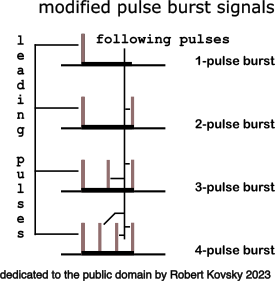
An exemplary position in the primal model illustrates the foregoing principles.
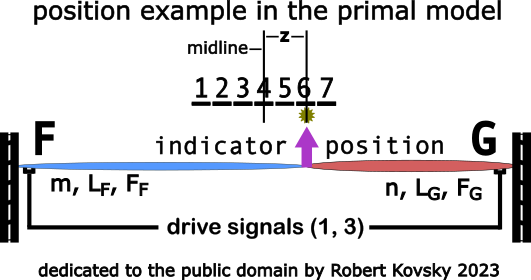
Mover F on the left is driven by signal m, has a momentary length LF and produces a momentary force or tension FF. Mover G on the right is driven by signal n, has a momentary length LG and a momentary force FG. Position vector z denotes the momentary distance from midline to the position indicator. In the example, drive signals (m,n) are set at m=1, n=3.
Applying Formula (1) to the previously-discussed mover with tonic force 4F1:
FG = (3+n)×F1 – j×ΔLG and n = 3. A similar expression holds for FF and m=1.
Also, for both movers: ΔL = L0 – L and L0 = 9ξ. As before, F1 = j×ξ. At the midline position, each mover has a length of 6ξ.
By inspection, LF = 6ξ + z; and LG = 6ξ – z. ΔLF = 9ξ – (6ξ+ z) = 3ξ – z; and ΔLG = 3ξ + z.
At the indicated steady position, FF = FG, 3+m=4 and 3+n=6.
FF = 4×F1 – j×(3ξ – z) = 6×F1 – j×(3ξ + z) = FG.
Hence, z = ξ, which means that the indicator position is held steady at 2 steps to the right of midline with a step length of ½ξ.
... Index to part C
5. Four movers operate in a VE model of gaze-directing movements of eyes.
The primal model is developed into the two-dimensional VE device model shown below, where the "control point" is pulled by movers into a set of positions shown as blue dots. Movements of the model are intended to mimic certain movements of human eyes produced by the "rectus muscles" shown below. Four identical movers (F, G, J and K) correspond to four rectus muscles in the eye. The "sensorial body" of the VE device model resembles a rudimentary retina.
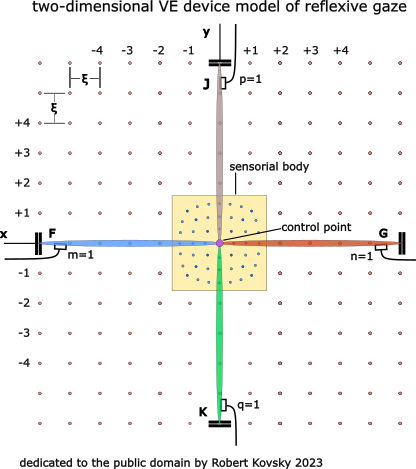
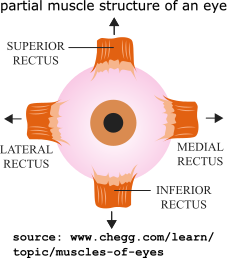
As in the primal model, stimulus of a single specific sensor in the sensorial body causes the control point to move to and hold a position directly corresponding to the location of the sensor. The movement of the model resembles movement of an eye directing the gaze at an object whose image appears on the retina. A spherical version developed from the rotating joint model would more closely resemble an eye. A flat version is sufficient for purposes here.
The VE device model is laid out on a grid with a spacing ξ between grid points that are referenced to "x" and "y" axes, where ξ = F1/j, based on specifications of movers. The sensorial body is attached to the grid. Drive signals for the two-dimensional model take the form [(m,n), (p,q)] where m is the drive signal to mover F pulling left; signal n drives mover G pulling right; signal p drives mover J pulling up; and signal q drives mover K pulling down.
Methods used for two opposing movers are extended to calculate steady positions of the two-dimensional model. If the control point is held by external forces at a specific position and specific drive signals are applied, the steady position is the unique position where the control point does not move when released.
A position vector z = (x, y) is referenced to the grid. In the example below, the control point is held at position z = (ξ, 0). Drive signals are [(1,3), (1,1)]. At this position, F and G are in balance while J and K produce substantial forces to the left.
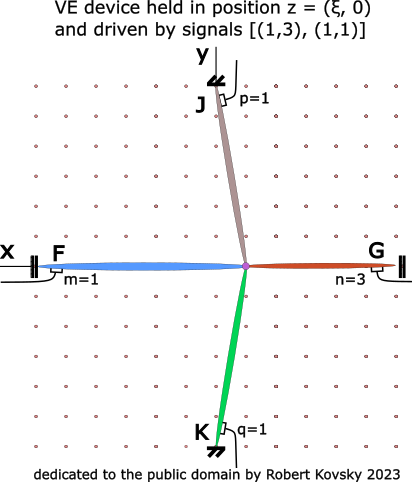
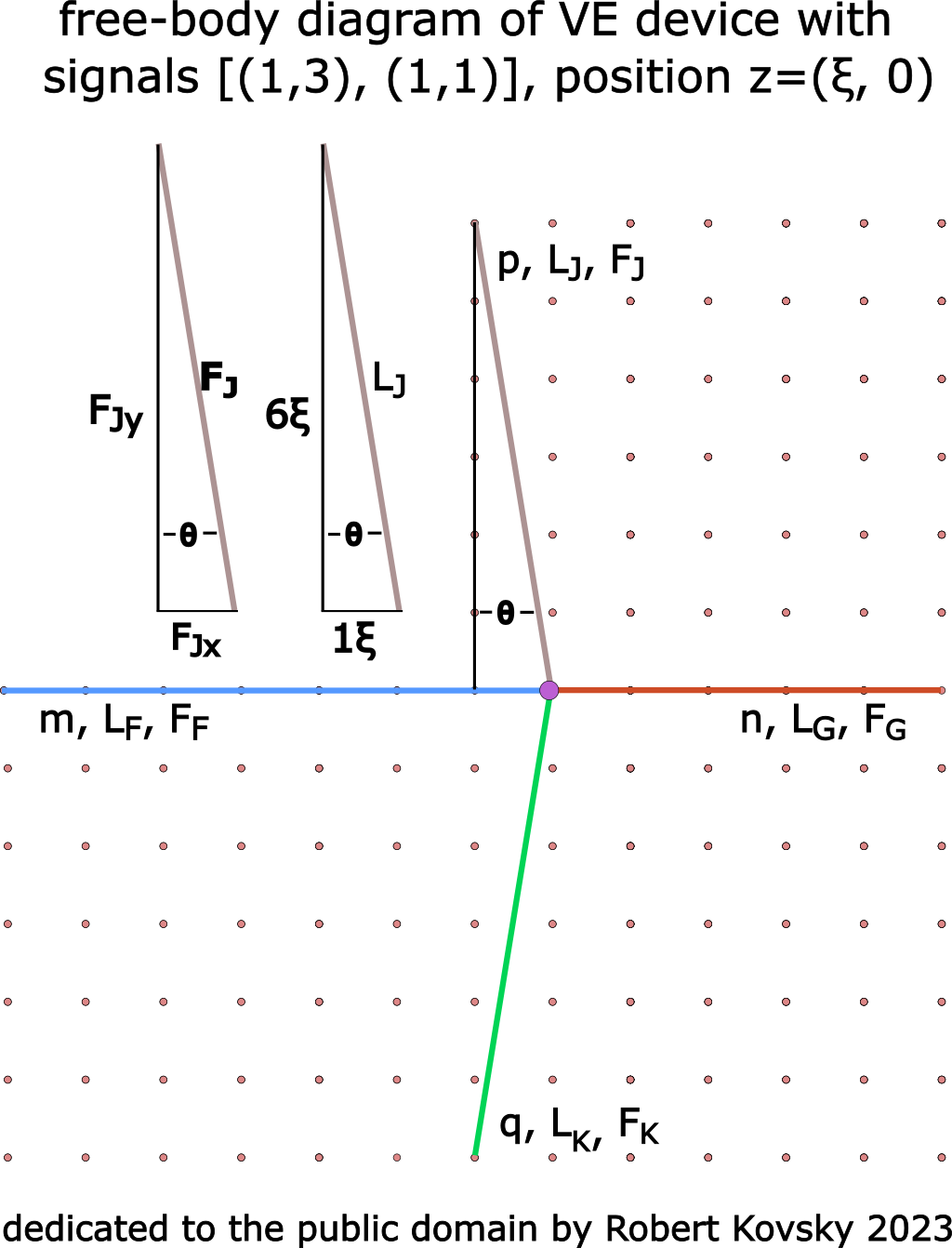
Principles of Statics taught in engineering lead to a "free-body diagram" in which forces correspond to line segments in triangles. Each mover is described by its drive signal (m, n, p or q), its length L, its force F and the angle θ it makes with the x-axis or y-axis.
In the insets next to the free-body diagram, the spatial triangle defined by LJ, 1ξ and 6ξ corresponds to force FJ along mover J and its x and y force components, FJx and FJy. Here, Fy components of FJ and FK are in balance, J pulling up and K pulling down. Fx components of FJ and FK are additive, each pulling towards the left.
In calculating the net force to the left, the angle θ plays the central role:
θ = arctan (1ξ/6ξ) = 9.462°. LJ = 6ξ/cos(θ) = 6.083×ξ. (This is also √37×ξ, applying the Phythagorean theorem.) Hence FJ = 4F1 – j×(9ξ – 6.083×ξ) = 1.083F1. FJx = FJ×sin(θ) = .178F1, pulling to the left. FKxis the same, totaling .356F1 pulling to the left.
Trial-and-error investigations lead to the position vector z = (0.85ξ, 0). In this position, θ=8.063°, LJ=6.060ξ and FJ=1.060F1. Hence FJx=FJsin(θ)=.149F1. FJx and FKx pull with a net force .298F1 towards the left.
FG and FF produce a net pull towards the right:
FG – FF = [6F1 – j×(9ξ – 5.15ξ)] – [4F1 – j×(9ξ – 6.85ξ)] = .300F1.
The imbalance in FG – FF almost exactly counters the pulls from FJ and FK. Hence z=(0.85ξ, 0) is close to the steady position of the two-dimensional VE device model when it is operating with drive signals [(1,3), (1,1)].
Drive signals [(1,2), (1,1)] produce a steady position close to z = (0.46ξ, 0);
drive signals [(1,4), (1,1)] produce a steady position close to z = (1.27ξ, 0).
Symmetry principles simplify calculation of positions on the diagonal where the position vector has the form z = (y, y). The figure below shows the free-body diagram applicable to the VE device when drive signals are [(1,3), (3,1)]. In this position, movers F and K have equal drive signals, equal lengths and equal forces; θK=θF. Likewise, as to movers J and G, p=n, LJ=LG, FJ=FG and θJ=θG.
The position of the control point in the adjacent figure [z = (0.75ξ, 0.75ξ)] is close to the steady position produced by the device with drive signals [(1,3), (3,1)]. The other approximate diagonal positions are:
drive signals [(1,2), (2,1)];
position z = (0.38ξ, 0.38ξ).and
drive signals [(1,4), (4,1)];
position z = (1.03ξ, 1.03ξ).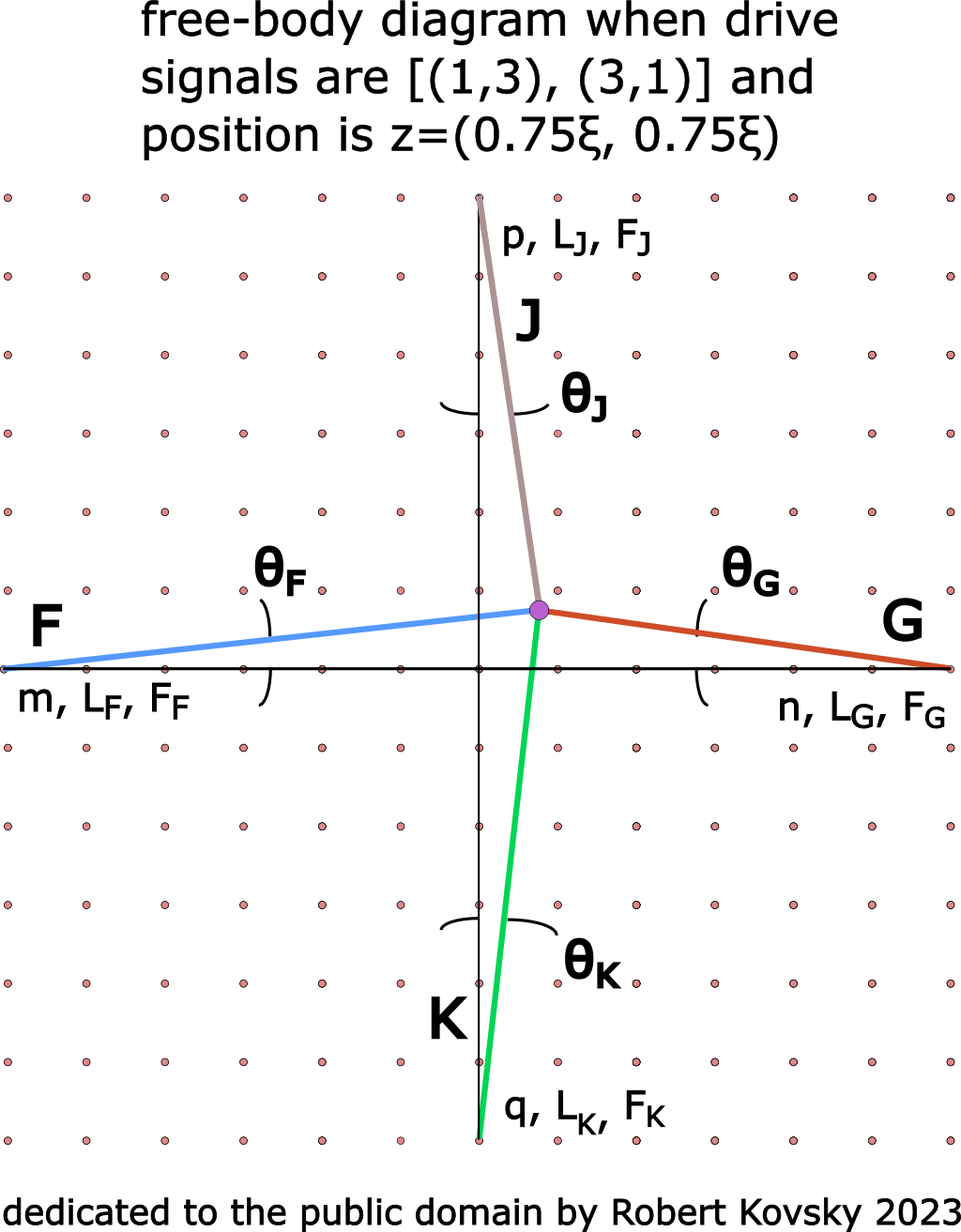
The adjacent figure shows all 49 steady positions produced by the 2-dimensional VE device model, plotted on the same grid as before.
Markers with the darker blue color lie along axes and diagonals on positions calculated above. The lighter blue color indicates approximated positions.
A new stage of development now commences that focuses on the sensorial body of the device model.
In this approach, certain material properties are imputed to the sensorial body. For example, a whole sensorial body might maintain either-or conditions of "off" and "on" and might be easily switched between "off" and "on."
Another example is entrainment or physical synchronization of ticking. Entrainment occurs in unison ticking of identical mechanical clocks that are standing together on a table. A foundation for entrainment is imputed to the table and can also be imputed to repetitively pulsing bodies that contain VE devices. As developed below, synchronization of individual VE devices that is a feature of collective quadnet device operations is based on such bodily entrainments.
Another material property called migration is imputed to the sensorial body of the two dimensional device model of reflexive gaze. During migration, a sensor in the sensorial body moves inside the body to a location that corresponds directly to the position of the control point that it stimulates.
In this approach, the positions produced by movers are definitive and sensors adjust their locations to mark those positions. If a mover should weaken slightly, affected sensors will migrate to locations that track new positions. Presumpively, the range of migration is limited, e.g., to one ξ from the original location.
It might be imagined that, before use, sensors are plotted on square grid points with spacings of ½ξ, like grids shown in the figures. Then, during a "break-in period," each sensor migrates to a location corresponding to the mover position produced on stimulation of that sensor.
The figure below shows the sensors, sensorial body and control devices in the two dimensional model. In this model, a stimulus at a sensor (top layer of dots) is converted into drive signals for F-G movers and J-K movers that position the control point at that sensor. To simplify the design, sensors are shown at locations on a square grid rather than according to previously shown mover positions. Such locations are presumptively adjustable.
New control devices are shown as numbered triangles along edges of the sensorial body. These timing devices send pulse burst signals to the burster modules. The number next to a timing device denotes the number of pulses in a burst. During operations, timing devices are ready and waiting, needing only the arrival of VE to trigger the discharge of a pulse burst signal to the targeted burster.
Operations of the peripheral timing devices and burster modules of the two systems (F-G and J-K) are (1) independent of each other and (2) employ identical designs, except for some labels. Burster modules and drive signals are the same as in the primal model.
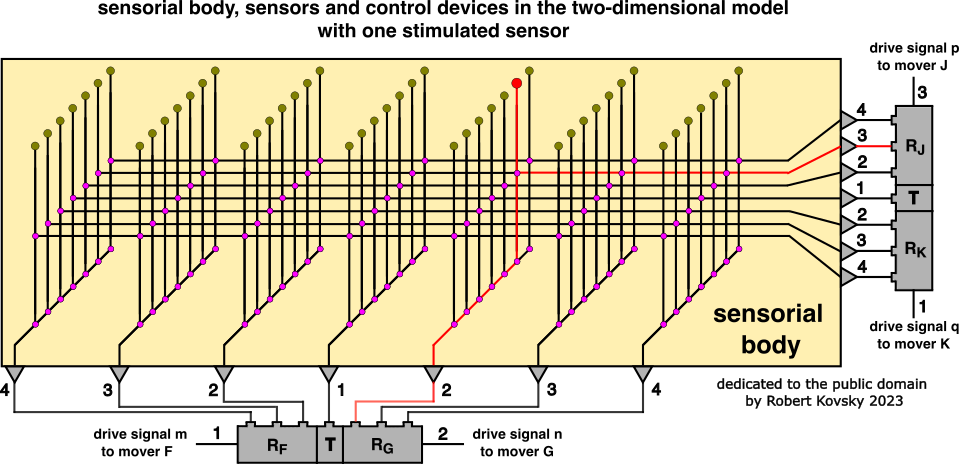
Inside the sensorial body, lines designate a new material property called channels. Channels in a body carry flows or currents of Virtual Energy that are similar to flows of VE in projections between devices, e.g., flows are instantaneous and lossless. In this project, flows start at sensors and end up at devices on the edge of the sensorial body. Channels have a feature that projections lack, namely, VE from multiple channels can flow into a common channel. In a projection, VE moves in uniform pulses; in a channel, VE moves in a range of quantities.
A capacity for maintaining flows of VE in networks of channels is imputed to the sensorial body. Small devices (pink dots in the figure) generate a VE flow in a horizontal channel when there is a flow in a vertical channel; these devices have independent sources of VE and thus maintain desired F-G and J-K flows. Absent such a device, channels that appear to cross in the figure are not connected.
... Index to part C)
6. Bundled movers produce denser repertoires of movements
In this project, a bundled mover is made of five identical sub-movers. Each sub-mover has an elemental force of 0.2F1 . Other than the smaller elemental force, sub-movers operate the same as the original steady movers. Sub-movers are driven synchronously by independent drive signals from separate bursters.When sub-movers in a bundled mover are driven with different drive signals, the sum of forces has an intermediate force value and the control point moves to an intermediate position.
The figure shows a "transverse view" of a bundled mover: a central purple sub mover and four peripheral sub movers. As shown in the "side view," sub-movers join at two terminal points of attachment to deliver a unified force. 
In the figure below, two opposing bundled movers are dis-assembled into sub-movers with separate attachments to the control point and indicator arrow, which is constrained to stand in a vertical orientation. Each sub-mover has an individual drive signal "ds." The midline position is maintained by drive signals ds=1 arriving at all the sub-movers.
The system produces 31 positions, corresponding to 31 sectors in the sensorial body. Seven light-colored sectors are carried over from the primal model. Four dark-colored intermediary sectors divide the space between each successive pair of primal positions. In a version with a rotational joint, each sector in the bundled version occupies 3°, noting that the range of motion in that version is 90°.

The figures below show incremental changes in the position of the control point and indicator arrow as individual signals to sub-movers are increased one by one. Incremental signals are applied to the peripheral sub-movers in a balanced progression; but the central (purple) sub mover has no incremental increase.
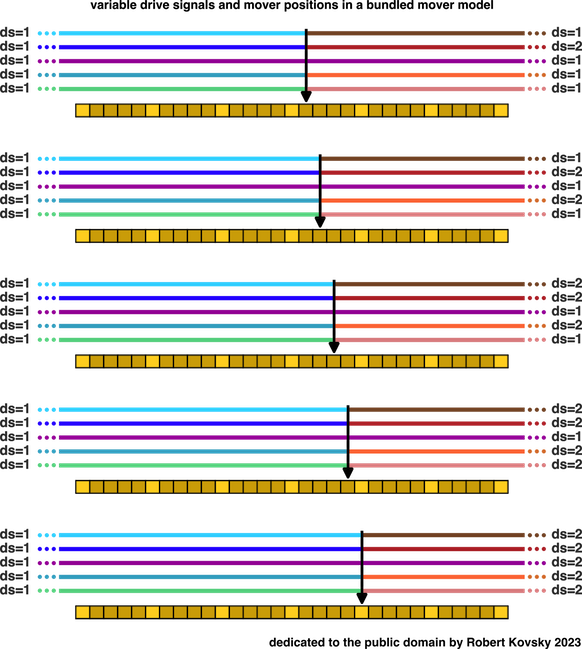
The figure below shows the channels in the sensorial body of the bundled mover model; these channels organize flows of VE between active sensors and targeted timing devices. Channels are connected so as to direct VE flows to two sets of timing devices. Pink dots connecting channels denote active sources of VE. Sensors, channels and dot devices all operate within the sensorial body, receiving VE through it and subject to its conditions.
One set of timing devices, called the "coarse control" devices, operate along the bottom of the sensorial body like the timing devices in the two-dimensional model above. All the sub-movers in a bundle receive the same "coarse control" signal.
The other sets of timing devices are located inside "fine control" modules on the sides of the sensorial body; these timing devices discharge signals that result in a specific number of sub-movers receiving an incremental signal of one additional pulse. The number of sub-movers to be incrementally increased appears inside the fine control timing device. Fine control timing devices discharge inside a repeating burster that is part of the fine control module; only one signal line is needed to carry that burster's output to the main burster module.
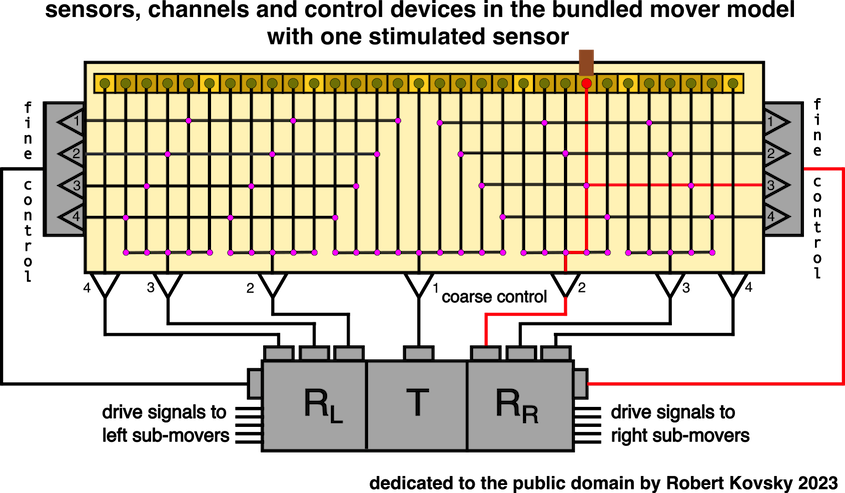
In the figure, drive signals to the right sub-movers produce an intermediate position between two primal positions. All five right sub-movers receive 2 pulses per cycle while three right sub-movers received an additional pulse. The collective right drive signal is denoted RR=2-3, following the form "coarse-fine." The left collective drive signal RL=1-0. These drive signals hold the control point at the location of the stimulus.
An important restriction on designs up to this point is the operating principle that a stimulus must activate exactly one sensor. There is no capacity for responding to stimulation of multiple sensors. Activation of many sensors by an extended stimulus is shown below, where a "centering device" operates between a bloc of stimulated sensors and the VE channel network. The centering device generates a VE flow in a single vertical channel leading to appropriate drive signals to sub-movers (RL=1-0; RR=2-3) that position the control point near the center of the bloc.
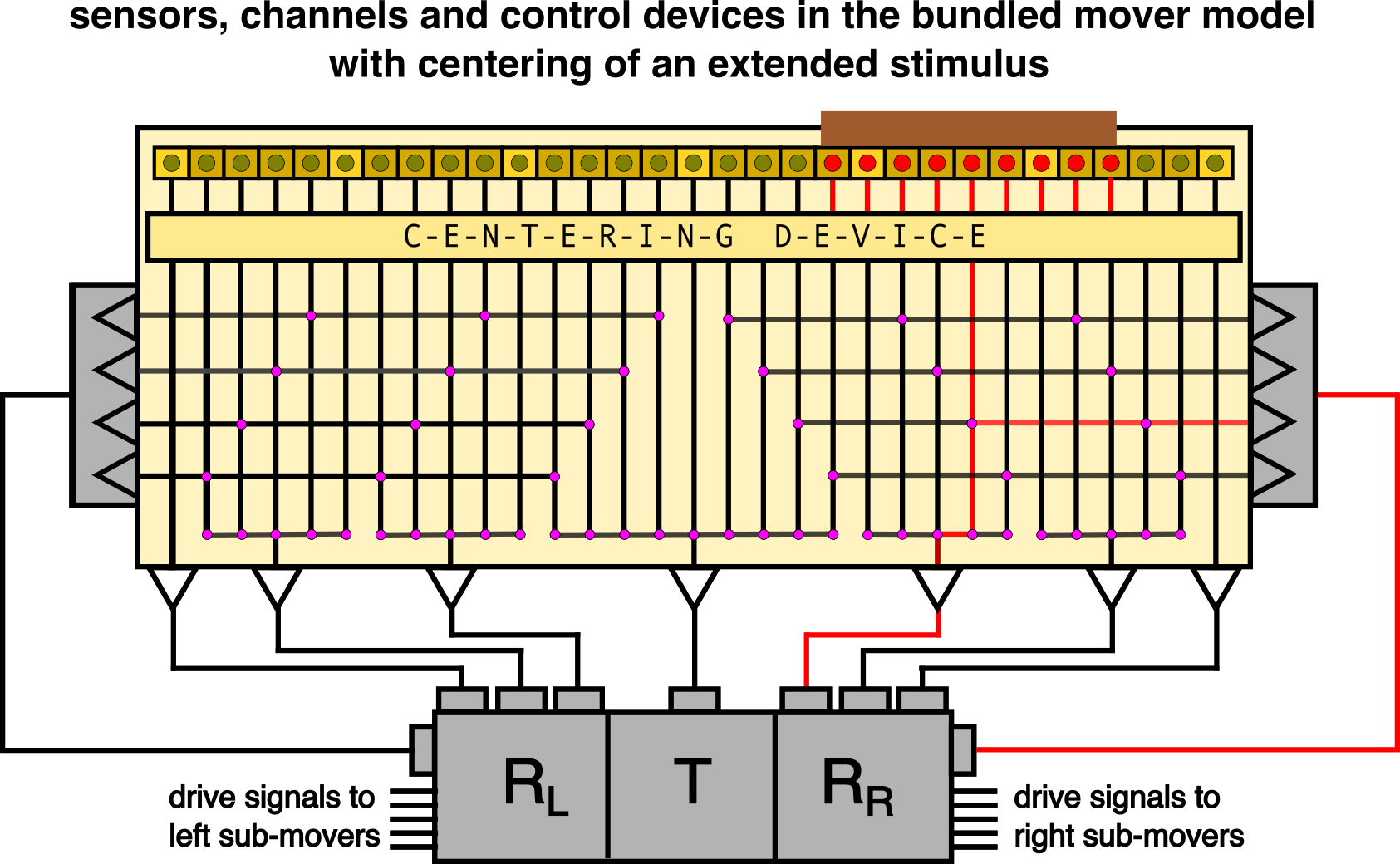
Operations of the centering device require an input with a nearly continuous bloc of stimulated sensors - a single group with no gap larger than a single sensory channel. With such an input, the output appears on a single channel that is at or near the center of the stimulated bloc. Examples below illustrate operations of the centering device. Detailed designs for centering devices are to be included in the formal VE model.
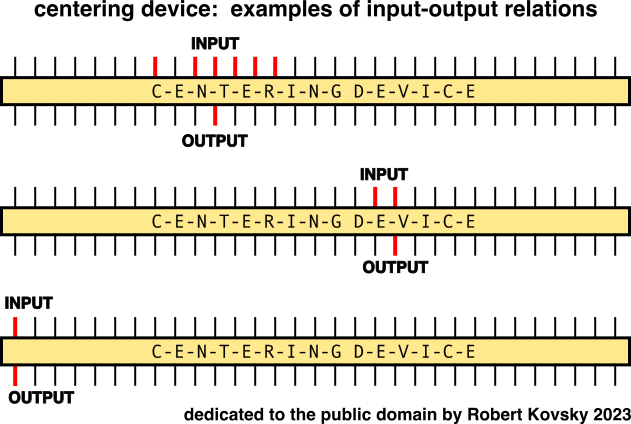
The bundled mover model with centering is readily extended to two dimensions, leading to the channel device model of reflexive gaze shown below. This design is used to drive the movements of F-G-J-K movers and sub-movers shown above in § 1 and constructed in §§ 5 and 6.
A centering device, channel network and repeating burster module are connected to the bottom edge of the sensorial device bloc; these control F and G sub-movers. Corresponding devices are connected to the right edge of the device bloc and control J and K sub-movers. Operations and movements of the two control systems are independent of each other. The two control systems have the same internal devices and connections as those in the bundled movers model. Device specifications and operations are also the same.
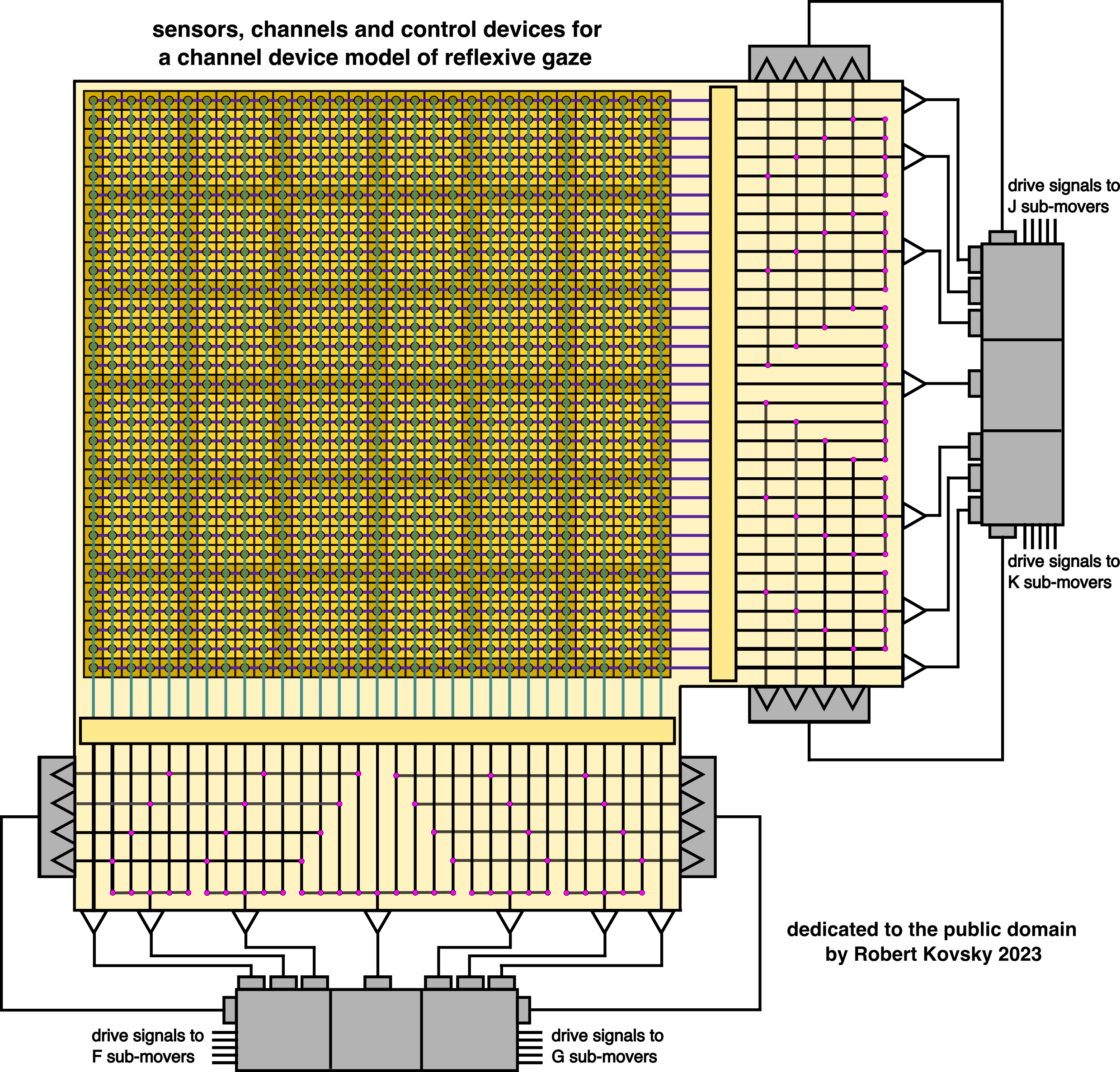
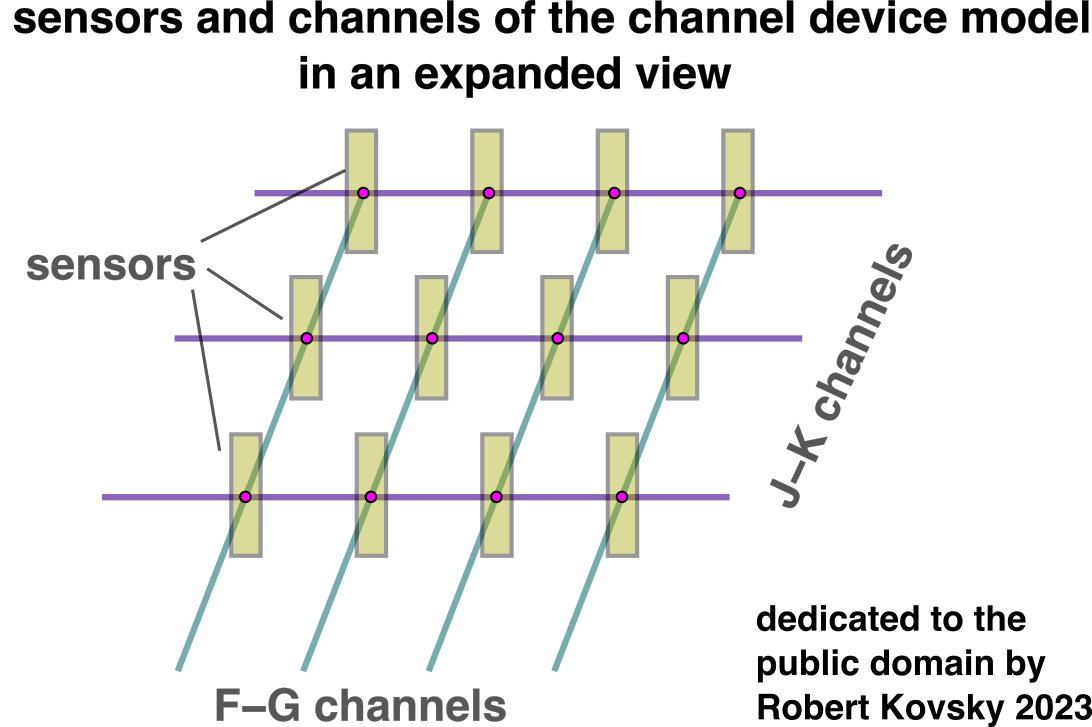
The adjacent figure provides a close-up view of operational elements inside the sensorial body of the channel device model of reflexive gaze. While the system is in a steady position and without stimulation, each sensor has a source of VE that is not active but is ready and waiting. When a sensor is stimulated, it discharges VE into both the F-G channel and the J-K channel specific to that sensor. The figure below shows an expanded view of one quadrant of the sensorial body and VE networks of the channel device model while processing the image from § 1. The image stimulates sensors, which discharge VE into channels that are colored red. After centering, resulting drive signals are: F=1-1; G=1-4; J=1-1; K=2-3. These signals move the control point to a position close to the center of the image.
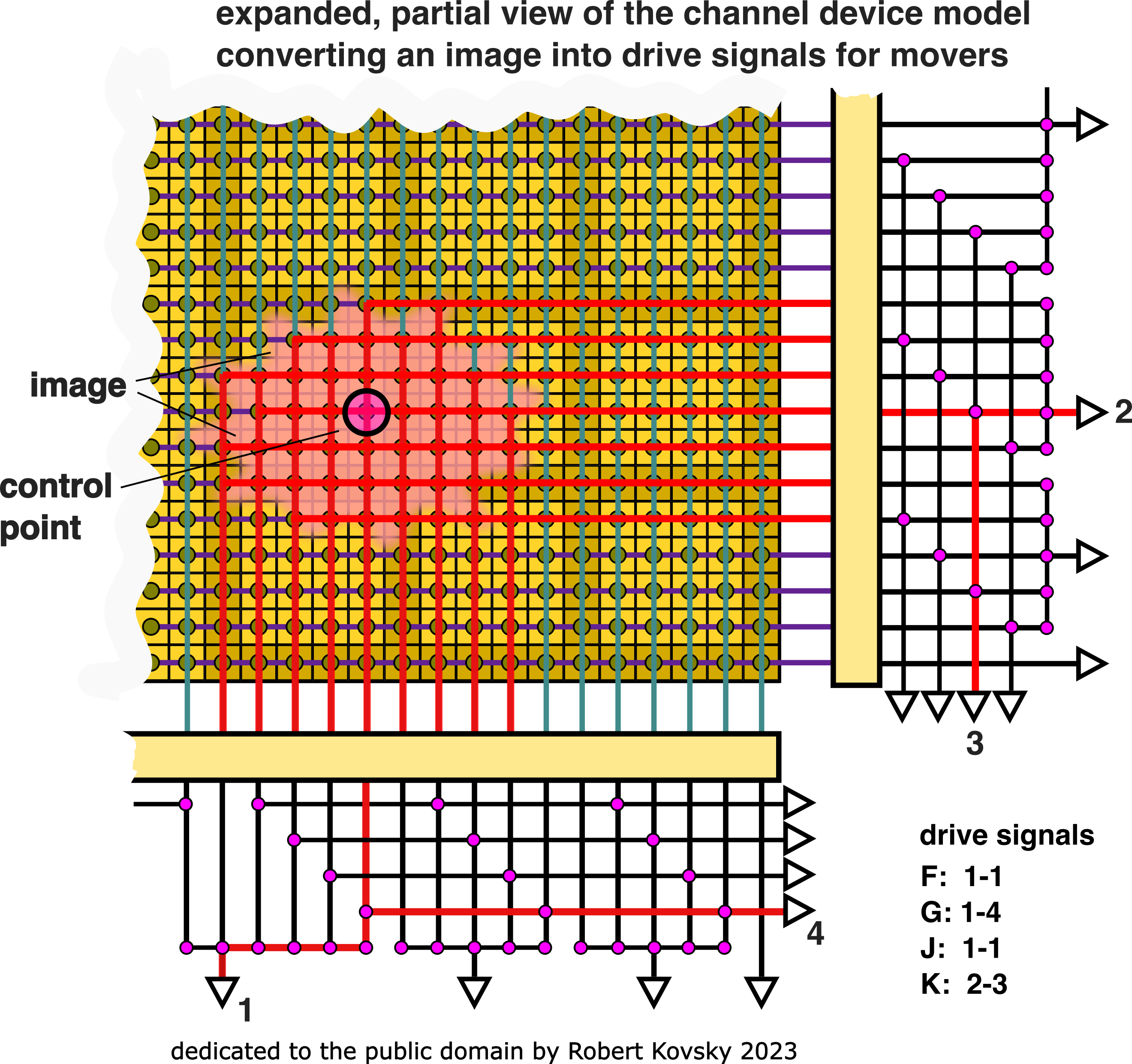
... Index to part C
7. In a fast simple design, a quadnet device in a sensorial body controls movements of a reflexive-gaze model..
The figure below shows the final Gazer model. Like the prior channel device model, it converts a compact image that stimulates sensors into drive signals for the mover system such that the control point is moved to and held at a position close to the center of the image. It differs from the channel device model in that operations are faster and simpler. A collective quadnet device operates inside the sensorial body and incorporates all the sensory elements. Timing functions are relocated to the sensorial body, which generates an ongoing beat that entrains active devices. In other changes, burst signals are simplified by omission of leading pulses, which controlled timing in prior models. Pulse bursts in the coarse control set have 1, 2 or 3 pulses. Operations of fine controls are unchanged.
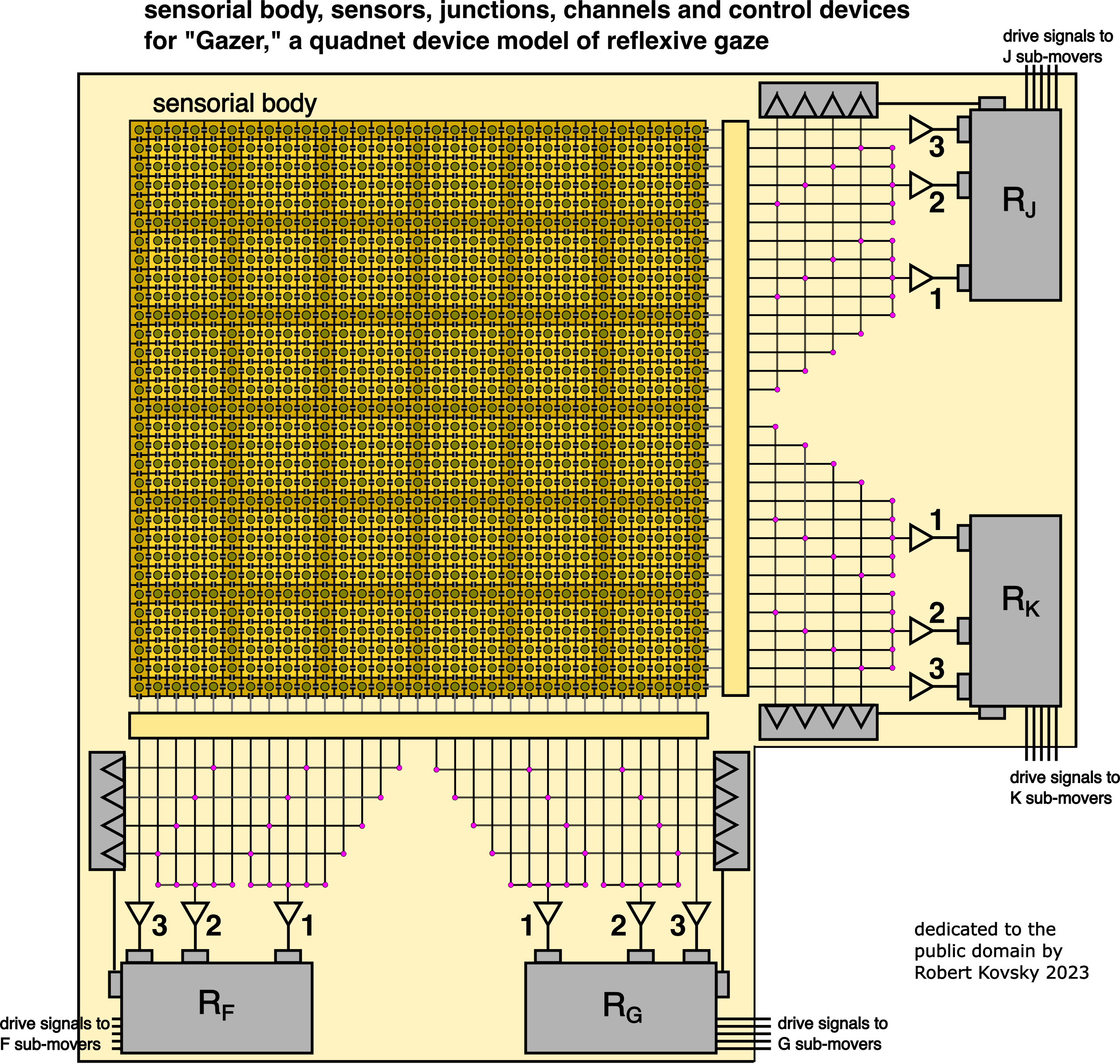
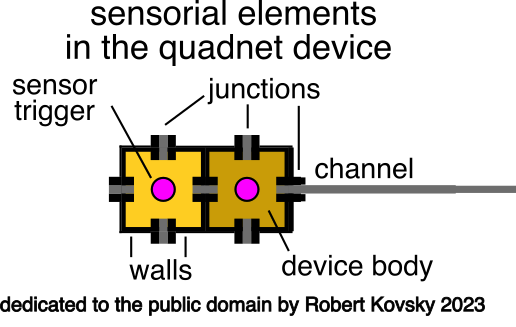
The adjacent figure shows sensorial elements of the quadnet device, which is an array of 961 sensorial elements. Internal junctions between elemental devices replace the continuous channels of the prior model. At the terminus, a junction directs a VE flow into an output channel in the control network.
The whole-body quadnet device operates cyclically and sensorial elements collectively pass through a series of conditions or phases. In this context, the word "phase" denotes a whole-body condition. At each moment, the body is in exactly one phase. Changes occur abruptly. The cycle has four steps and three phases: (1) F-G phase; (2) refractory phase; (3) J K phase; and (4) refractory phase.
During the refractory phase, all the junctions are closed; no VE passes through a closed junction. Sensory elements are resting. The quadnet cycle inserts a refractory phase between two active phases. Any depleted VE is restored during a refractory phase.
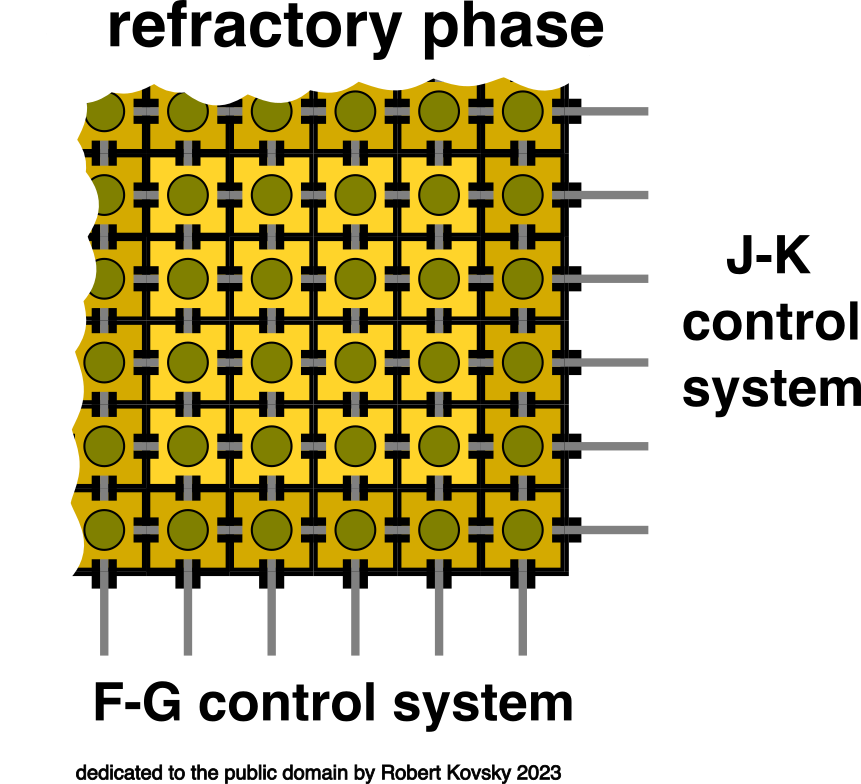
The adjacent figure shows sensory devices in an F-G phase that is ready but not stimulated. Half the junctions are open, making up internal passages for VE that are equivalent to channels and that can direct VE into channels of the F-G control system at the periphery of the quadnet device. 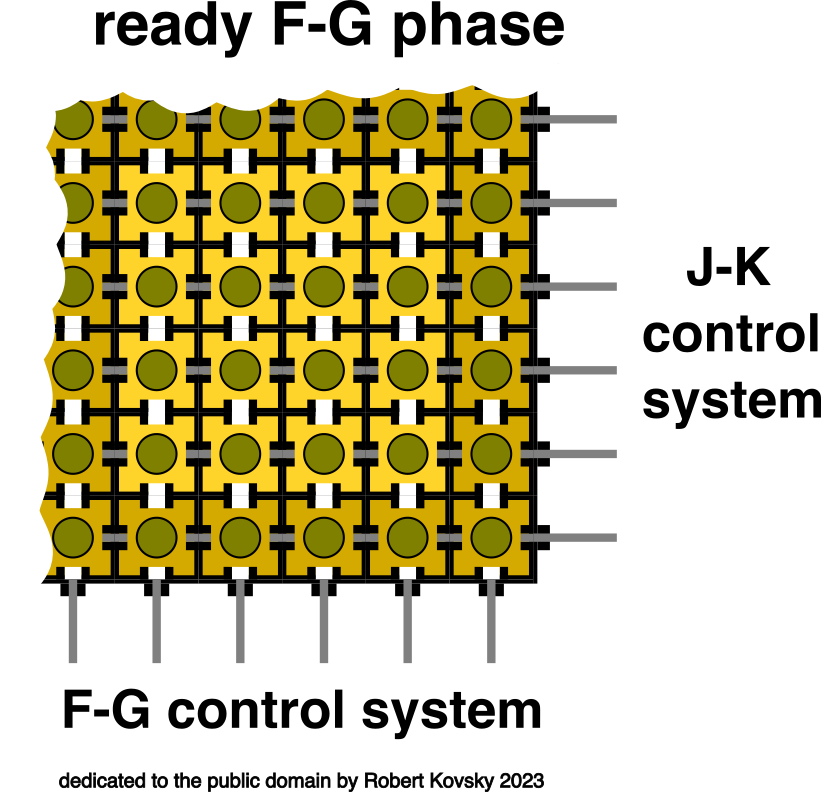
The adjacent figure shows sensory devices in a ready J-K phase, in which open junctions can direct VE into channels of the J-K control system. 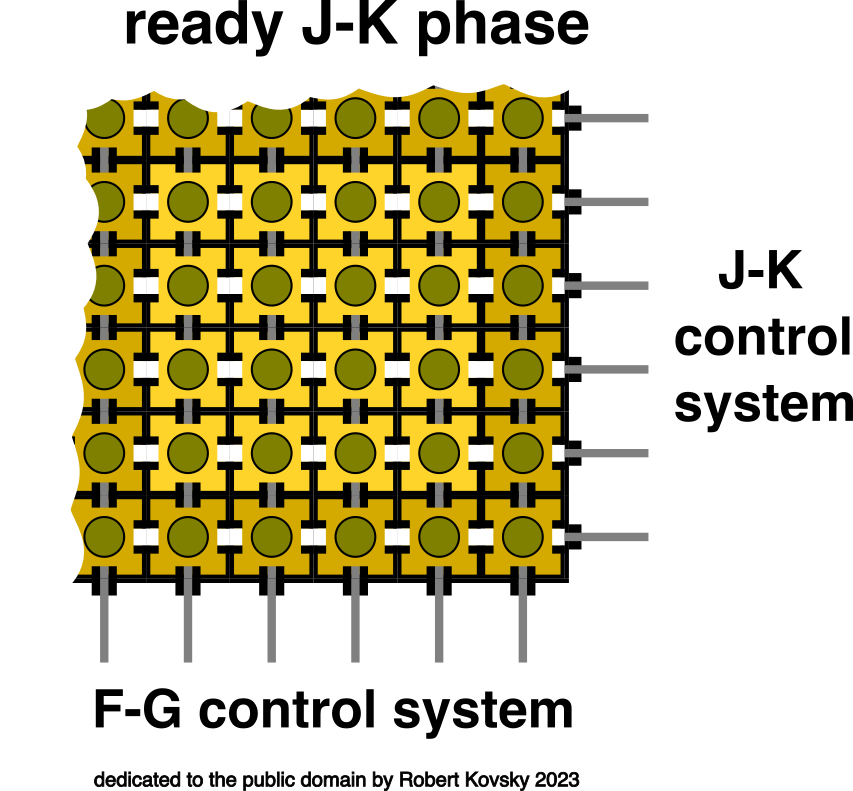
In the figures below, the visible image from prior figures has appeared on the sensorial body, stimulating a compact set of sensors in the quadnet device.
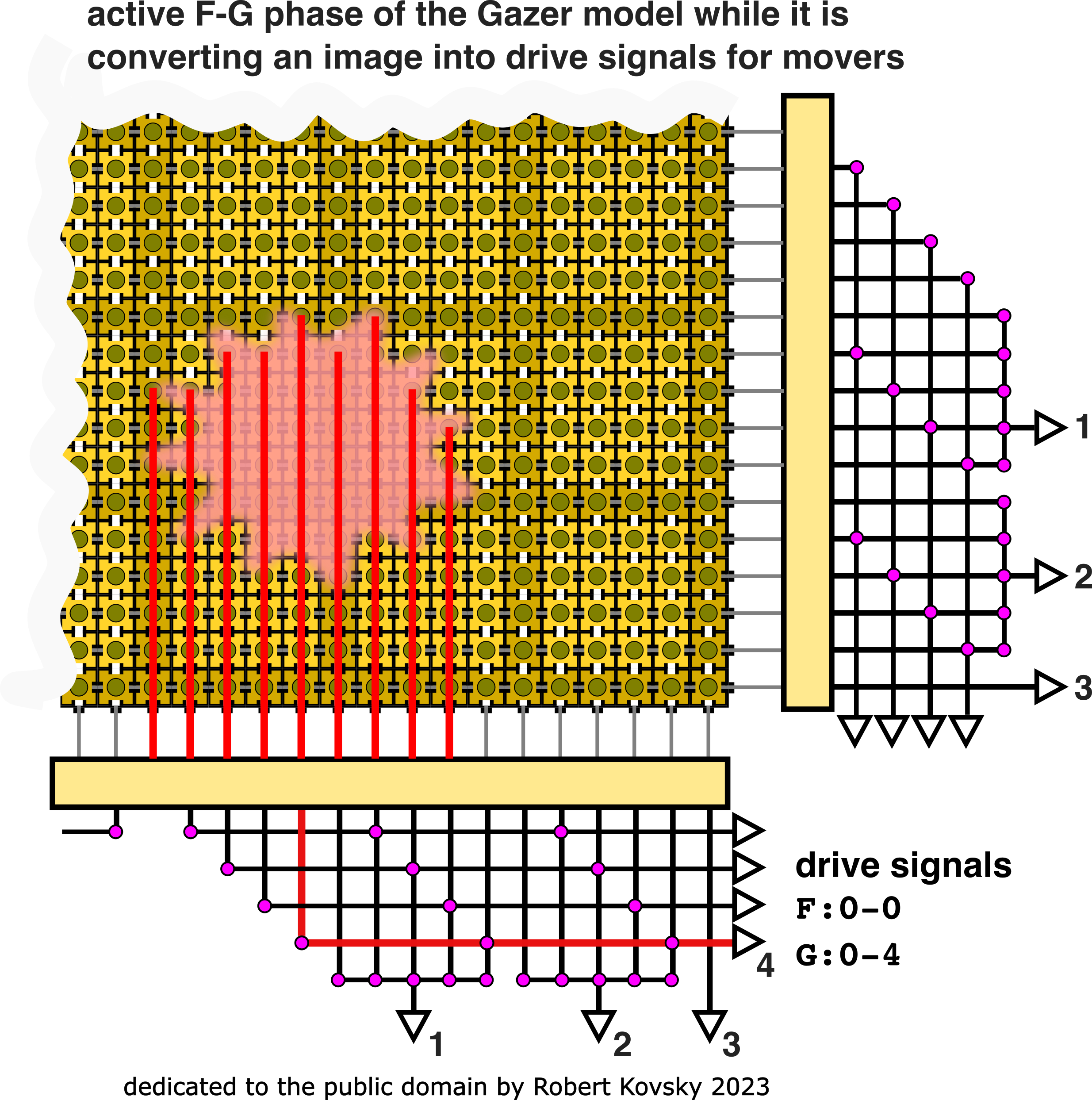
During an active F-G phase, stimulated sensors discharge VE that passes through columns of open junctions into channels of the control system. Only F-G channels are involved. Flows in junctions lead to F and G drive signals, which differ in value from those in the channel device model but which lead to the same resulting movements. 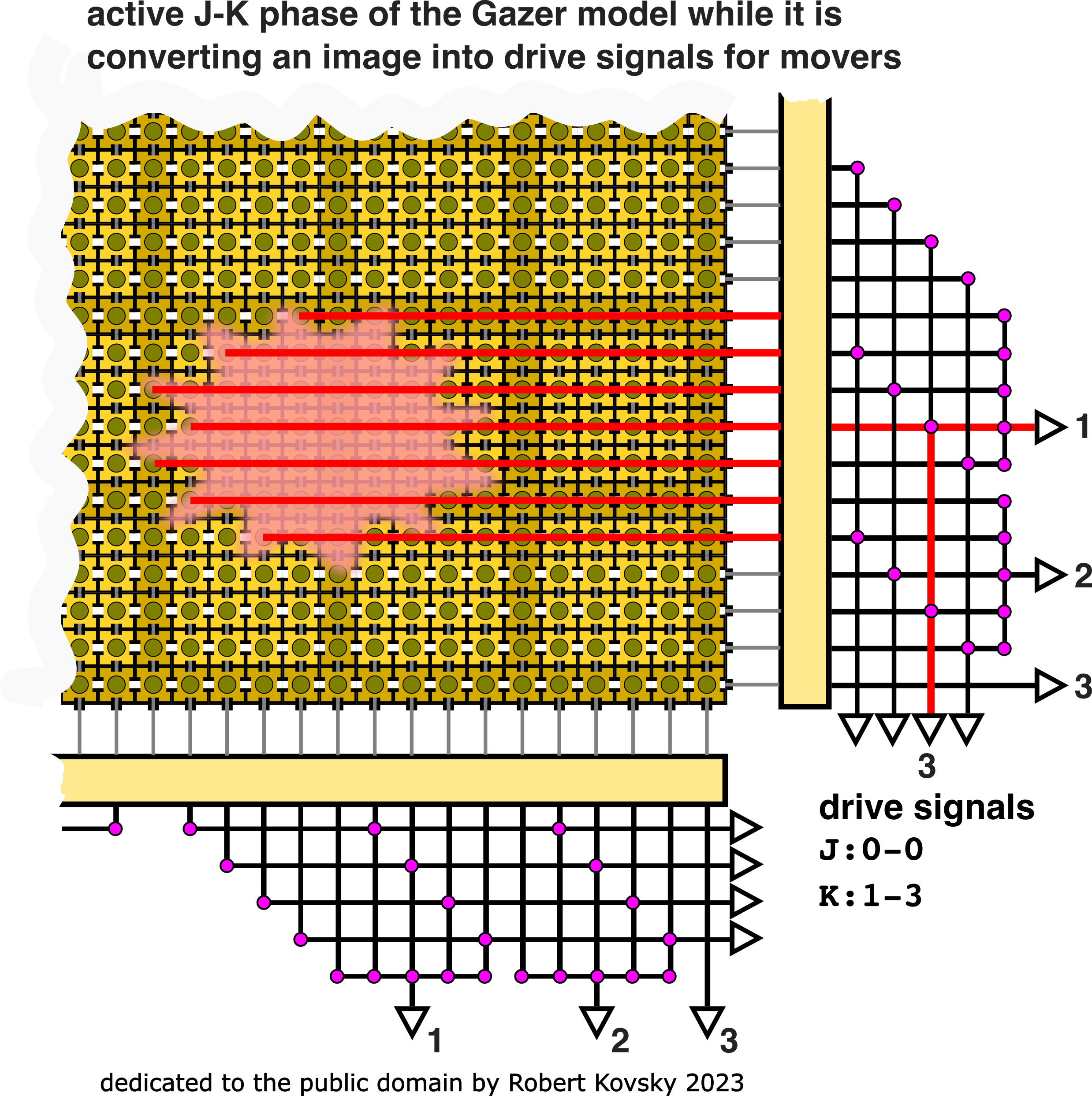
The adjacent figure shows an active J-K phase similar to the prior F-G phase, with the same visible image. In this phase, rows of open junctions direct VE into J-K channels. It is necessary to isolate the two phases from each other. If all the junctions were open at one time, VE would spread out, even to the edges of the quadnet device; and the resulting gaze would probably not be directed at the object.
The quadnet device model has one mode of operation called streaming, in which a set of signals generated by stimulation of sensors passes through stages of conversion and leads to drive signals that are sent to movers. Each set of sensory signals leads to one set of drive signals. Driven by the beat generated in the sensorial body, the model operates continually; if no image appears, all drive signals have the form 0-0 and the control point is maintained at the central location.
In contrast, the channel device model (like the Wriggler model) has two modes of operation, called holding and substitution. Holding mode operations are maintained in the absence of new sensory signals. When a new sensory signal arrives, the model switches to substitution mode for the next cycle. If no additional sensory signal arrives, the model reverts to holding mode. If an additional sensory signal arrives, substitution can continue. Continuous substitution mode in the channel device model resembles streaming mode in the quadnet device model, but the channel device model requires intermediary control devices and longer processing times.
The quadnet Gazer model completes the course of construction of this project. Initial mover constructions were foundational and later sensory and control constructions have specific features and operations that depend on the mover system. In the later constructions, concepts of VE flow have been developed, starting with pulses in projections, followed by VE flows in channels in sensorial bodies and finishing with VE flows through junctions in a quadnet device.
The quadnet Gazer model aims at distant goals of Shimmering Sensitivity, which also involves a cycle of phase changes in a quadnet device. The Gazer model is suggestive of further developments in that direction. Sensory signals generated in the primary quadnet that leads to reflexive gaze can also be connected to different kinds of devices in secondary quadnets. Sensory signals can become more complex, e.g., characterized by a frequency that corresponds to intensity. The secondary quadnets can participate in operations of image processing, e.g., comparing two images and detecting "same" and "different." Such developments are anticipated in the formal VE model.
... Index to part C
In preparation.
A formal Virtual Energy (VE) model and definitions for VE devices used in the project §1 Modeling methods.
Let's compare and contrast methods of VE models with methods of universal concepts invoked in "mechanics" systems such as Newton's mechanics, statistical mechanics and quantum mechanics. Both VE modeling methods and mechanics methods are used to construct conditions, movements and changes in imaginary domains that are intended to correspond to actual events in certain specific situations.
Surrounding contexts of the two methods are very different. Universal concepts such as gravity, computation and elementary particles are presumed to apply in all situations and at all times. Specific applications only provide convenient examples. Concepts in models, on the other hand, are tethered to specific applications and situations – even while the researcher seeks to extend the model to new situations. There is no presumption of universality needed for making models.
I consider methods of models to be better suited for investigations of feelings and freedom. Universal concepts imply commitments to uniformity, eternity and all-powerful Laws of Physics (including, of course, random chance), all of which tend to derogate feelings and to exclude freedom and personality.
In Rational Thermodynamics (2d. ed. 1984) at 424, Clifford Truesdell, writing about "The Maxwell-Boltzmann Equation," criticized such universalist attitudes because they "reflect a failure to come to grips with the real complications of nature. Beyond the easiest and long mastered special cases, nature is too intricate for any inclusive theory."
Truesdell compares and contrasts two methods used to investigate flows of fluids. First are continuum methods originating with Claude Navier and George Stokes where a fluid is presumed to be an infinitely deformable body that has certain idealized properties (e.g., linear relationship between velocity and viscosity). Second are mechanics methods of kinetic theory and statistics originating with James Clerk Maxwell and Ludwig Boltzmann where "the type of material ... [is] ... a moderately rarefied monatomic gas" such that "the molecules are mathematical points" and "all collisions are binary even though the intermolecular forces may extend to ∞." (Id. at 383, in a Lecture about "The Onsager Relations.")
At 424, Truesdell continues: "Different models have different uses; they emphasize different aspects of nature, often at the expense of leaving others altogether aside. Such is clearly the case in the kinetic and simple theories of fluids. One leaves out bulk viscosity, the other some effects of non-homogeneity ... Each leaves out much more, not the same for either. Each has its virtues ..."
Truesdell also states: "A good deal of misunderstanding seems to arise from the differences in psychic motivation. Researchers in statistical or kinetic theories are inclined to claim a kind of universality for their own results and hence to presume in others like aspirations to empire. Modern continuum mechanics has been, from its start in 1945, frankly a theory of models. No one, as far as I know, has ever claimed any universal truth for the theory of simple materials."
... sitemap (organized list of prior projects)
D. Music practice and performance — a domain of freedom
... 1. Repertoires of freedom in music practice... 2. Historical approach — the "new music" of 1601
... 3. Feelings and emotions: aims and results of performance
... 4. Collective freedom in performances of orchestral music
... 5. Repertoires of improvisation
... 6. In Chopin's Nocturne in E Flat Major, repertoires of freedom include "tempo rubato."
Overview. On the largest scale, expressions of musical freedom, creativity and beauty fill the cultural heritage of humanity as a whole and the lives of its diverse peoples — including music that accompanies dance, drama, marching and civil and liturgical ceremonies. Individuals are drawn to lives organized around music practice, performance and teaching, as well as attendance at performances by other artists. The actual life of a person's muscular movements, bodily feelings and freedom that was discussed above can be expanded to include beats, tones, harmonies, rhythms, etc. and also muscular movements that produce music and express musical feelings. Such domains of musical freedom are enormous and intensively interconnected.
These investigations of freedom in music focus on the beat. The beat coordinates multiple productions of movement and schedules exercises of freedom. I suggest that the beat occurs in a musician's body as part of actual life, along with variable accents and rhythmic changes. Related beats in the body also occur during a dance, procession or military march.
Musical repertoires of movement and freedom are introduced through the example of a young student of the violin who is learning rudiments of the instrument, e.g, how to coordinate movements of hands and arms with visual images of symbols of music notation and sounds that are produced. In the violinist, the beat coordinates two different kinds of movement in the right and left hands and arms. The left hand selects the pitch of each tone by fingering the instrument while the right arm and hand use the bow to articulate each tone and to group tones in phrases. During a practice session, the beat in the student's body drives a sequence of selections while symbols guide execution of selections. As in a contest, the driviing cause is distinct from the selective cause.
In domains of music, multiple kinds of movement occur at the same time. An individual performer combines movements of many body parts to produce musical tones and phrases. Multiple beats work together, e.g., in the fingers, diaphragm and mouth of an oboist. The principle of multiplicity is extended to performances of a duet or quartet, where tones and phrases produced by individual musicians are synchronized to produce streams of organized sound. A chorus can sing in unison or with parts in counterpoint.
In orchestral music, composer, conductor and performers exercise different kinds of freedom to achieve collective purposes of pleasing an audience. Long before the performance, the composer created a score or script in permanent notation. Performers and conductors of such pre-composed music exercise freedom that is called interpretation of the script. Interpretation occurs in actual time, incorporating a beat expressed through the conductor's baton that occurs synchronously in bodies of performers.
In one kind of performance, a soloist exercises individual freedom and the accompaniment is accommodating. In another kind of performance, an authoritarian conductor dictates tempo, phrasing and dynamics while numerous performers exercise collective freedom to execute the conductor's commands as if by a single body. An historical approach traces developments and ramifications of such freedoms.
In final investigations, genres of improvisation employs repertoires of freedom that cannot be reduced to notation, including those based on chant, dance, ornaments, tradition and virtuosity. Exercises of freedom required by Chopin's tempo rubato combine independent and interactive beats, a permanent script and runs of tones that resemble improvisation. .
1. Repertoires of freedom in music practice
Habits of actual life are adapted to violin practice. An initial investigation of freedom in music starts with the education of "Chris," a young student of the violin. In the first lesson in the teacher's studio, the teacher demonstrates how to hold the instrument with the left hand and the chin while explaining the chief features of the arrangement. When Chris attempts the position, the teacher provides verbal directions and corrects Chris by gently pushing, pulling and re-arranging parts of Chris' body. These interactions between teacher and student are simple examples of educational modes of imitation, instruction and training.
Holding the violin in the ready position, the teacher takes up the bow with the right hand and demonstrates stroking the open strings of the instrument without moving the fingers of the left hand; and Christ imitates this exercise. Next, the teacher demonstrates placement of fingers on the fingerboard with the left hand while bowing with the right hand, playing a four-note scale on each string. Chris imitates the movements of the scales and receives appropriate correction. For an extended period, the teacher plays scales while Chris tries to imitate the movements and to match the sounds.
The teacher introduces Chris to elements of music notation: first, the staff, treble clef and five score lines divided into measures by barlines; next, letter names and symbols for separate notes that appear in distinct positions in the staff and that use open and blackened ovals, along with stems and flags. Additional symbols denote a rhythmic time signature and downward and upward movements of the bow. Chris practices scales while also looking at the page with corresponding notation.
The teacher gives Chris a sheet of paper with notation for two pieces, "Twinkle, Twinkle Little Star" and "Lightly Row." The two pieces use the same simple fingering (C Major) and the same time signature (4/4). The first piece has a length of 12 measures, the second 16 measures. In repetitive cycles, the teacher plays each piece and Chris follows. Interactions between the teacher and Chris again revolve around educational modes of demonstration and imitation, instruction, performance and correction.
The teacher urges Chris to practice scales and pieces at least 20 minutes daily until the next weekly lesson. Perhaps Chris' parent is present at the lesson and promises to supervise the practice sessions.
The first violin lesson illustrates complex combinations of movements that are involved in playing the instrument. Certain body parts – chin and left shoulder and arm – must be maintained in fixed, even rigid, positions among themselves, while other body parts – left fingers and right arm and hand – are engaged in coordinated movements. When reading notation, movements of eyes must also be coordinated. Sounds are produced and are more or less satisfactory in reaching goals of imitation and musical expression.
Principles of the psychology of freedom previously discussed are adapted to movements of a violinist. The back and forth bowing movements are based on movements of brushing the teeth; the rubbing of the bow on a string resembles the rubbing of the brush on a tooth; adjustment movements of the right arm that shift the bow from string to string resemble movements that shift the toothbrush from tooth to tooth.
A left-hand finger pressing on the fingerboard resembles a finger scratching an itch. Instead of accurate placement of a finger directed at a skin location specified by to a bodily feeling, an accurately-placed finger on the fingerboard is directed at a location specific to a certain sound. If Chris is talented and can detect by ear the error of a misplaced finger, the finger moves to the proper location on the fingerboard — like a scratching finger accurately relocates to target an itch.
When Chris practices, movements are repeated, with aims of exact repetitions that conform to the notation and to a concept of the piece as a whole. Each movement requires a momentary exercise of freedom and playing the whole piece is an extended exercise of freedom. Exercises of freedom occur in specific situations, namely, in a practice room at home and at the teacher's studio.
Elements of the psychology of freedom that began with itching and scratching and that were extended to habits in the home are thus further applicable to music practice.
Very small repertoires of schemata are used at first: a few bowing movements, four short scales, sixteen tones, two short and simple pieces. Regardless of the small number of possible movements, tasks of coordination are complicated and must be repeated many times before an entire piece can be performed accurately and smoothly. Performance skills are based on memory of the body rather than images in the mind. Mental images can be acquired in the teacher's studio but acquisitions of actual bodily skills require hours of practice. Private practice in the home aims at performance in the teacher's studio, where Chris displays talent and skills and even "shows off."
Suppose that ideal student Chris is not only talented but finds enjoyment in practicing. Twenty minutes a day stretches to half an hour and more. The parent relocates to a more distant room. The teacher sees progress after the first week. A book of lessons is assigned and Chris learns additional pieces week by week, with new bowings and quicker fingerings. More pieces means more choices and more freedom. Learning is an ongoing exercise of freedom. Progress through a book of lessons resembles walking on a trail. During a journey that continues for years, Chris progressively acquires all the skills of a violinist and practices them in increasingly difficult pieces. There is, perhaps, an underlying expectation that Chris is preparing to perform in public.
These investigations explore certain repertoires of musical movement and freedom.
The beat. In an approach based on actual life, investigations into music practice start with the beat — a steady series of pulsations of movement and feeling in the body of the musician. I suggest that the beat in the body of a violinist is a foundational driving layer of movement and that additional movements of the performer's hands occur in secondary layers that ride on the beat. In a practice situation, the beat is prior to tones. (A listener is in a different situation.) While tones are being produced by a violinist, multiple parts of the body are involved in the beat: some parts are in fixed configurations and other parts are moving. Many violinists sway and bob as they play the instrument. Some violinists tap their feet to the beat.
In my approach, there are numerous repetitive pulsations in an animal body, e.g., in the heart, lungs and legs. The musical beat has an independent source and it can also match (synchronize with) an audible external beat. Human beings have a capacity for collective synchronization of individual beats. A single beat is shared by a group of persons who are participating together in a march, dance, ceremony or chant. A common beat is the foundation of collective movements and collective exercises of freedom in choral and orchestral music.
In musical practice and performance, repetitive pulsations of the beat continue in the musician's body in a steady stream while a piece is being performed. The rate of the beat, the tempo, is an important variable component of performance that is investigated below. The tempo can be strict (or metronomic) — with exactly equal time periods between pulsations — or periods between pulsations can vary to accommodate stresses of speech or musical phrasing and for purposes of declamation, fluency or emotional expression. Other ramifications of the beat include accents that divide or combine beats into phrases, meters and rhythms.
Manual independence and coordination. Movements of one hand of a violinist are independent of movements of the other hand — and the two kinds of movements are coordinated. Independence means that fingerings can change regardless of bowings; and that bowings can change regardless of fingerings. Musical expressions generally involve coordination of multiple independent movements. A singer coordinates movements of diaphragm, larynx, tongue and lips. Wind instruments involve breath, lips, hands and fingers. Coordination can be achieved by a means of a foundational beat. In Chopin's tempo rubato, however, manual independence produces two different kinds of beats.
Exact pitch and touch-based variants. In the first violin lesson, Chris acquires an initial repertoire of 16 pitches. Each pitch is produced by rubbing the bow either on an open string or on a string being pressed to the fingerboard by a finger. Correct pitches require exact tuning of strings and exact placements of fingers on the fingerboard. A guitar has frets that guide the placement of fingers; but a violinist must execute fingerings by means of sounds, talent and training.
For purposes here, each pitch corresponds to a particular key on the piano. When sharp and flat pitches are included, the full range of tones produced by a beginning violinist corresponds to a bloc of 29 keys on the piano keyboard. The correct placement of a finger is fixed and permanent. An essential skill of a violinist or a singer is to produce tones with the correct pitches required by the piece. The repertoire of correct pitches is exact and demanding.
A tone is conveniently described by a structure of frequencies, in which the pitch of the tone is identified with the chief low frequency. For example, the pitch of a correctly-tuned open A string on a violin is identified with the frequency 440 Hz, also known as "440 cycles per second." This pitch is sometimes called "concert A" on account of a custom of "tuning the orchestra" to that frequency before a performance.
Rigid rules of exact intonation are softened by a technique of vibrato. While a tone is being produced, the left hand of the violinist is attached to the neck of the instrument by the thumb and to the fingerboard by a finger. In vibrato, the left hand shakes or trembles so that the finger on the fingerboard wobbles back and forth a little bit, imparting a wobble to the pitch of the tone. Tones with vibrato have a sensual coloration or emotional warmth that can range from subtle to farcical. Violins playing with vibrato are often used to accompany intimate scenes in cinematic productions. For the finger to wobble, vibrato requires a light touch, where the force of the finger against the string is the minimum needed to pin the string to the fingerboard. An even lighter touch is required for harmonics, where the finger stops the string from vibrating at the point of contact but does not press the string to the fingerboard. Adjustments of vibrato and production of harmonics by a violinist require additional exercises of freedom.
Articulation. For purposes here, articulation in music refers to production of individual tones; phrasing (discussed below) refers to grouping a sequence of tones to produce a brief melodic gesture or longer musical schema. There is a parallel in speech, where articulation refers to production of distinct words and phrasing refers to grouping a sequence of words to produce a clause or sentence. Some poems have beats, meters and rhythms like those of music. Lyricist and composer synchronize their beats so that poetic phrases in song lyrics match up with melodic phrases in the accompaniment.
Articulation is a specific skill as to each instrument and the voice. Extreme polarized examples of articulation are tones produced by (1) a pipe organ or synthesizer and (2) a glockenspiel or xylophone. The pipe organ produces a sustained tone that fills the time assigned to it. The glockenspiel produces an instantaneous tone that starts the time assigned to it but that almost immediately fades away to silence.
A violin has a larger repertoire of articulations than either an organ or a glockenspiel. The violin's vibrating strings and resonant body enable the player to connect tones smoothly when reversing the direction of movement of the bow. Violin tones produced with steady full-length bow strokes resemble sustained tones of an organ; this articulation is called legato. In contrast, violin tones produced with short, jerky bow strokes resemble instantaneous tones of a glockenspiel and are called staccato. Another repertoire of tone production called pizzacato involves plucking strings with fingers of the right hand while selecting pitches with fingers of the left hand; such tones more closely resemble those of the glockenspiel,
Loudness. Pressing the bow against a string with more or less force makes the tone louder or softer. The range of possibilities is called loudness or volume. Selecting loudness of tones is an ongoing exercise of freedom. As a general principle in music, a performer can change the loudness of a tone without altering its pitch or aspects of articulation.
Phrasing. Suppose that fingering changes during a legato bow stroke. First one tone sounds, then a different tone; string vibration and instrument resonance are continuous. The two tones are said to be slurred. Two slurred tones make up a tiny phrase. A phrase can be extended to a sequence of tones; some are slurred and some are staccato. Repetitive back and forth bowing movements can shape phrases and go on indefinitely. Often, an extended sequence of phrases makes up a melody that makes sense as a whole and is easily remembered. Melodies or "tunes" are of high importance in Western music.
Tremolo is another bowing technique, where the right arm and hand oscillate or tremble so as to produce a continuous sequence of short back-and-forth movements of the bow. Left-hand fingering may be fast or slow while the bow moves with a constant activation. The tremolo technique imparts emotional intensity and dramatic suspense to phrases and melodies.
Comment. The repertoire of bowing movements for the right arm and hand contrasts rather sharply with the repertoire of pitches for left-hand fingers. The repertoire of pitches involves specific fixed locations and rigid rules of intonation. The repertoire of bowing movements incorporates many different articulations, allows for inventions and extends directly into the more complex repertoire of phrasing.
(...) Index of musical investigations
2. Historical approach — the "new music" of 1601
Historical investigations are based on Frederick Dorian, The History of Music in Performance – The Art of Musical Interpretation from the Renaissance to our Day (1942).Prof. Dorian discusses developments in musical forms, practices, interpretation and improvisation over a period of some 350 years. He also discuss multiple layers of constraints and controls that influence performances, including controls imposed by conductors, composers and audiences such as kings, clerics and critics. In the history of European music, formal disciplines and multiple constraints led to greater freedoms: more skills and movements, more pieces, more instruments and larger organizations with greater capacities. Freedoms of individual musicians were constrained in order to serve the freedom of composer and conductor and the pleasure of audiences. In later stages, the growing and developing European musical culture also combined with non-European cultures and generated new kinds of music such as jazz, a channel of improvisation.
Dorian, a refugee from tyranny, wrote in the context of the international war for freedom then being waged. The book concludes with an application of major literary themes to the national anthem of the USA, "The Star-Spangled Banner." Notwithstanding "objective musical conditions into which the conscientious interpreter must fit his rendition . . . there is still that intangible quality of emotion that makes the difference between a great and an ordinary performance."
Interpretation is the great force that brings to life what otherwise, as Wagner says, is "soulless pen music." The performer of the anthem must "glow, and feel," in the words of Berlioz, with the great emotional meaning behind the song. After all, there is no greater force than a people's voice for freedom.
Investigations of European Renaissance music around 1600 focus on two distinct situations: (1) churches and (2) courts of kings, dukes, counts, etc. Popular music and dance music circulated among peoples and musicians but was not officially recognized. Churches maintained traditions of choral singing. Instrumental ensembles in courts accompanied ceremonies and dances, entertained rulers and were a mark of prestige. Instrumental musicians sought courtly positions and salaries. Individual singers might perform in multiple venues.
Ensuing developments combined aspects of the two situations.
At pages 37-40, Dorian discusses the liturgical music of the premier Vatican composer/conductor Giovanni Pierluigi da Palestrina (1529-1594); and he also mentions the camerata, a group of inventive personalities that met in Florence in the palace of Count Bardi near the end of the sixteenth century. Efforts of the camerata led to the invention of opera, in the vanguard of new forms of music.
Palestrina was not only a superb composer of scores in the ecclesiastical spirit, but also their ideal interpreter. The classically balanced vocal polyphony of his compositions is eminently suited to the ideals of the sacred service . . . His type of interpretation expressed the collective spirit of the community, excluding the aspect of individual feeling from musical performance.. . .Palestrina adhered strictly to the unaccompanied type of choral performance, called a cappella. On the other hand, the contemporary Florentines sought expression, more and more through the medium of instruments.. . .A superlative choral conductor in spite of his notoriously weak voice, [Palestrina] accomplished with his singers wonders of tonal beauty, fulfilling the idealistic conception of . . . un harmonia et un concerto de voci higher than any combination of instruments.Dorian discusses the A Cappella Style of unaccompanied singing as a permanent aspect of liturgy. A chief feature is FREE DECLAMATION. Declamation is a style of speech that is used to recite poetry, with rhythms and accents adapted to words and their meanings. In the a cappella style,
. . . singers must maintain rhythmic precision and evenness of execution in all the parts. A symmetrical style of singing is required, also special skill in the rendition of dynamics. Since there were no hints in the manuscript . . . only very well-educated and capable singers could recognize the dialogue and echo effects from the music itself . . . The modern interpreter of the old a cappella music faces a difficult problem in the dynamics and must also realize that conducting with a regularly recurring accent has no place whatsoever in performances of this style, Instead of this, a free declamation with accentuation of words and motifs, contrary to the modern conception of the regular measure, is the aesthetic goal.As summarized in Dorian at 42, a somewhat different view of the a cappella style is provided in a 1596 treatise, Music Practice by Ludovico Zacconi, who. . . warns that the beat must never flutter, even if singers introduce embellishments, and that only an even, precise beat can insure clarity in direction. The beat was given evenly as a necessary means of orientation in performance. No change of tempi within pieces was permitted, the rhythmic dispositions being indicated through notes and measures. Thus acceleration and retardation were normally avoided . . .There might appear to be a conflict between the two foregoing descriptions. A style of "free declamation with accentuation of words and motifs, contrary to the modern conception of the regular measure," might appear to be in conflict with "an even, precise beat" over an entire piece and "rhythmic dispositions being indicated through notes and measures." The declamation, as it is described, would seem to be "free" of beats, notes and measures.I suggest that the conflict is only apparent. An even, precise beat by the director is consistent with a rhythmically freer declamation by trained singers, who synchronously depart from and return to the director's beat. As discussed below in connection with Chopin's tempo rubato, I suggest that musicians can sustain and combine two different kinds of time in performance. An even, precise kind of time and a free declamatory kind of time start a cycle together and match up at regular intervals while allowing for variable interpretations and expressive emphases between matchings.
In the Renaissance world outside of the church, such as in courts, music often had a character that depended on happenstance circumstances. As described by Dorian (62-63):
In the early days of the orchestra . , . the employment and grouping of instruments followed no definite order whatsoever. Apparently the only principle was not to have a principle. In those bygone days, whoever happened to be present at a performance played any available instrument. The method was one of extempore and improvisation. Instruments of all kinds were admitted, and the oddest combinations resulted. . . . [There was an] absence of tonal balance as we know it, since the old audience had no conception of our modern desire for tonal proportion. Instrumental symmetry in the art of scoring belongs to a considerably later period.In 1601, Giulio Caccini, "one of the leading protagonists of the camerata," published La nuove musiche—"The New Music," a collection of airs. (Dorian, 43)The conductor in the early days acted simultaneously as his own arranger. . . . First of all, he had to adjust the res facta, that is, the composer's written score and its tone rows to the vocal and instrumental forces at hand. . . . Michael Praetorius [1571-1621] did not believe in the pure a cappella sound of the Palestrina style as an unalterable ideal of interpretation. Enthusiastic about the new orchestral medium, Praetorius shows the possibilities of arranging vocal scores by changing kaleidoscopically the colors of voices and instruments.
Caccini's interpretation attacked whatever seemed opposed to genuine emotional expression. Now, with the humanistic attitude of respect toward the word, the new interpretative goal was to express clearly the true effect of the "tone language," as music was significantly called. This permitted a performance of the new monodic compositions on the basis of a broad subjective treatment of the text as the performer's guide. Emphasis was exclusively on the dramatic meaning of the poem and not on beautiful tone rows.. . .First and foremost, Caccini expressed his main idea of interpretation in the watchword, una certa sprezzatura di canto—"a certain subordination of the song." The singer's task was to speak musically, as it were. . . . [Other authorities of the same era] all present essential similarities of attitude. For the sake of genuine dramatic expression, the singer was given extraordinary freedom. As to tempo, authorities . . . all stress this liberty of movement. . . . the vital function of the musical interpretation was to intensify the spiritual content of the poetry. (Dorian, 44, 46-47.)
In the seventeenth century the singer was merged with the imaginary character to whom the poet's verses were ascribed. The singer had to identify himself with him whose joys and sorrows were depicted in the words. Hence music itself more or less abandoned vocal polyphony. And the monody, freed from the bonds of polyphony imposed on its voice parts, was not only inspired by the actual meanings of the words, but even by the speech cadence of the orator or actor . . . les jeunes, around 1600, aspired to a stilo recitativo or stilo rappresentativo, imitating natural diction and expressing even the most delicate and secret emotions of the soul. (Dorian, 49)
In discussing the romantic movement of the 19th century, Dorian observes that: "Romanticism is an eternal factor in the performance of music."
The performing style of the ars nova, the stressing of the poets' words in the Renaissance [e.g., Caccini], as well as the fantasies of the Baroque, must be considered romantic.The ars nova arose out of popular music and dance music in the 14th century. Blind singer, composer, poet and organist Francesco Landini (1325-1397) was a leading performer. He appeared as a character in a contemporary Romanza that resembles Bocaccio's Decameron. In the story, "Francesco played his love verses so sweetly that no one had ever heard such beautiful harmonies, and their hearts almost burst from their bosoms." The musical style incorporates "long florid melismatic passages." The poem "is written in a very free style with little regard for rime schemes or metre. Great stress is laid on vividness of description, to which end considerable onomatopoeia is used. If the subject permits, street cries and other similar calls and ejaculations may be inserted." [Leonard Ellinwood, ed., The Works of Francesco Landini, The Mediaeval Academy of America (1945).]
Baroque productions, with "vastness of proportion and splendor of colors" (Dorian, 75) included oratorios and operas. City-states and nation-states copied from and competed with each other, staging elaborate productions and aiming to please large audiences. Handel's Messiah, written in 1741 near the close of the era, continues to attract and thrill audiences every year.
As noted above, Wagner and Berlioz concurred on the central importance of emotional meaning in music, although they had entirely different musical personalities and each disparaged the other's conducting. [Berlioz on Wagner: "like dancing on a slack rope . . . sempre tempo rubato;" Wagner on Berlioz: "commonest rut of the vulgar time-beater." (Dorian 247)]
Musical theories of the the 18th century "center around the so-called Affektenlehre, the 'doctrine of affections,' " including in "affections" a broad sense of "emotions." (Dorian, 138)
. . . the roots of the Affektenlehre were already embedded in the antique Greek ethos. It also occurred in medieval music and served to guide performance in the Renaissance. . . . Today it must be remembered that its laws controlled the old interpretations and that every eighteenth-century performer was expected to obey its rules. (Dorian 138-139)According to several authorities, "it is only when the performer fully experiences the composer's feeling, that he is capable of arousing the corresponding emotion in those who listen to his performance." (Dorian 144) Quotations from notable figures (Dorian, 139) set forth principal themes of the Affektenlehre doctrine:
In the phraseology of the theorists, the music is either sad or lively, serious or tender, wild or gentle, indifferent or sensitive. It gives a picture of despair, comfort, peace, pleasure, joy, coldness, impatience. . . . No sooner has the musician done justice to one affection—to follow Philipp Emanuel's train of thought—than he provokes another; emotions are interchangeable. . . . Thus, only interpretations based on an appropriate scrutiny of the affections, and their suitable musical application, are sanctioned.The theorists assigned emotional associations to major and minor modes and to individual keys ("D minor is for quiet, agreeable, contented moods; G minor mixes seriousness with loveliness; . . . E major is for sad or desperate, suffering, penetrating effects."). Affections are specified in the score (e.g., doloroso, lugubre, pomposo, maestoso, amoroso).
Quantz considers first the intention and place of the performance—whether it is for a church service, for the theater, or chamber music; whether the occasion is festive or solemn, wedding or requiem. Every species has its definite laws of performance. Hence, the interpreter is told that church music demands more splendor and seriousness than that of the theater. . . . As one would expect, the whole picture changes in the theater. On the stage the interpreter has virually every freedom in tempo and expression.
I suggest that, when the concept of "feelings" is viewed from the perspective of actual life, the whole picture changes again. The "affects" chiefly identify particular kinds of feelings of a "listener," perhaps immobilized in a church pew or theater seat. I suggest, in an alternative view, that a "listener's" capacity for appreciating music is grounded in their actual life: their education and practice as a singer or instrumentalist; or dancing or marching; or participating in ceremonies or rituals. There are memories of muscular movements and bodily feelings bound up with music that are foundational for a listener's actual experience, even in a theater seat.
Therefore, I classify feelings and emotions identified by the so-called Affektenlehre doctrine as theatrical emotions, which are different from actual feelings that are grounded in muscular movements and bodily feelings of a performer. Similarly, actual emotions are grounded in events of actual life and can influence a person for extended periods of time, even a whole lifetime. Theatrical emotions, in contrast, are easily interchangeable, with suffering forgotten as the scene and sounds quickly change from sad to lively — or to wild — or to laughable. "Before Don José has a chance to kill Carmen, the audience is cheered up by a big chorus and ballet scene. . . . In Puccini's Tosca, a torture scene and a gavotte are friendly neighbors." (Dorian 111)
In addition to actual feelings and theatrical emotions, there are musical feelings that are based on details of auditory experience — e.g., quick, smooth performance; alternating dissonance and consonance; development of melodic motifs. Musical feelings are explored below in investigations of improvisation and Chopin's rubato. I suggest that musical feelings lead the performer and arouse and satisfy the listener. Such feelings reach a peak during an exceptional performance when virtuoso skills of the artist are magnificently displayed.
Musical feelings, like bodily feelings, can occur without theatrical emotions — and some performers and listeners prefer it that way. Chamber music — e.g., piano trios and string quartets — manifests the "absolute ideal of transparency and formal clarity . . . the spirituality of counterpoint, the basis of all classical music, is no vehicle for sheer emotionalism or virtuosity. . . . as early as the seventeenth century the chamber duet and concertante music reached noble heights of purity never meant to be represented dramatically. . ." (Dorian 291)
Feelings of freedom of a performing musician resemble those of an athletic contestant discussed above. A public musical performance, like a public athletic contest, is an event that is based on many years of education, individual practice and private events. The public display of skills is the culmination of previous efforts and may become a memorable event in the life of the musician. Like a contest, a musical performance fills a period of time defined by a starting moment and a finishing moment. Like a contest, a musical performance is distinct from other events.
In both domains, the body has a heightened physical activation during a performance event, felt as possessing more acute sensitivity and producing more highly controlled actions. Musical performers and athletes concentrate during performances in similar ways. During a performance, many separate exercises of freedom are combined into a unified construction in time; the performer maintains an image of unity as a guide for separate movements.
During a performance, a musician generates, channels and expresses streams of actual feelings, musical feelings and theatrical emotions. Anxiety ("stage fright") often accompanies the heightening of activation prior to performance. The musician knows that critical judgment is being applied to every detail of performance. There is a peak flow of energy during a performance which may result afterwards in feelings of exhaustion or inadequacy.
Berlioz wrote a famous Treatise on musical instruments and orchestration. In the Treatise, he describes each individual instrument in the orchestra and then turns to the orchestra as a whole.
The orchestra can be considered as a large instrument that is capable of producing at one time or in succession a multitude of sounds of diverse kinds. Its power can be subdued or colossal, depending on whether it draws on the totality or only part of the performing resources available to modern music . . .Dorian (p. 248) summarizes the approach of Berlioz:The performers of all kinds which together make up the orchestra would thus seem to be the strings, tubes, boxes, flat surfaces, of wood or metal, that are like machines endowed with intelligence but actuated by a vast keyboard touched by the conductor under the direction of the composer.
No personal freedom is conceded to the individual orchestra player. Although his vanity may be hurt by being held like child on a strap, it is only the conductor's conception that matters. The success of the rendition depends on whether all of the orchestra members are willing and capable of accepting and reproducing a unified interpretation of their concerted work. Consequently, the conductor must stand in supreme authority.I suggest an approach that differs from one where performers "are like machines endowed with intelligence" programmed and run by a "supreme authority," the "conductor under the direction of the composer." My approach is consistent with freedom of the performer. Freedom of performers is constrained when participating in collective activity but their freedom is also expanded by acquiring new repertoires of works and by participating in actual performances that attract large paying audiences and wealthy donors, providing substantial financial freedom for the performers. Many orchestra players also teach or perform individually or in small ensembles. Musical cultures of individual freedom and improvisation are supported by "orchestra members [who] are willing and capable of accepting and reproducing a unified interpretation."
I suggest that a performance of a piece of orchestra music involves multiple persons, each exercising freedom in specific ways. The composer creates a written representation of the piece, called the score. The score is permanent and unchanging, at least for purposes of practice, rehearsal and performance. In contrast, every performance is unique and often with distinguishing features. Actual music is a construction in time and each element in the construction has a transient duration, e.g., a tone that lasts for perhaps a second. A person interprets the score by converting the permanent representation into a temporal construction. Interpretation occurs during each performance. Skilled performers and conductors prepare for interpretations during performance by studying the score and by practice and rehearsal. Execution of the temporal construction means actual performance by the performer, perhaps under direction of a conductor. Execution can be individual or collective. A performer participating in collective execution must possess skills that are additional to those acquired solely by individual education and practice, e.g., moving in synchrony with other participants.
This investigation focuses on fully-separated functions of composer, conductor and performer. In some situations, a single person performs all three functions, e.g., a solo singer-songwriter or a baroque composer of a harpsichord concerto who both performed the solo part and also "conducted the orchestra from the keyboard," as the practice was known. The approach can be revised for small ensembles: in one ensemble, an authoritative leader acts like a conductor; in another ensemble, each performer leads the ensemble in sections of the piece where they have the leading voice.
|
Heritage from the Renaissance. The adjacent image shows a composition for three voices — "Green groweth the holly" — written while Henry VIII was King of England (c. 1530). It illustrates features of European music in the later Renaissance period: (1) A sequence of tones makes up a distinct and memorable melody that is the chief content of the composition. (2) The composition is notated, preserved and published. (3) The composition apparently uses no more than twelve pitches overall; each tone has a fixed specific pitch. (4) The composition uses six periods of time for tones; each period is a fixed fraction of a standard period. (5) Singers collectively produce harmonized tones and chords.
The foregoing features are absent in "alap" sections in improvised music of Hindustan Ra̅gas discussed below. (1) A ra̅ga resembles a Western scale or melodic tone row but it is chiefly used by the performer as a resource that can be fragmented and modified to provide source materials for moment-by-moment repetitions, variations and embellishments. (2) Such improvised music cannot be notated. (3) Some tones have pitches that change during articulation and pitches may depend on prior tones. (4) Periods of tones need have no fixed standard and are often irregular. (5) There is a fixed background harmonic texture maintained by drones that would interfere with changing harmonies or complex chords. |
[https://blogs.bl.uk/digitisedmanuscripts/music/
Add MS 31922] |
Pipe organs. I suggest that the foregoing features of European music are embodied in the pipe organ and arose out of the culture of organ music in medieval Europe, e.g., as examplified by Francesco Landini mentioned above. Regardless of changing styles of vocal performance and fluid forms of popular music, enduring principles of organ design shaped development, e.g., as to fixed pitches and permanent notations.
I also suggest that choral directors applied principles of organ music for singing in the a cappella style of liturgical music. In other word, the singers were trained to produce tones that resembled sustained tones produced by pipe organs and that were subject to organ-like combinations and compositional techniques. "Palestrina was himself an organist." (Dorian 38)
A tonal element in pipe organ music has a fixed, specific pitch determined by the size of a tube. All the tonal elements are related by mathematical ratios and organized by harmonies. The harmonic organization is embodied in the keyboard, with repeating spatial forms consisting of twelve keys. Such sustained tones and organized forms are readily notated and the notation itself can suggest further developments, e.g., in harmonic progressions.
In performances, the organ produces multiple tones at the same time, with an enormous number of possible combinations. The number of possibilities becomes even larger when the performer produces simultaneous lines of tones. Some simultaneous lines sound good together and others do not, leading to constraints on combinations of tones and permissible progressions — e.g., constraints called rules of counterpoint.
When a finger lifts from one organ key, relocates and presses on another organ key, a brief pause and a mechanical linkage intervene between tones. A tone starts suddenly and is sustained for its duration; then it ends suddenly. In a sequence of tones or a chord, all tones have the same loudness.
Melodic movements on the organ occur in distinct steps, in contrast to the undulating character of a voice or violin. Organ chords have the same step-wise character, often in blocks. Agile fingers can weave veils with legato, glissando and embellishments and two hands can coordinate multiple lines of tones, some sustained and some brief — but the blocky character of organ music is omnipresent, at least in the background and often in the fore.
The importance of organ music is illustrated by Girolamo Frescobaldi (1583-1643), who published "a most comprehensive description of organ interpretation," the Toccate. (Dorian 54-56)
He was not only the greatest interpreter on the organ of his time, and one of its greatest composers, but was also the teacher of generations of organists who came from other countries to Rome to study his masterful style. . . . The influence of this style continued until the severe Baroque of Bach's polyphony changed organ performance into an objective, transparent, specifically instrumental style.Frescobaldi's rules for interpretation set forth in the Toccate allowed the performer considerable freedom as to tempo and phrasing, "now languid, now lively, in accordance with the affections of the music or the meaning of the words." He offers "a variety of divisions and expressive ornaments . . . that can be played independently of one another. The performer can stop wherever he wishes, and thus does not have to play them all." Dorian discerns "rubato and phrasing in interpretation."
Creation of the orchestra and the struggle for domination. Please recall that in Caccini's new music of 1601, "the singer was given extraordinary freedom." Jacopo Peri (1561 - 1633), creator of the first operas, wrote of "the nuances and free passages of the singer Signora Archilei, the details of which nobody could put into notation." (Dorian 191)
In a further development, Claudio Monteverdi (1567-1653) brought about "a state of instrumental emancipation from the vocal setup [of the camerata] . . . the art of scoring enters into more definite forms . . . Monteverdi's orchestra displays a beauty of sound we can fully appreciate today." "Each scene was accompanied by the instruments that best reflected its particular character, emphasizing variety of shade and light in every number." (Dorian. 66-68)
Apparently, the singers took advantage of their freedoms to become dominant participants in the productions.
By the middle of the seventeenth century, the auspiciously inaugurated opera had already deteriorated to a musical theater production designed for singers and their undiscriminating audiences. . . . Composers were commissioned to write scores for specific virtuosi, keeping in mind the type of voice, register, and personality. Interpretation consisted of singing alone. Singers did not act. . . . In the recitativo secco, the orchestra being silent, the vituoso singer poured forth his runs and trills . . . Most of his ornamentations were improvised, according to his mood or taste. Embellishments that today would appear grotesque made the opera performance the hotbed of arbitrariness in interpretation. (Dorian 271)Jean-Baptitste Lully (1632-1687) "violently opposed these operas made to a singer's order like a tailored suit. And the tyrannical maître of the court of Louis XIV did away with fanciful ornamentation of even the favorite prima donnas." (Dorian 271-272) Lully's disciplinary attitude extended to the orchestra. Visitors to the Paris opera or Royal Academy "were stupefied especially by the string section of the Lully orchestra, referring to the unity of bowing as an unheard-of-phenomenon. . . . A specialty of the Parisian playing was the renowned premier coup d'archet (first stroke of the bow)." (Dorian 73)
Lully, a master not only in writing his scores but also in presenting them to the world, is by some historians given the credit for having moved the orchestra from its concealment behind the stage to a conspicuous place between the scene and the parquet. Here, in front of his musicians and visible to all, stood Maître Jean Baptiste, pounding the beat with a heavy, decorated stick—a musical commander with military manners, insisting upon instrumental discipline and utmost rhythmical precision. (Dorian 69)"But after Lully put down his enormous baton for the last time, all the vicious habits that he so vigorously fought rapidly crept back to the French opera stage." (Dorian 272) Christoph Willibald Gluck (1714-1787) later took up the campaign against such "vicious habits" of opera singers. Gluck initially indulged the prevailing ornamental style, including writing an aria specifically for a famous castrato singer. Then, along with theatrical colleagues, he introduced innovations.
Gluck eliminated the recitativo secco and provided instead a very expressive accompaniment for the vocal parts. . . . [E]very performer is strictly bound to interpret according to his part. Consequently, the instrument of improvisation, the harspichord, had to disappear from an orchestra now directed by a binding score script. . . . Gluck's radical objectivism forbade that a single tone be shortened or held a little too long by arbitrary singers. He insisted on the proper setting of tempo. He did not tolerate the employment of an appoggiatura, trill, or run in the wrong place. (Dorian 272-275)Gluck affirmed that:
I was determined to abolish all those faults that had stolen into Italian opera through the unwarranted pride of singers and the foolish acquiescence of composers, that had made it tiresome and ludicrous instead of the greatest and most impressive spectacle of modern times. I sought to restore music to its proper place—that of enhancing poetry by bringing out the sentiment and appeal of the situations without interfering with the action or impeding it with superfluous ornament. (Dorian 69)Therefter, the hierarchy of dominance was established, with performers subordinated to composers and conductors. "Spontini, as Berlin Generalmusikdirektor, evoked the admiration of Wagner for his despotic drill of performers, putting vain coloratura sopranos, tenors, lazy baritones, and arbitrary condutors in their places." Verdi "like Lully, Gluck, Spontini, and Weber, [was] a despotic tyrant in his productions." "The distrustful Rossini wrote ornaments and coloratura passages in full to confine the extravagances of his prima donnas." (Dorian 286, 287) "Stravinsky does not hesitate to compare a good conductor with a sergeant whose duty it is to see that every order is obeyed by his player-soldiers." (Dorian 30)
Major events in development: "The Script Becomes Binding" and "Improvisation Disappears." Dorian's phrases describe a changing culture. (pp. 153-155) "With the classical period as a turning point, the script becomes increasingly binding. . . . The written character of the work tends to exclude any license from the performance. What the composer wants is more and more frequently shown in detail."
In the prior era, "the old performing style" incorporated "discretion of the players."
Most of the great composers prior to the nineteenth century supervised their own performances and thus could enforce their wishes personally. . . . Frescobaldi and Byrd were their own performers on the keyboard. Palestrinra and Monteverdi, Bach and Handel, Haydn and Mozart supervised not only the renditions of their scores, but likewise all the rehearsals prceceding the productions of their works. Last but not least, as a general characteristic of the old performing style, the interpretation of parts was left to the discretion of the players. In other words, the players were expected to render their parts according to their instrinct and musical common sense, to phrase correctly without the help of signs and symbols. (Dorian 161)Changes are shown by the life and compositions of Joseph Haydn (1732-1809). Rising from poverty, he was employed for some thirty years by the House of Esterhazy, high in the ruling elites of Austria. In the early years, the position unified functions of composer and music director. The nature of the musical establishment is described by Dorian (176):
An old picture shows Haydn conducting his opera, L'incontro improviso. He directs the performance from the cembalo [harpsichord] near the stage, in order to have the closest possible contact with the singers.Based on the picture and other information, Dorian estimates (p. 176) that the size of orchestra under Haydn in 1775 was "nineteen players, including the concertmaster."
In his maturity, Haydn's fame spread and he toured England, composing and presenting works for large halls. Dorian (174) reports that the size of the orchestra for these perfomances included 39 players for the strings alone. Depending on the work, 10–12 wind instruments and a percussionist fill out the roster on a score. Haydn conducted but was not personally familiar with the orchestra members. Instructions were set forth in the score and notational parts for players.
. . in his Oxford Symphony . . . Haydn marks his wishes regarding tempo, phrasing, and tonal quality. Thus, the player of the first violin part knows which tones Haydn wants slurred and which ones he wants separated. The tempo is indicated (adagio) and the dynamic marks are not written as vague generalities, but individual signs are given for the respective instruments.
Another repertoire of collective freedom is called orchestral dynamics, which occur when the sound volume produced by the orchestra as a whole changes from soft to loud and from loud to soft (crescendo and decrescendo). Orchestral dynamics were invented in Italy and developed in Mannheim Germany around the time of Haydn through efforts of conductors Jommelli, Stamitz and Cannabich. According to a contemporary authority, "previously, all pieces of music had been executed at the same intensity of tone, or left to the discretion of the player." (quoted in Dorian 148-149)
. . . beginning with Jommelli, the choice of modulation to piano or forte, crescendo or decrescendo, no longer resided in the will of the performer, but had to be sought in the instructions of the composer himself. . . . the unheard-of tricks of the Mannheim ochestral rendition could not have been the result of improvisation in performance. The Mannheim playing was, on the the contrary, the consequence of careful rehearsal and elaboration of definite indications in the score script. . . . it is obvious that only excellent players could have performed with such brilliancy. We are told that Stamitz, and after him Cannabich, developed the Mannheimers into orchestras in which "were more soloists and composers than in any other in Europe."The performer's repertoires of articulation and phrasing were likewise subjected to the authority of composer and conductor. (See Dorian 158-164). "Phrasing is a feature common to both speech and music." The content of a vocal performance is a stream of sounds. The stream is interrupted or divided into segments by the need to breathe. In simple music, a phrase of tones — a musical schema of tones in sucession — fills a segment as its content. The schema has a whole-body character that is recognizable on repetition and is also often recognizable notwithstanding changes, e.g., by modulation to a different key or by insertion of grace notes. We recognize "Twinkle, Twinkle Little Star" regardless of whether it is played on a pipe organ, a violin or a glockenspiel.
Scripted breaths occurred in litugrical music prior to the Renaissance. "The evolution from a score without prescribed phrasing to one with phrasing indications may be ascribed to Gluck, Jommelli, the Mannheim orchestra, and, of course, the Classicists."
Lully controlled bowing of string instruments by means of personal direction. Dorian concludes that "centuries before a binding script had incorporated the marks of phrasing as part of scoring, the practice of phrasing flourished in both vocal and instrumental performance."
Notation for phrasing in the score was developed during the 18th century. As discussed above, violin bowing can produce brief detached notes called staccato, which are distinguished from smooth notes that flow into each other, called slurred or legato. Philip Emanuel Bach complained of prior scores that "[t]he signs determining whether notes are to be slurred or to be played staccato are often missing."
Of signal significance in the evolution of the binding script was the "End of the Fugured Bass." Originating in the camerata as a keyboard accompaniment to vocal performance in the stilo recitativo, "the figured bass part [w]as an inevitable characteristic of concerted rendition. Thus, the keyboard part was executed ad libitum, interpreted in an improvisatory way. But improvisation, as the art of making music extemporaneously, ceases to be a factor in classical interpretation." (Dorian 157) "The great step forward toward the disappearance of improvisation was made by Haydn when he gave up the use of the figured bass in his symphonies." (Dorian 175) When he was re-arranging Handel oratorios, "The main problem confronting Mozart was to dispense with the figured bass, and to incorporate the parts intended for organ or harpsichord into the newly arranged score." (Dorain 262)
As the function of the orchestra expanded, there was a constant and proprtionate increase in the precision, clarity, and dependability of the score. In the earliest stages, just as the role of the orchestra was indeterminate, so the score was ambiguous, offering only vague information as to its performance. However, as the baroque period reached its height, scores began to display that clear and unmistakable graphic character that changed the problem of interpretation from guesswork to knowledge, from dependence on the interpreter's instinct to reliance on the composer's instructions. (Dorian, 59-60)
The conductor beats the time. As an ongoing theme, Dorian distinguishes between objective and subjective kinds of performances; and he upholds an objective standard. I suggest that a critical examination of objectivity concepts in music performance reveals a failure to recognize the freedom of the conductor or other interpreter.
In my alternative view, composer, conductor and performers have the collective purpose of pleasing an audience. The audience may be the Pope (in the case of Palestrina), Prince Esterhazy (in the case of Haydn) or the donors and subscribers that support a modern orchestra. One way to please an audience is with a familiar work played in a familiar way but also including energy and sharp precision, like an interpretation by Toscanini, "the great living symbol of objective interpretation." (Dorian 129) Another way to please an audience is with "stunts," "pyrotechnics" and a "hyperromantic flood of dynamic thrills." (Dorian 328). The conducting of Leopold Stokowski, a contemporary of Dorian's, might be described by such phrases. Some audiences want tradition; other audiences want innovation. In one era, opera audiences dote on virtuoso singers; in the next era, the fashion swings to highly-disciplined large-scale productions. Mozart, Beethoven, Wagner and Stravinsky invented "stunts" and they all wanted to attract audiences.
Dorian states that, in an "objective treatment, [] the interpreter's principal attitude is that of unconditional loyalty to the script. . . . the objective interpreter has but one goal in mind: to interpret the music in the way the author conceived it." (Dorian 26-27) In a performance of Bach's St. Matthew Passion, "[t]he objective school, of course, follows with strict allegiance the meager directions of the score for tempo and dynamics. Each detail of the polyphonic texture and instrumentation is adhered to with utmost fidelity," (Dorian 77)
In contrast, "the subjective approach reflects the interpreter's individuality more than it does the world of the masterwork." (Dorian 26) As to the St. Matthew Passion, "[t]he subjective school . . . allows considerable deviation from the original Bach directions, from what is actually written down in the symbols and marks of Bach's notation. Dynamics and phrasings are added. The Passions are considerably dramatized." (Dorian 77)
The opening of Beethoven's Fifith Symphony illustrates differences between objectivity and subjectivity in conducting. "Logically, the objective interpreter of the Fifth will perform the opening measures according to metronomic and other objective determinations, as indicated by the score and not by his personal feelings." A subjective treatment, on the other hand, might emulate "Fate knocking at the door" or might follow Wagner's instructions on achieving "a rapturous or terrible spasm" in a "passionate allegro" by means of "fermatas—sudden long sustained notes . . . Hold the long E flats firmly after the three short tempestuous quavers." (Dorian 23-27)
Another example of objectivity is provided by the last movement of Brahms' First Symphony, where a "choral theme appears twice—the first in the andante introduction . . . the second time . . . close to the end. While the first appearance of the theme is performed piano dolce, played by three trombones, the bassoons and the double bassoon, the second appearance is fortissimo in full scoring." Many conductors use a slower, weightier tempo for the second appearance, but this is a violation of the objectivity standard. "The Brahms style, however, does not permit interference with the unity of the form. . . . if Brahms had wanted alteration of time, he would have indicated it, as he so carefully did in other passages in the same symphony, in fact in the same movement." (Dorian 290-91)
Dorian's polarity between objective and subjective seems to carry moral connotations of good and bad, as in his approval of conductors' suppression of the "vicious habits" of opera singers. In this polarity, objectivity is permanent while subjectivity is momentary. "Of course, objectivity is an interpretative ideal that may be applied by modern performers to the baroque masterworks" as well as to later works with more detailed scripts. (Dorian 157-158) Gluck and Mendelssohn, paragons of the objective approach, are said to have established enduring standards of performance. On the other hand, Dorian obviously scorns the "romantic performer who follows the impluse and inspiration of the moment." (Dorian 340) Wagner's style of conducting, "the climax of of Romanticism in interpretation," suffers from faults of "strong willfulness" and his "extreme subjectivity seeks the strange company of a passionate striving for extreme loyalty." (Dorian 284)
A critical examination of Dorian's objectivity concepts begins with shortcomings he himself recognizes.
Because of this shortcoming, modified forms of "objectivity" are suggested. Thus, Mahler's scores "reinforce the binding precision of the script to an extreme by adding a multiplicity of verbal directions," yet: "The composer's watch word—'What is best in music is not to be found in the notes'—emerges as the desire to discover the spirit behind the letter, an objectivity of the intended effects rather than of printed symbols." (Dorian 307, emphasis added)NOTATION CANNOT EXPRESS INTANGIBLESThere are certain intangibles that cannot be expressed by our method of writing music—vital musical elements incapable of being fixed by the marks and symbols of notation. Consequently, score scripts are incomplete in representing the composers' intentions. No score, as written in manuscript and published in print, can offer complete information for its interpreter. (Dorian 28)
Then again, Schumann's score script, being more detailed than that of his predecessors, sets down specifically what he wants conveyed in tones. Even so, no amount of verbal indications, which from now on join specific musical directions, can cover the whole ground, and it is here that room is left for personal contribution of the performer. The true Schumann interpreter, portraying the author's world of dreams and fantasies on an instrument, does more than simply outline the score. He first makes the hidden poetic idea of the work his own, then he retraces the musical structure of the score in utmost loyalty. (Dorian 228, emphasis added)Another modification of objectivity standards is when improvements are made to masterworks. "Beethoven's scores are favorite subjects for instrumental re-adjustment on the part of modern conductors." (Dorian 317) For example, when French horns with valves and a full repertoire of pitches replaced valveless horns with gappy repertoires, an obvious re-orchestration was made to Beethoven's Fifth Symphony. Nonetheless, the revision "may claim objectivity as its final goal: to re-create the author's unmistakably intended effects by means which he would doubtlessly have used had they been available. We have here objectivity of the spirit rather than of the letter." (Dorian 318, emphasis added)
In sum, whether the remedy is "an objectivity of the intended effects," "the hidden poetic idea of the work" or an "objectivity of the spirit," there are evident shortcomings in objectivity concepts.
In other shortcomings, objectivity standards would seem to award superior marks to performances I call museum reproductions. A museum reproduction performance takes place in a room that resembles rooms where the piece was first performed. Instruments are reproductions of instruments in use at that time. Performers follow idiosyncratic practices of the period. For example, pitches of tones have changed over the years. Recalling the current standard pitch of 440 cycles per second: "The fork used in 1780 to tune Mozart's piano had a frequency of 422 vibrations. Mozart played on an instrument between a quarter and a half tone lower than ours." (Dorian 319-320).
If the standard is "unconditional loyalty to the script" and if "the objective interpreter has but one goal in mind: to interpret the music in the way the author conceived it," full approval is reserved for the museum reproduction performance. I would be happy to attend such a performance but I do not see that it is necessarily superior to a performance pursuant to a score revised for a larger orchestra using modern instruments and pitches in a big auditorium.
Important shortcomings in objectivity standards are revealed when attention is focused on the tempo of the beat, of chief concern here. In discussing "Tempo and Metronome," Dorian first quotes an adage of Beethoven: "Tempo is the body of performance."
Dorian then states (179):
Tempo feeling is a quality common to all human beings. Yet, as the heartbeat varies in different persons, so the degree of tempo feeling varies from one individual to another. The sense of time varies with age, the country, the race, the century. . . . Is it surprising, then, that tempo, more so than dynamics or phrasing, is the most difficult feature of musical performance to approach through the intellect and the analytic method of interpretation? The emotional response of audiences to tempo is determined by the musical habits and conventions of the particular period.Suppose that the composer assigns a metronomic marking for the composition, e.g., ♪ = 132. Following an objectivity standard, this notation would seem to convey "the author's unmistakably intended effect." This does not mean that a metronome could replace the conductor. A metronomic beat might be suitable for music that accompanies dancing in a club or the practice of a drill team; it is clearly not suitable for emotionally expressive music performed in concert halls.
According to Affektenlehre theorists, "the changing affection is the only dependable guide" to tempo. (Dorian 143-144)
As no passion completely equals another, the tempo cannot be precisely the same at all stages. It must be modified, slowing down for sad affections, and accelerating with energetic, happy motifs. Quantz considers an absolutely even tempo nonsensical.Beethoven had various dealings with the inventor of the metronome, Johann Nepomuk Maelzel.
Beethoven's attitude toward both Maelzel and his metronome oscillate just as does the pendulum of that instrument, swinging from a lawsuit with the inventor, at one extreme, to immortalizing that little machine in the second movement of the Eighth Symphony, with its musical suggestion of the metronome's ticktock rhythm. However, Beethoven's real appraisal of the metrical machine was, by and large, not one of wholehearted approval. His own statements in this regard are of value not only for Beethoven interpretation, but also for the general outlook on the tempo problem and its relation to the metronome.The London publisher of the Ninth Symphony asked Beethoven to metronomize the work.On the manuscript of his song Nord oder Süd, Beethoven wrote the notation "100 according to Maelzel. But this must be applicable only to the first measures, for feeling also has its tempo and this cannot be entirely expressed in this figure." (Emphasis in Dorian at 198)
But the copy somehow disappeared in Beethoven's Vienna apartment; thus the composer, disgruntled, was compelled to begin anew and designate all his tempi a second time. No sooner had he finished the task than the lost copy was found. Alas! The comparison of the two metronomizations showed a deviation of the tempo in every movement. Thereupon, the master exclaimed angrily: "No metronome at all! Whoever has the right feeling needs none; and whoever lacks it, has no use for one—he will run away with the whole orchestra anyhow." (Dorian 200)Wagner had an experience similar to that of Beethoven.
At a rehearsal of Tannhaüser, Wagner complained to the conductor about his choice of tempi. The rejoinder was: "But what do you want? We play precisely the tempi indicated by your own metronome marks." Experiences of this kind prompted Wagner to forego the use of the metronome marks in his scores. He considered the lack of tempo indications in Bach to be the only logical procedure in the true musical sense. (Dorian 180)As discussed in Erica Heisler Buxbaum, "Stravinsky, Tempo, and Le Sacre" (1988), while also quoting from Igor Stravinsky, Dialogues (1963):
Stravinsky notated his tempi precisely with both Italian words and metronome markings and asserted on many occasions that the primary value of his recordings was that they demonstrated the proper tempi for his works. In the recordings, however, Stravinsky often departed from the metronome markings, creating doubt about which should be considered definitive, the markings or the performance tempi.In sum, objectivity standards and metronomic markings do not provide firm guidance for the conductor's choice of tempo, even for the beginning of the piece and the baseline tempo. Less guidance is provided for "tempo modifications" — a phrase "in use since the time of Spohr and Wagner," but also "known to writers and perfomers of the Renaissance and . . . in the doctrine of affections." (Dorian 185) I suggest, rather, that the conductor's beat is an ongoing exercise of freedom, weaving together multiple influences, e.g., metronome markings, traditions based on the composer's instructions, performances the conductor has heard before, new ideas suggested by research, rehearsed details and impulses of the moment. Each performance incorporates different choices and a conductor's choices may change throughout their career.Stravinsky's ideas about the value of recordings and about tempo changed significantly between 1934 and 1971: (many quotations from the composer, including): "If the speeds of everything in the world and in ourselves have changed, our tempo feelings cannot remain unaffected. The metronome marks one wrote forty years ago were contemporary forty years ago. Time is not alone in affecting tempo — circumstances do too, and every performance is a different equation of them. I would be surprised if any of my own recent recordings follows the metronome markings."
As the best solution of the problem of tempo modification, Philipp Emanuel Bach offers the golden mean between rigidity and freedom—symmetry. He insists that notes and pauses (fermatas and cadenzas excepted) be played strictly in accordance with the general movement. Otherwise the reading would become obscure. Yet he also concedes that one may commit the "most beautiful faults against measure with good intention." Such faults against measure are nothing but another formulation of tempo rubato. And since variation in time played so important a part in musical performance, it appears necessary to discuss tempo modification in detail where it becomes a major problem for the interpreter, as in the case of Mozart, Beethoven, Chopin, and Wagner. (Dorian 186)
Numerous distinct musical styles or genres of improvisation have developed through individual performers whose exercises of freedom involve rich repertoires and layers of tradition. As discussed above, baroque operas featured figured-bass improvisation at the keyboard and scenes where "the vituoso singer poured forth his runs and trills" while the orchestra was silent. The singer's freedom extended to improvised ornaments, grotesque embellishments and coloratura passages. Famous instrumental improvisors in Dorian's history include J. S. Bach, Mozart, Beethoven, Paganini and Chopin.
Popular music audiences often welcome improvisation. Celebrity improvisors sing and play jazz, pop and blues. When sung by a proficient Jewish cantor or chazzan, synagogue liturgy incorporates extensive improvisation. Improvised vocal and instrumental ra̅gas of North India invite detailed investigation.
Melisma appears in vocal examples of the foregoing genres of improvisation as well as in composed music. In melisma, the singer maintains a single syllable of text while vocalizing a melody or musical schema. Composed examples include
In improvised music, a melisma expresses an overflow of love or devotion. The improvised melodic line comes from the heart. A jazz singer stretches out the final
Theme and ornamentation. This brief investigation of ornaments is set at the harpsichord because of the quick, light action of its keys and the instantaneous tones it produces, resembling those of a glockenspiel.
For a primitive example, use a moderately slow tempo (andante) and a theme with just two tones, a tone at G4 that occupies the first beat, followed by a tone at D5 (a fifth higher) that occupies the second beat. If sung or if played on a pipe organ or violin, the tones can connect without a break and the theme is clearly heard although it has only a rudimentary character. However, when the theme is played on a harpsichord, the first tone falls away so quickly that the second lacks connection to it. There is a gap of silence between the two tones and no theme is heard. If the theme has a larger number of tones, gaps of silence interfere with musical feelings.
Ornaments can fill in a gap of silence and fill out the theme. When ornaments are confined to a gap between two tones, their melodic content is minute; but multiple appearances and complex embellishments can add up to a stylistic flourish or even a virtuoso performance.
From a baroque opera singer's perspective, gaps can be extended and become prolonged intervals between chords, which provide useful moments of rest for the singer between flights of vocal acrobatics.
One way to fill a small gap between two tones is by rapidly repeating the first tone (G4); this quickly becomes tiresome. If, however, G4 rapidly alternates with A4 (one step above) until the second beat arrives — the sound of this ornament can be pleasant, if it is not used excessively. It is called a trill. The rate of alternation can vary. A slowing trill can lead a melodic line to resolution and rest. A quickening trill can lead to a jump and a run. Various trills make up a repertoire of movements that can be used at the performer's option during improvisation.
Another way to fill the gap (or reduce the gap to smaller gaps) is with an intermediary tone that serves as a step between the first and second tones, a step that can be deliberate (appoggiatura) or fleeting (acciaccatura). Such methods are also called graces or grace notes. In further developments, nimble fingers can string together two, three or four grace notes between two thematic tones, dancing or weaving or flying, creating a wealth of ornaments.
Philipp Emanuel explains the basic function of the graces. He indicates where ornaments are useful, as well as where they are indispensable; besides their main purpose of linking the notes, they also enliven them, and give them special weight and emphasis. Graces, we learn, help to bring out the meaning of the score, whether it be sad, happy, etc.—to point up whatever mood the music expresses. In addition, they enable the performer to display his talent and taste.In Dorian's view, musical ornaments have a natural origin: "the language of birds is nothing more than a superabundance of sounds that, if written in musical notation, would primarily be a multiplicity of graces."
He also concludes that musical ornaments have a natural origin in human beings (emphasis added):
First attempts of primitives to express themselves musically are likewise based upon the principle of tone variation. Here, too, self-creating forces are at work, developing motifs into a maze of ornamental patterns. Ages later, analogous methods of tone variation are prevalent in the music of . . . Arabs, Hindus, Persians and Turks . . . in the oriental church song and in the Jewish synagogue . . . [And in] the music of the gypsies [where i]ts essence consists in the above-mentioned principle of tone variation; a wealth of melisma, spreading over the melody, playing around it, hiding the tune in a multicolored variety of passages, shakes, portamenti, glissandi. . . . the ornament creates music by spinning forth its own motifs into scrolls and graces adorning the primitive melos.
Dance. According to Dorian (106-107), all musical forms are "changing constantly throughout the ages." "Each period alters to some extent the design and shape of musical forms, and quite frequently even their original structure. Their names alone remain."
. . . this remarkable process of metamorphosis became the particular fate of a variety of forms centering around the conception of dance music, resulting in a flowing, never resting transmutation of types. . . . Thus, dance types conceived in early instrumental periods yield to the natural desire for technical change and artistic variety in the baroque, rococo, and classical epochs. New expression dispenses with the old patterns, tempos, steps. And yet, the very essence of older forms, with all their capacity for further development, can frequently be realized in spite of fresh influences.Dance types have been organized "into three principal eras: (1) the age of the galliard, from 1500-1650; (2) the age of the minuet, from 1650 to 1750: (3) the age of the waltz, from 1750 to 1900." In developing the symphonic minuet, Haydn departed from "the stately courtly type of Lully. The gaiety, the bucolic freshness, of the Haydn minuet are due to the earthy qualities of its rustic model, the old Austrian Ländler; it calls to mind Peter Brueghel's canvases in the most vivid and realistic portrayal of Dutch peasant life." (Dorian 114)
The waltz had similar origins:
There are a number of different accounts as to where and how the waltz may have originated . . . As early as 1670, we have a tune that is undeniablyLikewise, "Schubert's dances were inspired by the Austrian Ländler type. . . . There should be a distinct accent on the first beat and an emphasis upon the bass note." (Dorian 135)Ländler-like in character—Ach du lieber Augustin. People sang its refrain immortalizing an actual merry drunkard of a wandering Austrian musician, who, imbibing barrels of liquor, even acquired an immunity to pestilence ravaging Vienna, and was saved from death in spite of his lying in one grave with others who succumbed to the disease. Such a miraculous escape, of course, the Viennese attributed not only to the power of their wine, but also to their waltz. In Ach du lieber Augustin, and in all the tunes that followed later, the fundamentals of the Viennese dance are already clear: the very rhythmical three-four time, the bass note accentuated on the first beat, the other two quarters being somewhat limping and uneven. (Dorian 133)
In Schubert's Opus 9, No. 16, there are two introductory bars of bass solo, probably the first appearance of this form. Today, such a start before the tune begins has become such a commonplace that any child would recognize a waltz by the openingSuch "fundamentals of the Viennese dance" and "oom-ta-ta" rhythm appear below in discussion of Chopin's Nocturne in E Flat Major."oom-ta-ta, oom-ta-ta" rhythm.
The virtuoso. From the perspective of actual life, sources of musical creativity originate in the body. Confirmation of this view is found in lives of virtuosi discussed by Dorian (250-259) — violinist Nicolò Paganini (1782-1840) and pianist Franz Liszt (1811-1886). "The phenomena of their styles—each a miracle of verve and audacity—appeared identical to their contemporaries."
The colorful and fantastic background of each personality completely fulfilled the popular conception of what a great artist should be. In appearance, both were the long-maned archetypes of the romantic musician: the handsome Liszt, idol of young girls' dreams; the ugly Paganini, demonic, like a figure out of Hoffman. Their life-stories read like exciting romances, with princesses for heroines of plots that would make modern movie thrillers seem tame by comparison.Of Liszt it was written: "He develops the capacity of his instrument to the utmost. Triumphantly, his technique overcomes all difficulties." His appearances generated such public enthusiasm that poet Heinrich Heine coined the term Lisztomania.. . .Both were willing and superbly equipped to supply the musical entertainment paid for by the spoiled and superficial haute volée in European capitals. These audiences expected a mixture between the concert hall and the circus.
Negative judgment was rendered by the famous pianist, Clara Wieck: "His passion knows no limits. He often wounds one's sense of the beautiful by destroying the melody. He arouses fright and astonishment."
According to Dorian:
The satirist Saphir compares Liszt's pianistic power with that of a victorious field marshal: "The conquered pianos lie scattered around him . . . the audience look at one another, drunk with surprise, as after a sudden storm in a serene sky. And he, the Prometheus, who with each note forged a being, his head bent, smiles strangely before this crowd that applauds him madly."Paganini, more inward and lacking social skills possessed by the younger pianist, astonished audiences with his unique techniques. "He would throw the bow upon the string, skipping through the scale with the most remarkable lightness and rapidity," He had a "wizard's mania for playing on one string alone," usually the G string that produces the lowest tones. "He finally gained such mastery of this single string, encompassing three and a half octaves (with harmonics), that this type of performance was pronounced one of the wonders of the musical world."
Apparently improvising, Paganini "decorated the classsical music [of Haydn] with what the nineteenth-century audience cheered as the 'loveliest embellishments and graces.' " When playing an "adagio, the artist seemed as if transformed by magic; no trace remained of the preceding tours de force. A soulful singer in legato style and of tender simplicity, he drew forth celestial tones that came from the heart and penetrated the heart."
One contemporary musician, Guhr, "was for many years haunted by the obsession of solving the riddle of Paganini's technique" and published a "systematic approach to Paganini's fanciful tricks."
With the instrument . . . in his left hand, Paganini would hold his bowing arm close to his body, while the left shoulder leaned conspicuously forward. In such a position, his method of bowing was entirely individual following no system previously known. Moreover, his bowing was often in direct opposition to the established rules of any school, with indulgence in a reversal of the rules conerning up and down bowings. "With what power did the master endow his long-drawn-out bow, and in the adagio how did he breathe his tones, as it were, over the instrument," remarks Guhr.An Italian physician published an article about Paganini that came to the attention of Johann Wolfgang von Goethe (1749-1832), who wrote that the author
most ingeniously sets forth how the musical talent of this remarkable man was urged, directed, even finally conditioned by the formation of his body and the proportions of his limbs, to achieve the incredible, nay, the impossible. This he traces back, pour nous autres to the conclusion that the organism, in its various aspects, engenders the singular manifestations of living beings.
North Indian ra̅gas — a genre of improvisation. In contrast to historical European improvisations that were rooted in scripts, musical cultures of India, Pakistan, Iran (Persia) and more Western regions depend on traditions maintained through teacher-student relations. Improvisation, innovation and development are often more fluid in the absence of permanent textual authority.
For purposes here, a useful genre is defined by compact discs produced and sold by Nimbus Records in series called "Indian Classical Masters" and "Hindustani Classical Vocal." The producers held to uniform, high standards of quality and selected artists who manifested a collective style in their general approach. All of the principal artists (including drummers) are virtuosi. The genre illustrates the capacities of improvisational Indian music to create new developments and new domains of freedom.
Representative Nimbus discs are:
Tabla are a pair of hand-beaten drums and appear in all ra̅gas. This investigation focuses on the initial parts of a ra̅ga where melodic instruments perform solo and the tabla player does not participate. Rhythmic repertoires are neglected here. In later parts of the ra̅gas, the tabla performer and melodic performer can have equal involvement and exchange leading and accompanying roles in a conversational way.
Quoted materials in following discussion are from printed notes accompanying the Nimbus discs. Notes concerning Sulochana Brahaspati were prepared by Jane Harvey; all other notes were prepared by Neil Sorrell.
The santur (or santoor) is a hammered dulcimer also called a "box zither with metal strings struck with two light hammers" and "found in different guises and under different names" in many nations and geographical regions. Tones resemble those of a harpsichord, falling away very quickly. Harpsichord tones have only slight dynamic variation (loudness varies little) but santur tones can have a large dynamic variation.
Until Shivkumar Sharma introduced [the Indian version] into Indian classical music it was used primarily in the Sufi music of his native Kashmir. The modern instrument generally has some 60 strings, arranged in 15 quadruple courses over small bridges. The tuning is determined by the notes of the Ra̅g to be played. What Shivkumar Sharma has achieved is a revolutionary hammering technique of great dexterity and variety. By a special use of tremolo and rapid motion from one course of strings to another he is able to create the effect of a smooth transition between notes which is so important in Indian music. He is also able to exploit the natural ability of the instrument to play fast and exciting music where individual notes can be alternated at great speed with a reiterated drone note."Indian music is vocal in conception and most of the instrumental repertoire is derived from vocal music." "The Santur can play the fixed pitches of Indian music but not what lies between them. Thus it cannot reproduce the fluid slides and other graces of vocal music." However, Shivkumar Sharma "can create the illusion of vocal music and thereby magnificently overcome the problem." His father (and first teacher) was a singer.
The bamboo transverse flute "has a long history and religious association." It "occupies a special position in Indian culture" and "is associated with the playful and seductive Lord Krishna."
Hariprasad Chaurasia was largely self-taught, yet he points out that his most profound influence came from a great artist—Annapurna Shankar—who, though a skilled instrumentalist, taught through the medium of singing. It is entirely in keeping with the priorities of Indian music that Hariprasad Chaurasia trained first as a vocalist. . . . the artist in effect singing through his instrument. The tone and fingering techniques are made to be as close as possible to the human voice, and the actual music is derived from the vocal repertoire, or is even an exact copy of it. The very simplicity of the flute . . . and the mellow tone from the bamboo . . . ensure its intimate bond with the human voice and hence its suitability for extended classical performance.Shivkumar Sharma and Hariprasad Chaurasia were major participants in an innovative 1967 EMI recording Call of the Valley, a vanguard event with developments that extended from classical performances to movie theaters and dance clubs.
Sulochana Brahaspati studied at the "traditional stylistic school" of Rampur, where teacher-student lineages and relationships made up a network resembling a family, with numerous ramified influences. Her chief teacher, Mushtaq Hussain Khan, "was one of the most beloved singers of the Rampur tradition in this [twentieth] century." "It was his opinion that 'if one wants a variety of colours one must learn from many gurus.' "
"To further develop her music, Sulochana Brahaspati underwent intensive training from her [late] musicologist husband, . . . a celebrated scholar and gifted composer. . [her] repertoire includes hundreds of his compositions."
A sarangi accompanies Sulochana Brahaspati. As described in another Nimbus disc, NI 5119, featuring the "unique virtuosity" of Ram Narayan:
The Sarangi is the most important bowed instrument in North Indian classical music, and has traditionally been used to accompany the human voice. This supports the view in India that its sound comes closest to that of the voice, but also implies a subservience which is one of the reasons why the Sarangi is something of an endangered species.In all ra̅gas, simple stringed instruments called "drones" or tamburas continuously define the aural domain by maintaining in the background the chief tones of the ra̅ga, usually the tonic or fundamental tone, the dominant (perfect fifth) and octave. These never change and there is no modulation between keys.
A natural scale — the same in European and Indian music — has a tonic, an octave tone and six intermediate tones. In such a scale, Do-Re-Mi in European music is matched by Sa-Re-Ga in Indian music. In addition to the European repertoire of fixed pitches, the Indian repertoire includes sliding tones.
The definition of a ra̅ga starts with a scale that may be different from a natural scale; e.g., pitcheses may include the equivalent of flats and sharps. For purposes of tuning, "the musician chooses a pitch to suit his or her voice or instrument, and the other pitches are related to it."
A Ra̅g is a unique melodic structure with infinite possibilities of variation. It is nothing until the musician brings out its unique personality, and uses his powers of improvisation to explore its subtleties. From the melodic scheme of a Ra̅g are distilled a number of characteristics which constrain the musician and focus his creativity. The permittted notes are fixed, as are their organization into a hierarchy of importance and ascending and descending contours."Because the Ra̅g is considered to inspire a certain mood, each one is assigned to a time of the day or night, and many have been depicted in miniature paintings." Ra̅gs "are very different from each other as far as mood, melodic progression, intonation and ornamentation are concerned" and appear to have more diversity than the various keys of European music, where tempered scales have been adjusted to allow for smooth modulations.
"The Ra̅g Lalit . . . is the main Ra̅g for performance at dawn." Ra̅g Lalit has "an unusual scale," omitting the perfect fifth and including the equivalent of a diminished fifth, which is a highly dissonant interval in European music.
. . . there is no doubt that the note is used in a rather delicate way, tending to fall back on to the [perfect fourth] or the [major third]. . . . To many ears, the scale of Lalit and Tambura tunings will create the impression that the [perfect fourth] is acting as the 'tonic' with the [octave] as the 'dominant,' replacing the normal perfect fifth relationship . . . which is absent in this Ra̅g. This will not be a problem to Indian ears but they will still find in Ra̅g Lalit an unmistakable strangeness and even instability which is often found in Ra̅gs to be performed at the junction of day and night (dawn or dusk) when nature is itself unstable. . . . If nothing else, this proves how live and dynamic Indian music is, and should dispel notions that it is ancient music which is impervious to change.Performance of Ra̅g Madhuvanti by Shivkumar Sharma "follows the usual sequence of an Alap, which is a section in which the Ra̅g unfolds in a slow, unmetered way, followed by progressively faster improvisations with a clear pulse, called the Jor and Jhala . . . The tabla enters on a signal. . ."
With fewer preliminaries, "Sulochana Brahaspati starts the performance with a short alap, to lay the foundation of the raga. She concentrates on phrases close to the tonic and covers [an] octave . . . Then she moves directly into the first composition in a rhythmic cycle of 48 beats [on the tabla]. This is based on the 12-beat Ektal, but is rendered so slowly that each beat is further divided into four to maintain the momentum." The performance is in the khyal style; the term "has been translated variously as thought, imagination, contemplation or fantasy." "In modern khyal the slow composition is the main vehicle for elaboration and expression of the raga, and most time is devoted to this part."
The entire performance of Ra̅g Lalit takes some 69 minutes and the tabla does not enter until minute 36. The first half hour resembles the awakening of nature at dawn, with a similar slow pace. The first flute tones are low, tentative and prolonged. In an ongoing stream, tonal steps wobble up and down. Tones begin to combine to form groping gestures that arise and recede, gradually acquiring a higher level. Groping climbs on groping and the tones become clearer. Occasional happy phrases appear, with arcs of movement and satisfying resolutions. Groping alternates with bits of the happy phrases as the mood brightens. Happy little bits hook up and begin to pulse.
Hariprasad Chaurasia gives the Ra̅g a suitably expansive treatment, according to classical procedures. First comes the unmeasured Alap, in which the Ra̅g is gradually revealed in all its beauty and subtlety. This takes the customary shape of a gradual ascent, with the important notes [] clearly established and the other notes grouped in melodic patterns around them, according to the dictates of the Ra̅g. As the pulse gradually becomes apparent, the music changes to the Jor section and increases in excitement. This leads naturally into a section of fast passages called Tans, and into a kind of Jhala, achieved on the flute by skillful fast tonguing, even flutter-tonguing mixed with Tans.On the crest of this energetic display the Tabla makes a very striking entry with a brilliant display from Anindo Chatterjee. The flute then begins a composed melody, a Gat, in [a] 7-beat Tal [rhythm] . . . .
Later Hariprasad Chaurasia changes to another Gat, moving at about twice the speed of the previous one, in [a] 16-beat [Tal]. . . . The point about the interaction of melodist and Tabla player is that they usually take it in turns to improvise all kinds of complicated patterns which may make the Tal hard to follow. In this case it is the task of the other player to keep the Tal structure clear, either by its basic articulation on the Tabla, or by a melodic refrain (on the flute) taken from the pre-composed material (Gat). The structure of the performance is thus broadly similar to a Rondo or rather two Rondos with two different Gats and Tals, but sharing the same Ra̅g.
It is agreed that "The origin of the tempo rubato is a vocal one" (Dorian 190), that the phrase means "robbed time" or "stolen time" and that the "phrase rubare il tempo originated with [Pier Francesco] Tosi in 1723" (Rosenblum).
[Tosi] showed how the tune—that is to say, its time—could be retarded or quickened at certain spots, the whole being left to the discretion of the singer. The purpose of this technique of "robbed time" was expression. Rubato was thus used where a particular phrase required special expressive emphasis. This was accomplished by diminishing or increasing the value of the notes—the bass, at the same time, maintaining its regular pace. After a certain phrase was rendered rubato, the performance would return to its regular rhythm, the melody and bass strictly corresponding with each other.As noted above, Dorian discerned rubato in the pipe organ style of Frescobaldi early in the 17th century. In England during the 16th century reigns of Henry VIII and Elizabeth, the virginal, a rudimentary harpsichord, was the chief keyboard instrument. Extensive ornamentation accomplished "the prolongation of the short-lived virginal tone." "Its masters employed virtuoso technique in an almost modern sense, their scores presenting problems of manual independence comparable to those of the scores of Chopin." (Dorian 51-54.)There is no reason to assume that Tosi . . . invented first his set of rules, and that the obedient performers of his time only waited for the publication of the book to put rubato into musical practice. The opposite, of course, took place. Rubato must have been in the air, and Tosi captured it, tying it down to textbook rules. (Dorian 190)
Rosenblum finds a similar reference in a 1596 treatise by Ludovico Zacconi: "While the conductor maintained a strict tactus or beat, singers could hold a structural note longer than its written value for the affect and return to the tactus by hastening the subsequent ornamental notes." This description also appears to apply to the combination of even beat and free declamation in the a cappella chorus of Palestrina discussed above.
Philip Emanuel Bach composed measures in 2/4 time that hold eleven notes. (Rosenblum, Fig. 1.) According to a Rosenblum, "Bach redefined rubato" and his treatise states that a musical phrase could have
more, sometimes fewer notes than the [usual] division of the measure allows. In this manner one can distort . . . a part of the measure, a whole measure, or several measures. The most difficult and most essential thing is this: that all notes of the same value must be played exactly equally. When the execution is such that one hand appears to play against the meter while the other strikes all the beats precisely, then one has done everything that is necessary. . . . Whoever has mastered the performance of this tempo, is not always bound by the indicated numbers, 5, 7, 11, and so on. He sometimes plays more, sometimes fewer notes, according to his mood. . . (Rosenblum translation, emphases omitted).Mozart also identified chief features of tempo rubato, writing to his father that the piano manufacturer Stein "sees and hears . . . that I do not make any grimaces and still play espressivo, that I always accurately play in time. No one seems to understand the tempo rubato in an adagio, where the left hand does not know anything about it." Dorian states (see 188-191):
we are amazed at the coincidence between Tosi's vocal and Mozart's instrumental rubato. In both cases the same features appear: quasi-independence of the parts—melody and accompaniment—and at the same time, correlation of the main beat, the whole being performed with such discretion that the listener could hardly determine how it was accomplished.
Chopin's rubato.
"The left hand," Chopin explained to his pupil von Lenz, "is the conductor. It must not waver or lose ground. Do with the right hand what you will and can." (Dorian 239)In correspondence with Liszt:
Chopin wrote of rubato: "Imagine a moving tree with its branches swayed by the wind. The trunk moves in steady time, the leaves move in inflections." Liszt: "Do you see those trees? The wind plays in the leaves, life unfolds and develops beneath them, but the tree remains the same—that is Chopin's rubato." [Chopin, George R. Marek and Maria Gordon-Smith (1978) at 168.]Rosenblum states:
Descriptions of Chopin's playing by his students, colleagues, and contemporary critics leave no doubt that , , , part of the uniqueness of his playing was his contrametric rubato in the Italian vocal tradition. He often played with the melody subtly lingering or passionately anticipating the beat while the accompaniment stayed at least relatively, if not strictly, in time. He would have heard this rubato in opera performances in Warsaw and also at the Conservatory, where an Italian, Carlo Soliva, directed the voice department.There is musical evidence that Chopin may have intended such a realization when he wrote "rubato" in some of his early works. The word appears in the Mazurka Op. 6/2 at measure 65 (Fig. 7b). An early holograph version of this piece contains a measure with similar texture in which the four melody notes are written as four quarter notes within the 3/4 meter (Fig. 7a). This contrametric pattern is common in Polish folk music and it, or a freer version, works well at rubato in the completed mazurka. . . . In the finale of his Concerto No. 2 the term rubato appears twice, but only in the piano part. In both places the pianist plays a mazurka-like melody doubled at the octave while the orchestra provides only basic rhythm and harmony. Rubato invites a rhythmically freer melodic line against the steady accompaniment.
Structure of the Nocturne
MutopiaProject.org is the source of the attached ( ... ) score of the Nocturne and extracts below.
Disregarding rough edges, the piece contains 35 measures in 12/8 time, for a total of 420 beats. The initial tempo in the score is set at ♪ = 132 beats per minute ("bpm"). If this tempo were to be strictly maintained throughout a performance, the required time would be 3', 11". A maintained tempo of 105 bpm would last for 4 minutes and one of 90 bpm would last for 4', 40". Actual performance times on YouTube recordings are between 4 and 5 minutes and cluster around 4', 30". It would appear that underlying performance tempi (subject to slowing in certain passages) are in the range of 85 -110 bpm.
|
For purposes here, the structure of the piece is:
A – A' – B – A'' – B' – A''' – C The investigation focuses on the four versions of the tune and the two interludes, which are listed in the adjacent table and set forth in two groups below.
|
1. Cantabile rubato.
The four versions of the tune set forth below are increasingly complex; and tempo rubato is employed increasingly during the performance. An independent beat in each hand both performs its own functions and also acccommodates the functions of the other hand. The left hand seeks to maintain a strict beat; the right hand expresses feelings that anticipate, emphasize and linger. Expressions, accommodations and continually shifting relations between the two hands require ongoing exercises of freedom.
During a performance, the pianist both displays techniques and also communicates feelings of the heart. The techniques and the feelings were first created by Chopin and then re-created by many others. The audience marvels at the skill of the performer in striking so many piano keys in quick succession and combining the tones into a single arc of musical movement that takes flight and maneuvers in an arena like the sky before gracefully returning to ground. Feelings of flight and freedom are followed by a sweet nostalgia.
I use the phrase cantabile rubato to describe such techniques. In the tune passages, expressions of songful melody produced by the right hand are of first importance and the left hand plays the role of accompanist. As previously described, the human voice speaks heart-to-heart and emotional voices of instruments were based on the human source. Although it is some distance from the voice to the piano, Chopin, like Shivkumar Sharma discussed above, has bridged it, with technique and ornamentation that resembles in style and function a coloratura performance of a baroque opera performer.
First version of the tune
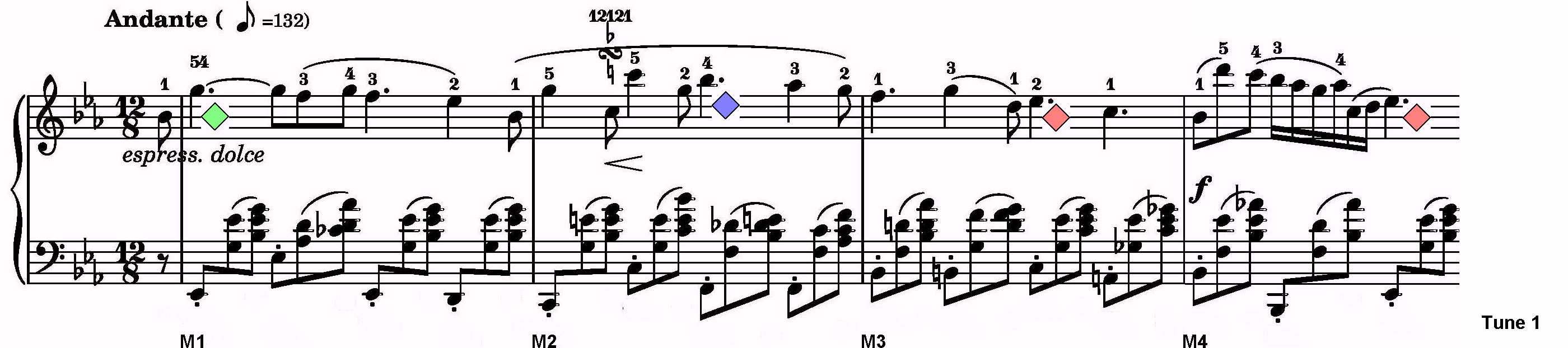
Second version

Third version

Fourth version

In tune passages, single tones follow one another in an uninterrupted flow. Standards of performance require distinct articulation of each tone, often legato — but avoiding clusters of tones or a smear of tones like a glissando. Cantabile rubato is thus needed in measure M16 as there are too many notes for the right hand to articulate at the original tempo. "Too many right-hand notes" means that left-hand notes in the score must be spread out on the page — and in time. Where left-hand notes in the score are spread out on the page, beats must be slowed. A beat in the left hand must be delayed until the right hand has reached a particular tone or cue that triggers the left-hand movement. The same observations apply to M24.
Another kind of rubato distinguishes between beats in the left hand: some are strict and some can be shifted in time. Throughout all four versions of the tune, the left hand is playing a waltz as previously described:
For another example, the first version of the tune is simple and timings of melodic tones are easily synchronized with strict left-hand beats and with little or no rubato. As an exception, the ornament in the second measure (a "turn") inserts four additional notes into the melodic stream — which means either delaying the next oom beat or reaching the next melodic note (C) after that oom beat, contrary to the score. Resolving this problem requires an exercise of freedom.
2. Notated rubato and tutti rubato
Notated changes in tempo such as poco rall., poco ritard. and stretto call for changes in the beat in both hands together. In contrast, in cantabile rubato, tempo changes are different in the two hands. In notated directions for unified changes, the performer exercises freedom as to the extent of the tempo change.
I use the phrase tutti rubato for tempo changes and choices that apply to all voices together. Such tutti rubato also occurs when an orchestra conductor introduces tempo changes that are not directed by the score. As noted above, Berlioz commented on the conducting of Wagner: "like dancing on a slack rope . . . sempre tempo rubato."
In the Nocturne, freedom in choice of tempo is expressly granted to the performer through the direction poco rubato in measure 26 of the Coda, where another turn must be accommodated. Even more freedom is granted by means of senza tempo in measures 32 and 33, where the beats seem to overflow the meter..
3. Interdigitation rubato
In Measure 18 in the Second Interlude (see below), the score directs the pianist to produce four right-hand tones during the first three beats. This appears to be an instance of the "contrametric pattern [that] is common in Polish folk music," noted by Rosenblum above, "in which the four melody notes are written as four quarter notes within the 3/4 meter." Alternating left-hand and right-hand movements require give-and-take timings that I call interdigitation rubato.
|
As shown in the adjacent extract from the score, another example of interdigitation rubato occurs in the Coda, Measure 29, beats 4-6 — three metric beats into which 8 melodic notes are inserted. |
|
4. Unified beats and conversational rubato
In the tune versions discussed above, rubato passages rise out of and return to passages with unified beats,. As shown in extracts from the score below, the identical final measure of the two interludes illustrates unified beats: staccato chords in the right hand are synchronized with similar chords in the left hand. The score directs the performer to play with a slowing tempo (poco rall) that applies to both hands. With the exception of the interdigitation beats discussed above, the Interludes generally manifest unified beats. The closing two measures of the Nocturne also have unified beats..
First Interlude:
Second Interlude
Anchor beats in tunes provide periods of rest for the right hand between flights of virtuoso rubato. In an anchor beat, the right-hand plays a long note from the E Flat Major triad (E♭– G – B♭) while beats in the left hand maintain control, imposing strict tempo. In the First Version of the tune, the first anchor beat occurs at beat 1 of the first measure, a G, marked with a green diamond or ♦ in the extract from the score. Intermediate anchor beats occur at beats 7-9 in the second meaure (♦ for B♭) and, in the third measure, beats 7-9 (♦ for E♭). Intermediate anchor beats extend to following phrases. The final anchor beat occurs at meaure 4, beats 7-9 (again a ♦). The foregoing pattern of anchor tones and beats appears in all versions of the tune.
During anchor beats, the left hand is in control. In tune passages with cantabile rubato, in contrast, the left hand accommodates the right hand. During interdigitation rubato and tutti rubato, the sides coordinate equally. Summing up such observations, I conclude that control moves between the hands in a fluid way that I call conversational rubato.
In repeated cycles of conversational rubato, the right hand takes control and produces a stream of tones that are expressive of feelings while the left hand plays the role of accompanist — but then the right hand relinquishes control to the left and the stream of melody comes to a period of rest for several anchor beats — or it settles into a steady, even pace in an interlude. During climactic cycles, complex and delicate arcs of tones have a fleeting existence. Rubato resembles improvisation — and flights of freedom in rubato passages, like those of improvisation, resolve into feelings of sweet nostalgia.
(...) Index of musical investigations
... sitemap (organized list of prior projects)
... 1. A table organizes diverse bodily practices and activities.... 2. A progressive construction of practices leads to nataraja yoga — in which slow improvised dance movements also generate internal imagery of the whole body performing in a mental theater of bodily awareness.
- ... 3. The construction begins with hatha yoga practices — in which positions, feelings and movements are controlled by conscious mental imagery ("will").
- a. Savasana
b. Yoga nidra (rotation of consciousness)
c. Asanas
d. Prana yoga (controlled breathing)
... 4. Buddhist mindfulness practices detach residential movements of breathing and walking from mental control while maintaining conscious awareness.
... 5. Feldenkrais exercises raise into consciousness certain feelings that improve production of complex movements.
... 6. Qigong and tai chi practices develop diverse repertoires of intentional repetitive movements that are coordinated with conscious breathing.
... 7. In nataraja yoga, the body produces slow fluid movements that are first defined by a formal routine and then improvised in three synchronous cycles: slow deep breathing movements; variable steady pelvic movements; and variable wavy movements of shoulders, arms and hands. Synchronized and improvised movements also appear as internal imagery of the whole body exercising freedom in a mental theater of bodily awareness.
| Activations | Energy Levels | Exemplary Practices, Exercises, etc. | ||
| Stationary | relaxed | savasana (yoga rest position on back on floor) | ||
| stretched | asana yoga (supported positions) | |||
| stressed | asana yoga (progressive positions) | |||
| Steady | stepping | walking on a level surface, prana yoga, Feldenkrais, qigong | ||
| loaded | walking on a sloping surface, vinyasas, metabolic weightlifting | |||
| ranging | walking a circular route on a hillside, qigong programs, sequenced vinyasas (e.g., sun cycle), circuit training of muscle sets | |||
| Saccadic | playing | ball throw and catch, darts, push hands | ||
| working | jogging, running, anabolic bodybuilding, drills of wrestling and judo | |||
| striking | drills of boxing, gongfu, karate; aiming and shooting at stationary targets | |||
| Shimmering | stroking | yoga nidra (rotation of consciousness), mindfulness of breathing and walking, ping pong, shooting at flying targets | ||
| schematic | t'ai chi and karate forms, wilderness trails | |||
| improvisational | wilderness exploration, competitive combat sports, nataraja yoga |
Simple practices are combined to make up a layered construction of movements and bodily feelings, memories and habits that are adapted for a new practice, nataraja yoga, a slow, spontaneous dance combining multiple kinds of movements. The body moves on its own and exercises freedom on its own, under conscious supervision and mental guidance, like that of a parent minding a child who is climbing inside a cage of bars in a playground.
Some listings in the table involve groups of activities. As the chief group, yoga contributes multiple practices to the construction, manifesting progressive levels of energy flow: savasana, yoga nidra, asanas, prana yoga and nataraja yoga. A different group, the Chinese group, includes qigong (also written as chi kung, chi gung, etc.), push-hands (a low force combat sport), tai chi (t'ai chi ch'uan or taijiquan) and gongfu (kung fu – a classic combat sport). Practices in the Chinese group are based on actual movements occurring in actual time – in contrast to traditional hatha yoga practices that are controlled by states of mental imagery.
Three levels of walking outline three levels of steady activations. All levels share a smoothly rolling cycle. They differ in amounts and variations of exertion.
Steady movements and saccadic movements have distinctly different characters and forms of expression, which also often overlap and combine. An ideal steady movement is constant; an ideal saccadic movement starts from rest with a jump. In anticipated investigations, the two kinds of movement have independent origins and are also combined in constructions. Perhaps a saccadic impulse starts a movement that is sustained by a steady follow-up in the initial direction.
Distinctions between steady walking and saccadic jogging (or running) were introduced in part A. In walking, at least one foot is always on the ground; sometimes two feet are on the ground. In jogging, there is never any moment when two feet are on the ground; there is, at most, one foot on the ground. Walking is smooth over a cycle with a wavy character; in jogging, each foot impact is a distinct event and forceful leg thrusts alternate with effortless intervals.
Distinctions appear when fast walking and slow jogging are compared. If a treadmill operates at a constant speed where both gaits are possible and the person switches between them, fast walking requires a stride that is longer in both distance and time between strides — while slow jogging uses a shorter stride.
Similar distinctions are observed in the two different kinds of bodybuilding. Metabolic bodybuilding aims for a slow steady speed that imparts minimal momentum to the weight, requiring a steady application of force over the range of movement, especially at the "sticking point" near the middle of the range of movement where applied force is weakest. Anabolic bodybuilding uses a sudden surge of force at the beginning of a movement that imparts enough momentum to the weight to carry it over the "sticking point." Thus, anabolic bodybuilders work out with larger weights than metabolic bodybuilders, e.g., 60 lb. dumbbells compared to 20 lb. On the other hand, metabolic bodybuilders produce more repetitions of movements in a set, e.g., 20 reps instead of 8 reps for an anabolic bodybuilder.
Metabolic bodybuilding develops stamina and resembles physical labor performed by experienced workers who maintain their bodies without injury while getting the job done on a daily basis. Muscles grow larger in anabolic bodybuilding but there are greater risks of injury and the body requires rest and recuperation for days between workouts.
In shimmering activations, the table itself goes through a change of character. Progression in lower levels is reflected in requirements of muscular energy and coordination complexity from the most relaxed stationary activation to forceful working and striking activations. In shimmering activations, in contrast, increases in mental energy flow are manifest. Two kinds of movement – striking (saccadic) and stroking (shimmering) – include examples with different sizes of forces. A chief distinction between striking and stroking is that stroking movements are sensitive to changing internal imagery or to changing external events while striking practices work best when an external target remains fixed and the body exercises freedom with variable movements. For example, aiming and shooting at a stationary target involves a fixed final point and deliberate adjustments of the body that sharpen its action directed at that point; in contrast, a flying target requires quick adjustment skills and bodily movements that can track exterior events.
Skills of moment-by-moment invention are manifest in practices of improvisation. In the culminating practice in this project – nataraja yoga – improvisation is based on "equipotential postures" and "equipotential movements" that can lead to multiple next movements. Selections of next movements are carried out through unification of multiple synchronous streams of internal bodily feelings, habits and intentions in a body producing movements and exercising freedom.
... Index to part E
The "body-mind" is described by Bob Klein in Movements of Magic: The Spirit of T'ai-Chi-Ch'uan (1980), pp. 5-8 (emphases added).
The [T'ai-Chi] Form, a slow, relaxing series of movements based on animal behavior, is designed to develop calm, peace and gentleness within us.The "self-image" is described by Moshe Feldenkrais in Awareness Through Movement, Health Exercises for Personal Growth (1972). This concept has a large reach for the author, as manifested in the first sentence of the Preface: "We act in accordance with our self-image. This self-image—which, in turn, governs our every act—is conditioned in varying degree by three factors: heritage, education and self-education." In the first chapter ("The Self-Image"), the analysis has a heading The four components of action and a definition:. . .
... the Form is done as slowly and smoothly as clouds drifting in the sky. The muscles learn to tense and relax slowly and smoothly. So slow is the Form that it resembles a slow-motion film of the animal called the slow loris. . .
Many lessons are learned from the smoothness of the Form. While smooth, the movements are not mushy, but crisp and precise. Each movement is clearly finished before proceeding on to the next. Our attention is focused on the present moment.. . .
To concentrate on the present is to trust in the future and in your own power. As a present-minded student, you trust that in the next second you will make the proper movement. You don't have to think about it first. You don't have to check up on yourself. The next second, your inner power will be there to do the right thing, just as it is there this second. This inner intelligence, which we call Body-Mind (BM), does not need the thinking mind to tell it how to do the Form.. . .
Momentum is felt as slow-motion waves flowing through the body. As an arm moves to the right, a wave of momentum slowly spreads through it until, reaching the fingertips, the wave slowly bounces back through the center of the body and perhaps into the opposite leg, which steps out next. Thus, these waves of momentum splash in slow motion from one part of the body through the center and into another part. It is a very sensuous experience.. . .
The Form is an art which the BM can really "sink its teeth into" and thereby exercise its abilities. Motion is the canvas of this art, and the eddies and currents of the waves of momentum are the paints. BM paints a moving internal picture with momentum. Each eddy and current has its own set of qualities, just as each brush-stroke has its own quality and adds a new color to the canvas.
Our self-image consists of four components that are involved in every action: movement, sensation, feeling and thought. The contribution of each of the components to any particular action varies, just as the persons carrying out the action vary, but each component will be present in any action.Feldenkrais' self-image is limited in most persons. "The parts of the body that are easily defined in awareness are those that serve man daily ..."
A complete self-image is a rare and ideal state, as discussed on page 21:
A complete self-image would involve full awareness of all the joints in the skeletal structure as well as the entire surface of the body-at the back, the sides, between the legs, and so on; this is an ideal condition and hence a rare one. We can all demonstrate to ourselves that everything we do is in accordance with the limits of our self image and that the image is no more than a narrow sector of the ideal image.
The theater of bodily awareness generated during nataraja yoga is not a rare state or an ideal state like that of Feldenkrais' complete self-image. Neither does it involve "full awareness" of all body parts. It is, however, repeatedly generated during daily practice sessions and, like Feldenkrais' self-image, it does include whole-body awareness of multiple kinds of movements, sensations and feelings that are occurring together.
With a suitable music background and supervision by the mind, the body maintains three slow, long, matching cycles of synchronous movements: breathing movements, pelvic movements and movements of the shoulders, arms and hands. Then, while the mind continues to control deep breathing, control over the body is released — and improvised movements arise in the pelvis, torso, neck, shoulders, arms and fingers, which often repeat and sometimes change spontaneously into fresh movements. The practice also generates a theater of bodily awareness in which the unified body and image, like a dancer on a stage, moves and feels on its own while the observing mind controls breath cycles and occasionally triggers a change of movements.
... Index to part E
Hatha-Yoga, the "forceful" yoga of bodily transformation ... Perhaps the best-known modern representatives of this type of Yoga are B. K. S. Iyengar (who has trained many Western practitioners), Swami Vishnudevananda, ..."Vishnudevananda teaches:
(Georg Feuerstein, Yoga, the Technology of Ecstasy (1989) at xxi.)
Hatha Yoga gives first attention to the physical body, which is the vehicle of the soul's existence and activity. Purity of the mind is not possible without purity of the body in which it functions and by which it is affected. Through the practice of asanas and pranayama, the mind becomes one-pointed and thus one can progress quickly in concentration and meditation.
(Swami Vishnudevananda, The Complete Illustrated Book of Yoga (1960) at 237.)
a. SavasanaInvestigations start with the most relaxed yoga position, called savasana, or "corpse position." According to B. K. S. Iyengar:
It means relaxation and therefore recuperation.. . .
When savasana is well performed the breath moves like a string holding the pearls of a necklace together. The pearls are the ribs which move slowly, very steadily and reverently, reverent because when one is in the precise state, the body, the breath, the mind and the brain move towards the real self (Atma).... . .
Alignment Savasana is performed lying down full length on the back on a blanket spread on the floor.. . .
First adjust the back of the body. Then adjust the head from the front. ... Then adjust the front of the body, keeping the centre of the eyebrows, the bridge of the nose, chin, sternum, navel and centre of the pubis in line. ... To prevent any tilt of the body keep it straight and level. ... Finally stretch and adjust the back of the neck, so that it is centrally placed on the floor.. . .
Keep the feet together and stretch the outer edges of the heels; then let the feet fall outwards evenly. The big toes should feel weightless and non resistant.. . .
Keep the hands away from the body, forming an angle of fifteen or twenty degrees at the armpits. ... Extend the hands from the wrist to the knuckles, palms facing upwards. Keep the fingers passive and relaxed, with the backs of the middle fingers touching the floor up to the first knuckles.. . .
Unconscious Tensions One may be unaware of tension in the palms, the fingers, the soles of the feet or the toes. Watch for and release this tension when and where it occurs.. . .
Removal of Tensions First learn to relax the back of the body from the trunk to the neck, arms and legs. Next relax the front of the body from the pubis to the throat, where emotional upheavals take place, and then from the neck to the crown of the head. In this way learn to relax the entire body.. . .
Complete serenity of the body is the first requisite, and is the first sign of attaining spiritual tranquility.. . .
The Senses ("the senses are withdrawn inwards") ... Eyes ... Ears ... Tongue ... Skin ... Breathing ... Head ... Brain .... . .
The aim in savasana is to keep the body at rest, the breathing passive, while the mind and intellect are gradually sublimated. ... Then the mind, free from fluctuations, dissolves and merges in the self, like a river in the sea.(B.K. S. Iyengar Light on Pranayama: The Yogic Art of Breathing (1988), selected excerpts from the chapter "Savasana / The Art of Relaxation.")
The practice is set forth as a series of commands from the instructor to the student. For a simple approach here, commands in a text are said to be equivalent to those delivered in person or on a recording. In contrast, traditional yoga practice revolves around a personal relationship in which a student worships and obeys the guru as if they were a god.
Regardless of form of delivery, commands are mentally processed by the student and then sent to the body, which is expected to obey. Thus, we are instructed by Iyengar to: "learn to relax the back of the body ... Next relax the front of the body ... In this way learn to relax the entire body."
The student learns the words of the commands after a few repetitions and sessions. Then the student can practice on their own, internally reciting the commands and directing the body to obey. This activity of mind control can be called "will." It develops into "free will" in subsequent steps. However, such concepts of "will" and "free will" are limited to specific domains where mental control is effective. The concepts can become delusional when attempts are made to expand their use into other domains of actual life, e.g., parent-child relations. A different meaning of "will" is "purposeful self motion of the body that continues regardless of pain and fatigue" as in "the will to survive." Various meanings of "will" get conflated and confused. Freedom is obscured by a connection with the word "will."
During the construction of nataraja yoga, "will" and "free will" are superseded by freedom of the body.
How does the body learn to obey and to relax? This is the Art of Relaxation. The chief answer is that learning comes from doing and from repeated practice. Lying on the back and being instructed to relax has a relaxing effect. The chest collapses a bit while exhaling and there is silent sigh, or perhaps an audible sigh. Slackening of tension is felt. The student notices these responses and has a feeling of satisfaction that they are advancing in the practice of yoga. Perhaps after a few more breaths and mental repetitions of instructions, tensions are felt to subside in the neck and shoulders, another satisfying event.
Iyengar's sequence of commands is based on a kind of verbal map of the body: first align torso – and head; then align legs, then arms and hands. Sequences can be repeated mentally and begin to establish a practice. Imbalances and tensions in body parts are noticed thereby and then energies in such parts rise out of an intermediate level of relaxation and re-position the parts at a more relaxed level.
Perhaps doing it again the next day sets the practice into a groove of relaxation and satisfaction. Repeated practice develops more acute sensitivity of misalignments, imbalances and tensions and greater skills of correction with only slight effort. Day by day, at the appointed time and in the appointed room, the groove grows deeper and steadier. Eventually, the only mental command needed is one to start the practice at such time and in such room - and the body begins to relax on its own. Thereafter, a return to savasana becomes a grounding event in a more highly developed yoga practice.
b. Yoga nidra (rotation of consciousness)Yoga nidra was invented by Swami Satyananda Saraswati in the middle part of the 20th century, as described in his book Yoga Nidra (1998 reprint). Satyananda and Vishnudevananda name Swami Sivananda Saraswati as their guru and Master, respectively. According to Satyananda, Sivananda "guided thousands of his disciples and aspirants all over the world and authored over 200 books."
Yoga nidra is a program of relaxation in which performance of savasana as described above is the first step. With a fully relaxed body, activity is entirely mental. Mental activity is directed by an instructor's voice, typically on a recording. A recorded version by Tim Rowe is available on my website. (www.quadnets.com/yoganidra.mp3)
Satyananda directs the practitioner:
... lie down in shavasana and listen to whatever the voice is instructing. Go on following the instructions mentally. Do not concentrate, do not control your breath, just listen to the instructions and follow them mentally.Aims of yoga nidra are mental relaxation and removal of tension from the personality. Multiple kinds of mental activity are practiced that might be compared to different styles of massage. For such purposes, a practitioner who is following the instructor's commands puts their mind into a "hynogagic state"
in between waking and sleep ... In this state, the mind is exceptionally receptive. ... enables one to receive intuitions from the unconscious mind ... fount of artistic and poetic inspiration ... most creative scientific discoveries ... Wolfgang von Goethe ... Kekule ... Niels Bohr ... Einstein ... the answers to all problems ... opening of the "third eye" ... divine consciousness ... As the [scripture] states: "Therefore, realize with a still mind your own true nature ... This is the real Self, inhering in which one is no longer deluded." (Yoga Nidra at 7-8.)This project is directed towards movements of the practitioner's body, different from the mental approach of Satyananda. A wide-ranging construction incorporates multiple body consciousness practices drawn from diverse sources, along with related bodily feelings and mental imagery. Towards this end, I investigate a particular practice in the yoga nidra program – called "rotation of consciousness" "– and adapt it for my purposes. In later stages of the construction, the mind engages in detached observations and playful interventions that are far from a hypnogagic state.
Satyananda teaches the student how to perform rotation of consciousness:
...there are only three requirements to be fulfilled. (i) remain aware, (ii) listen to the voice, and (iii) move the mind very rapidly according to the instructions. When the instructor says 'right hand thumb,' repeat it mentally, think of the right hand thumb and move on. It is not necessary to visualize the different body parts. You have only to become accustomed to following the same sequence, mentally repeating the names of the different body parts in the same way that a child learns to repeat the letters of the alphabet. (Id. at 80.)A full yoga nidra program includes body relaxation exercises, breathing exercises and image visualizations in addition to rotation of consciousness. The Yoga Nidra book includes four full programs of increasing complexity. In the first full program, the practitioner performs savasana and follows instructions during relaxation exercises. Then the instructor reads the following script:
Rotation of consciousnessWe now begin rotation of consciousness, rotation of awareness by taking a trip through the different parts of the body. As quickly as possible the awareness is to go from part to part. Repeat the part in your mind and simultaneously become aware of that part of the body. Keep yourself alert but do not concentrate too intensely. Become aware of the right hand. pause
(right side)
Right hand thumb, second finger, third finger, fourth finger, fifth finger, palm of the hand, become aware of your palm, back of the hand, the wrist, the lower arm, the elbow, the upper arm, the shoulder, the armpit, the right waist, the right hip, the right thigh, the kneecap, the calf muscle, the ankle, the heel, the sole of the right foot, the top of the foot, the big toe, second toe, third toe, fourth toe, fifth toe...(left side)
Become aware of the left hand thumb, second finger, third finger, fourth finger, fifth finger, palm of the hand, back of the hand, the wrist, the lower arm, the elbow, the upper arm, the shoulder, the armpit, the left waist, the left hip, the left thigh, the kneecap, the calf muscle, the ankle, the heel, the sole of the left foot, the top of the foot, the big toe, second toe, third toe, fourth toe, fifth toe...(back)
Now to the back. Become aware of the right shoulderblade, the left shoulderblade...the right buttock, the left buttock...the spine...the whole back together...(front)
Now go to the top of the head. The top of the head, the forehead, both sides of the head, the right eyebrow, the left eyebrow, the space between the eyebrows, the right eyelid, the left eyelid, the right eye, the left eye, the right ear, the left ear, the right cheek, the left cheek, the nose, the tip of the nose, the upper lip, the lower lip, the chin, the throat, the right chest, the left chest, the middle of the chest, the navel, the abdomen...(major parts)
The whole of the right leg ... the whole of the left leg ... both legs together, pause The whole of the right arm...the whole of the left arm ... both arms together. pause The whole of the back, buttocks, spine, shoulderblades ... the whole of the front, abdomen, chest ... the whole of the back and front ... together ... the whole of the head ... the whole body together ... the whole body together ... the whole body together.(Repeat one or two rounds gradually decreasing speed.)
Please do not sleep ... total awareness ... no sleeping ... no movement, pause
The whole body on the floor, become aware of your body lying on the floor. pause Your body is lying on the floor, see your body lying perfectly still on the floor, in this room. pause Visualize this image in your mind. long pause
One hypothesis is that thinking about a body part is devoid of content when there is no actual bodily feeling, sensation or muscular movement. Contrary to such an hypothesis, my practice of yoga nidra does have content, but it is very subtle and not very relaxing. Notably, my practice is not yoga nidra — I don't like hypnogagic states and recorded instructions irritate me after a few sessions. Accordingly, I have dispensed with instructors and practice yoga nidra on my own, running a script in my own mind and observing my responses. The commands of the instructor become my own commands subject to my timing and my own inventions and variations. Recalling the discussion of "will" in connection with savasana, this might be called "free will" but for lack of actual movements.
In other words, at first the instructor provided the "will" by reading the script and I followed the instructor's will. The instructions were easily learned and I now substitute my own will. I can move my will from finger to finger at a rate I choose and I can change the order of the movements if I choose. For example, I can move the will from fifth finger to fourth finger to third finger, in an order different from instructions. Such movements of will are effortless and can be quick. Different movements are possible at every step and choices are easily changed. In my approach, I presume that multiple possible movements and quick, effortless changes arise from an underlying shimmering condition of a body. I suggest that a body in a shimmering condition is ready to produce any one of a repertoire of movements and to generate related feelings.
A verbal map of the human body was introduced above in the savasana practice. The verbal body map in the rotation of consciousness script is much more detailed. According to Satyananda's book, the verbal body map in his script corresponds to an actual brain map defined in the primary motor cortex in the cerebrum at the top of the head. Neurons in this region send signals directly to the spine for conversion into drive signals for muscles in the spine and limbs.
Satyananda represents the organization of cells and groups of cells in the primary motor cortex by means of a motor homunculus, which is like a doll of a human being with body parts distorted to illustrate the different sizes of cell groups in the primary motor cortex that drive different body parts. Thus, the hands of the doll are huge, compared to its torso, because many more motor nerves control the hands. Supposedly, the order of words in Satyananda's verbal map tracks the order of cell groups in the cortical map, so (on the right side), first comes the thumb, then the second finger, etc., up the arm and down the side, ending up with the toes. The verbal map for the left side repeats the process.
Recent studies refute Satyananda's simple mappings and doll representation. Notwithstanding such shortcomings, his description is roughly congruent with my own experience. After repeated practice sessions on my own, my "feeling" or sense is that, when my mind utters "right hand thumb," my right thumb controllers are alerted or activated to be ready to twitch on command. Then, with the next step, attention shifts to the second finger, which is alerted and activated while the thumb is de-activated. I suggest that the state of higher activation is a readiness condition of the mind that is specifically restricted to a single thumb or finger at a time. And it is this readiness condition that is manifested in a feeling.
In experiments in self-touching in part A of this project (domain of actual life), a right hand fingertip is brought into contact with a left hand fingertip, with visual control in one case (remote) and with eyes closed in the other case (residential). When eyes are used as part of remote control, the primary motor cortex is appropriately organized with other brain parts for such functions.
The construction path in part A began with residential movements and introduced mental controls incrementally as cues, commands and choices. Residential movements were foundational and mental activity was based on those movements. In this part, a very different construction path begins with mental activity and then detaches residential movements in several developmental stages. Consciousness based on mental activity is foundational,
Hence, the rotation of consciousness practice starts with parallel courses of events in the domain of feelings and in cerebral brain structures: a verbal instruction is interpreted to activate a specific body part by means of a small part of the primary motor cortex, giving rise to a specific feeling of readiness. To complete the anatomical course of events, the pyramidal tract collects all the nerves from all the parts of the primary motor cortex and traces their routes in the body and their connections to corresponding motor drive neurons in the spine.
Towards the end of the rotation of consciousness practice, awareness is directed towards "whole" body parts, e.g., "whole of the right leg," and "whole of the left leg." Finally the all-inclusive "whole body together" becomes an object of consciousness. Final instructions are: "Your body is lying on the floor, see your body lying perfectly still on the floor, in this room. pause Visualize this image in your mind."
Recall that in savansana, the practitioner was instructed to "relax the entire body." Similar "whole body" consciousness and imagery is generated in Feldenkrais practices ("self image"), in tai chi practice ("body-mind") and during nataraja yoga.
Throughout rotation of consciousness, all voluntary muscles are subject to the relaxation exercise of savasana and are wholly unready for any movement. Feelings are associated with fingers but hands are immobile and fingertips rest in air, generating null sensations.
Feelings in yoga nidra are entirely cerebral. The culminating exercise is to construct a holistic visual image in the mind. With higher activations, such feelings, restricted to the mind, can serve as a nucleus for forms with additional feelings and actual movements.
Looking at more highly activated examples in actual life, audible instructions for finger movements are provided during an executive's dictation to a touch typist. The typist's body is highly activated, with an erect position maintained by residential movements, which also place the hands and arms in positions that serve as starting points for multiple possible movements that are quickly made, with minimal effort. The typist's mental activity and muscular activity are both based in shimmering conditions. A particular selection in the mind triggers a few selected movements of the body.
Suppose that the typist is also a poet in another part of their life. Verbal images in the mind that move muscles are provided by the will of the dictator in the office; in the private poetry space, however, the will and the words are free. Similar varieties can be observed in various performances of an ideal pianist, sometimes accompanying a chorus, sometimes practicing alone, sometimes practicing trio music with a violinist and a cellist, sometimes composing.
c. AsanasAccording to The Sivananda Companion to Yoga (Foreword by Swami Vishnu Devananda) (1983) at 29:
Asanas are postures to be held, rather than exercises, and are performed slowly and meditatively, combined with deep abdominal breathings. . . .Meditative asanas include cross-legged sitting positions that are suitable for prolonged immobility and breath control exercises discussed below. In other asanas, the practitioner performs stretches, bends, twists and headstands.There are three steps to each asana – coming into the pose, holding it, and coming out of it. . . . The real work of an asana is done while you hold the position – adepts of yoga will remain motionless in a pose for hours at a stretch. Try to keep still while you maintain the pose and breathe slowly and deeply, concentrating your mind. Once you are able to relax in a pose, you can adjust your position to achieve a greater stretch. Always release your body from an asana with as much grace and control as you used to come into it.
According to Vishnudevananda, Illustrated Guide at 51, 56-57:
The main purpose of exercise is to increase the circulation and the intake of oxygen. This can be achieved by simple movements of the spine and various joints of the body, with deep breathing but without violent movement of the muscles. . . .Exercises in this project differ from traditional yoga practices and focus on bodily feelings, along with slight movements ("wobbles"). Exercises involve minimal stretching and exertion. "Less stretch" variations of the forward bend are shown below; the concept and images are from Maxine Tobias & Mary Stewart, Stretch & Relax (1985). The authors trained in Iyengar methods and taught them to teachers, also stating: "We are both rooted in the traditions of our own culture and religion and are not interested in quasi-mysticism or the 'Eastern way of life.' ". . . you can, knowing that it is largely a matter of training, increase your own efficiency for, perhaps, less strenuous tasks we have to do. Moderate and consistent Yogic exercises, aside from making you feel better and relaxed, can help your body to become more adequate for the demands placed upon it. Moreover, a well-trained body helps a great deal to train the mind, which is the main purpose of all Yoga, in order to attain complete freedom and immortality, which is the aim of all religions of the world.
In a "much less stretch" variation (upper left-hand image), the practitioner is supported by a cushion and reduces intensity by looping a strap or belt around the feet. All positions shown are supported, by the floor or by a chair and a wall.
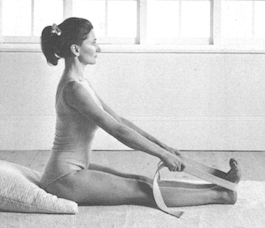
|
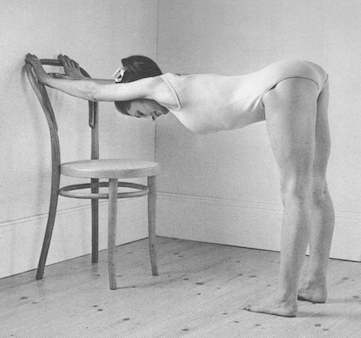
|
A "more stretch" — or progressive — version of the forward bend requires a practitioner to stand erect without support, with legs and feet widely spread, and to touch their fingers to the floor by rotating at the hips and without bending the knees. Additional effort is needed to maintain balance. Some extreme progressive exercises require contorted positions.
Slow cycling of movements and sensitivity to feelings is a recurrent feature in practices in this project, producing exercises of freedom that can be observed in detail. In this case, such movements are under the control of will and include free selections of positions and speeds, within limits and constraints of the practice. The guideline of "minimal feeling" is applicable to other exercises of freedom during which the practitioner detects feelings and thereon changes movements.
For a second exercise, I stand at the end of a bare table with my thighs touching the table top. My height is such that, while standing with my legs nearly perpendicular, like the ideal forward bend position shown above, I can lie down on the table, resting my weight on my belly; and then I can relax my torso on the table without moving my legs. (Books to stand on or using a countertop instead of a table can adapt the exercise for people of different heights.)
As I bend over the table, I use my forearms and hands on surface to help stabilize balance and control movements; I slide my forearms and hands on the table as I lie down, while keeping my back straight.
Starting near the vertical position, weight is carried primarily by my legs and back. Effort is reduced as the forward bend proceeds because weight is borne by my belly and torso resting on the tabletop. At any place in the range of motion, I can take my hands off the table without much additional effort in legs and back.
After lying down on the table, I reverse the movement and raise my torso from horizontal to vertical, keeping my legs immobile, using leg and back muscles, while assisting with hands and arms. The movement can cycle, lying down and rising up, lying down and rising up, etc.
Thus I can maintain rotations around the hip joints, keeping my legs perpendicular to the floor, but with less effort than that required for the standing exercise shown in Stretch & Relax. My movements extend over a range, rather than standing fixed in immobility. I am especially aware of cycles of feelings in my lower back, where the effort and stretch are concentrated.
The third exercise combines features of the first two exercises and also includes more freedom. Support is provided by a bare kitchen countertop. In an ideal final position, the feet are several feet away from the countertop; legs, hips and back are in positions like that in the ideal standing position from Stewart/Tobias; instead of hands pressing against a wall for support, a substantial weight rests on forearms, arranged in a triangle on the countertop with elbows at the edge. Hands are lightly closed in fists, touching in the center and with thumbs up. (I try to avoid sustained weight on palms of hands, as potentially injurious to wrists.)
The initial position of the third exercise is somewhat different from the ideal final position. The legs and feet are much closer to the countertop but still a foot or more away. Legs are perpendicular to the floor and there is some rotation around the hips. Forearms in the shape of a triangle are resting on the countertop with the elbows at the edge; there is slight weight on the forearms. The feeling of forward stretch in the back is slight or even absent.
The initial position is adjustable so as to increase and decrease the feeling of forward stretch in the back. Perhaps I keep feet fixed and press the hips forward towards the countertop, or to draw them back away from the countertop - the legs also sway back and forth. Cycles of pressing forward and drawing back are investigated. These are "whole body" movements of very slight size.
Another cycle of adjustments is produced when the practitioner shifts weight from side to side so that the weight is carried first by the left leg and then by the right leg and then back to the left leg, and so forth. These are "whole body" movements of a slightly larger size.
Another way to increase feelings of stretch in the lower back is to start in the initial position and then to slide or shuffle the feet and pelvis backwards, additionally rotating the hips, so that legs are perpendicular to the floor. The new position can be investigated by cycles of pressing forward and drawing back.
Movements in these exercises are primarily produced around the pelvis; feelings related to hip and pelvic movements combine with those in the lower back. Pelvic feelings and movements are developed later in this construction and combined with breathing movements and upper body movements to make up nataraja yoga.
Other asanas stretch different body parts and can be added to make up a daily program. Stewart/Tobias suggest programs with eight different asanas; other programs call for 20 or more. A program of asanas generates another kind of body-map, with feelings of stretch becoming active and sensitized in different body parts in an orderly succession.
Phenomena of will and free-will discussed above are further developed in the asana practice. I can say that free will causes actual movements and thereby generates bodily feelings, which, in turn, influence will in its decisions. In hatha yoga practices, will and free will are prior to movements and feelings. This approach is from a direction different from the approach in part A that starts with actual life, in which movements, feelings and freedom are prior to mental activity.
d. Prana yoga (controlled breathing)According to Mircea Eliade, Yoga: Immortality and Freedom (1969), shaman practices of breath control began in ancient times in widely scattered societies around the world. He suggests that Hindu yogic breathing practices have been adapted by Chinese Taoists, Islamic mystics and Christian monks of Mt. Athos.
Many claims are made about yogic practices of breath control or prana yoga, e.g., acquisitions of fantastic powers, possession by deities and indefinitely prolonged life. Vishnudevanda and Iyengar start their teachings on prana yoga by invoking an all-powerful "prana" or "energy" that permeates the universe, that is acquired by breathing and that is distributed inside the body through nadis or channels.
Vishnudevananda (407, 248, 326) teaches that nadis are "Physical and astral nerves," that there are "ten nadis (subtle nerve tubes) through which the nerve currents or prana moves" and that the three chief nadis are located in and around the spine.
According to Iyengar, "There are several thousand nadis in the body and most of them start from the areas of the heart and navel." (15) More generally (274):
Nadi A tubular organ of the subtle body through which energy flows. Nadis are ducts or channels which carry air, water, blood, nutrients and other substances throughout the body. They channel cosmic, vital, seminal and other energies as well as sensations, consciousness and spiritual aura.Disregarding excessive language, my experience is that powerful bodily feelings are actually generated during regular prana yoga sessions — and that these feelings might be usefully organized by a concept of prana. Generating and channeling such feelings is a major component of the practices. In this project, however, the focus is on movements and accompanying bodily feelings that are much simpler and more easily produced than flows of cosmic energy.
Breathing movements are made of alternating exhalations and inhalations. During exhalation, lungs are compressed and "used air" is expelled through the nose and/or mouth. During inhalation, lungs are expanded and "fresh air" is drawn in through the nose and/or mouth.
To build a conceptual model of yoga breathing, I presume that, within certain limits that are explored during practice, my free will can control the extent of the movement and the amount of used air expelled during an exhalation. An approximately equal amount of fresh air is drawn in during the next inhalation.
To investigate variations in breathing that are subject to my will, I assume a stationary meditative position and vary the amount of air expelled and also the rate or frequency of cycles. I discover a range of movement: near one end of the range of movement, small amounts of air are expelled during any one exhalation and the rate of such "shallow" breathing is quick. Towards the other end of the range of movement, large amounts of air are expelled during any one exhalation and the rate of such "deep" breathing is slow. Maintaining steady cycles at either end of the range of movement requires both practice and effort, perhaps called an effort of free will. This is a deliberated effort, in contrast to the more willful effort to hold your breath as long as you can until you can't hold it any more.
Such variations of breath in prana yoga are restricted to stationary positions of the body. In contrast, efforts of swimmers in a race are directed towards movements of limbs and their breath movements are maximal as to both speed and depth.
The chief feeling under investigation in prana yoga practices is called air hunger. It is felt as a need to inhale fresh air, expelling used air if necessary. It is felt when swimming underwater or when engaged in muscular work at high altitude. Some people feel air hunger when emotional stresses are high.
Here, the initial goal is to generate feelings of air hunger at a barely detectible level. This goal resembles the goal of minimal feelings of stretch during asanas. In ideal steady breath cycles, air hunger is felt shortly after maximum exhalation and relieved immediately thereafter. The practitioner investigates breath cycles that generate a very slight feeling of air hunger for a very brief moment. This practice sharpens the mind without straining the body.
Exercises of will in basic prana yoga practices involve the slow deep end of the range of movement. In a slow deep breath, different movements are located in the belly, the chest and the shoulders. Thus, the belly moves out and in. During inhalation, the internal muscular diaphragm pulls the lungs down and pushes the belly out. During exhalation, the diaphragm moves upwards. Also the chest expands and compresses; the shoulders move up and down.
Practice leads to separation and articulation of the three kinds of movement: when exhaling, first pull shoulders down, then compress chest and finally push the belly in towards the backbone. During inhalation, reverse the order, first inhaling into the belly, then into the chest and ending up with rising shoulders. In slow, deep breathing, belly breathing takes more than half the time, while chest breathing takes more time than shoulder breathing. An ideal full breath touches extremes of full exhalation, generating a slight feeling of air hunger, and of full inhalation, when belly, chest and shoulders unite in expansive efforts to draw air in.
An analytic approach to prana yoga is supported by introduction of a steady metronomic beat, which is provided by an .mp3 recording available on my website.(quadnets.com/bpm40.mp3 – 6.3 MB) The rate is 40 beats per minute; the length is 7.5 minutes. In later developments in this project, movements according to an external musical beat occur during dance-like practices of nataraja yoga.
The recorded beat serves as a will substitute, reducing the need for efforts of will. I adjust exhalation and inhalation so that they take equal periods according to the number of beats. This may require re-balancing of the breath cycle. The number of beats is adjusted so that minimal air hunger is felt at full exhalation. I have no intention to increase the number of beats in a breathing cycle, although adjustments may bring this about. My efforts are more easily directed at adjustments than at full cycles and timings.
In my practice of prana yoga, feelings of air hunger are felt in the heart. Scientific evidence supports this location as cells that are sensitive to oxygen levels in the blood are located in aortic bodies, adjacent to the blood stream in the aorta as it emerges from the heart. Minimal air hunger is immediately relieved upon the first intake of fresh air; detectors close to the lungs seem more likely to produce such an effect than distant brain locations. The heart is also identified by monks of Mt. Athos as the chief source of feelings in their practices of breath and prayer.
At the start of a practice session, efforts are directed at deepening the breath, using feelings in the belly to measure depth. My conclusion is that my body, left to itself, maintains a constant or residual air hunger that I feel during prana yoga practice. Intentionally driven deep breathing at a fast rate relieves any feeling of residual air hunger and leads to greater sensitivity. After a while, willful intentions are unable to sustain a high rate of deep breathing and the rate slows on its own. Then, the body is ready for steady practice.
When residual air hunger has been eliminated, I can exhale completely without feeling air hunger and then wait a few beats until I become aware of air hunger, which is a mental cue or trigger to start inhaling. The waiting period provides information (feelings) that I use to adjust the number of beats in a full breath.
Practice and training lead to full steady breathing that can be maintained with minimal conscious mental control. To be sure, conscious control is required at full exhalation while waiting for the first twinge of air hunger and than to start the inhalation smoothly so that the lungs reach full capacity after a certain number of beats. Once the inhalation is underway, however, less conscious control is required as practiced movements rise in the belly, pass through the chest and into the shoulders. Thus relieved, mind can recite mantras or visualize. The exhalation is also well-practiced; shoulders, chest and belly smoothly compress as consciousness readies itself for its repetitive duties.
... Index to part E
The result of the innovations was a "seemingly paradoxical position, in which the Buddha opposed both orthodox doctrines and ascetico-contemplative disciplines yet at the same time adopted their premises and techniques. ... The importance of the guru as initiatory master is no less great in Buddhism than in any other Indian soteriology." (Eliade at 163, 166-167.)
Mind continues to control, even while exercising detachment. "In Buddhist doctrine, mind is the starting point, the focal point and also ... the culminating point." (Nyanaponika, below, at 21.)
Among modern forms of Buddhism, the Theraveda tradition ("the Teaching of the Elders") reaches as far back as can be seen; and the guiding texts of Buddha's Discourses on the Foundations of Mindfulness have a strong claim to authenticity. Here, text and commentaries are provided in Nyanaponika Thera's The Heart of Buddhist Meditation (1970 American Edition). The title page names Satipattana as "The Heart of Buddhist Meditation" and provides a subtitle: A Handbook of Mental Training Based on Buddha's Way of Mindfulness. Nyanaponika (1901-1994) mostly lived in Sri Lanka, also known as Lanka or the Isle of Ceylon in his lifetime; his discussion includes similar practices taught in Burma at that time.
The author states (p. 9) that, "... as a general psychological term, [Satipattana] carries the meaning of 'attention' or 'awareness'."
Practices set forth in Nyanaponika's handbook fit into this project. The prana yoga practice discussed at the conclusion of the previous section was preparation for this new practice. In the previous practice, mind and will controlled breathing so that movements were slow and deep. In the Buddhist practice, on the other hand, mental control is detached from movements and mind only observes breathing movements that occur on their own. Breathing movements that occur on their own are shallow and of moderate speed, neither slow nor quick — the body is in the familiar immobile position, consuming minimal oxygen.
The following text is a condensed version of the opening of Buddha's Greater Discourse on the Foundations of Mindfulness, part of Nyanaponika's book:
Thus have I heard. At one time the Blessed One ... addressed the monks ... [and] spoke as follows:Aspects of mindfulness are described by Nyanaponika (24):This is the sole way, monks, for the purification of beings, for the overcoming of sorrow and lamentation, for the destroying of pain and grief, for reaching the right path, for the realization of Nibbana, namely the four Foundations of Mindfulness.
What are the four? Herein (in this teaching)
a monk dwells practising body-contemplation on the body, ardent, clearly comprehending and mindful, having overcome covetousness and grief concerning the world;
he dwells practising feeling-contemplation on feelings, ardent, clearly comprehending and mindful...
he dwells practising mind-contemplation on the mind, ardent, clearly comprehending and mindful...
he dwells practising mind-object-contemplation on mind-objects, ardent, clearly comprehending and mindful...
I. The Contemplation of the Body1. Mindfulness of BreathingAnd how, monks, does a monk dwell practising body-contemplation on the body?
Herein, monks, a monk having gone to the forest, to the foot of a tree, or to an empty place, sits down cross-legged, keeps his body erect and his mindfulness alert. Just mindful he breathes in and mindful he breathes out.
Breathing in a long breath, he knows 'I breathe in a long breath'; breathing out a long breath, he knows 'I breathe out a long breath'; breathing in a short breath, he knows 'I breathe in a short breath'; breathing out a short breath, he knows 'I breathe out a short breath'. 'Conscious of the whole (breath-) body, I shall breathe in', thus he trains himself. 'Conscious of the whole (breath-) body, I shall breathe out', thus he trains himself. 'Calming the bodily function (of breathing), I shall breathe in', thus he trains himself; 'Calming the bodily function (of breathing), I shall breathe out', thus he trains himself.
Mindfulness ... [is] something quite simple and common, and very familiar to us. In its elementary manifestation, known under the term 'attention', it is one of the cardinal functions of consciousness without which there cannot be perception of any object at all. If a sense object exercises a stimulus that is sufficiently strong, attention is roused in its basic form as an initial 'taking notice' of the object ... Because of this, consciousness breaks through the dark stream of subconsciousness ... This function of germinal mindfulness, or initial attention, is still a rather primitive process, but it is of decisive importance, being the first emergence of consciousness from its unconscious subsoil.Further (Id., 30):
Mindfulness in its specific aspect of Bare Attention ... provides the key to the distinctive method of Satipatthana, and accompanies the systematic practice of it ...In his Instructions for the Practice of Mindfulness of Breathing (108), Nyanaponika reiterates aWhat is Bare Attention?
Bare Attention is the clear and single-minded awareness of what actually happens to us and in us, at the successive moments of perception. It is called 'bare' because it attends just to the bare facts of a perception as presented ... attention or mindfulness is kept to a bare registering of the facts observed, without reacting to them by deed, speech or by mental comment which may be one of self-reference (like, dislike, etc), judgement or reflection.
warning not to interfere with the breath in any way: in Buddhist practice, there should be no holding or stopping of the breath, no deliberate deepening nor attempts to force it into a definite time rhythm. The only task here is to follow the natural flow of the breath mindfully and continuously, without a break or without unnoticed break. The point where one should fix one's attention is the nostrils against which the breathing air strikes, and one should not leave that point of observation because here one can easily check the entry and exit of the breath.
In the monk lifestyle, Mindfulness is present throughout the day, often during routine activities.
The initial purpose of this general application of Mindfulness is the strengthening of awareness and concentration to an extent enabling the meditator to follow the unceasing flow of variegated mental and bodily impressions and activities for an increasingly long period, and without a break of attention or without an unnoticed break. It will count as 'uninterrupted mindfulness' if the meditator is not carried away by his stray thoughts and if breaks of attention are noticed at once when they occur, or soon after. (94)Formal practice requires a particular place, a particular seat, a particular posture. An easier exercise than mindfulness of breathing (set forth above) is used to introduce the beginner. Feelings in the abdomen from breathing movements are easier to follow than feelings of air in the nostrils.
Now one turns one's attention to the regular rising and falling movement of the abdomen, resulting from the process of breathing. The attention is directed to the slight sensation of pressure caused by that movement, and not by visually observing it. This forms the primary object [] of mindfulness, in the course of practice described here.I suggest that modifications of a prana yoga practice lead to a practice of mindfulness of abdominal movements. The prana yoga practice discussed above is a practice of mind control where a conscious feeling of air hunger starts a movement of inhalation. An external beat helps mind to control movements. Breaths are as deep and as slow as possible. Belly breathing, chest breathing and shoulder breathing are distinctly articulated.... It should be well understood that one must not think about the movement of the abdomen, but keep to the bare noticing of that physical process, being aware of its regular rise and fall, in all its phases. One should try to retain that awareness without break, or without unnoticed break, for as long a period as possible without strain.
... Though it is the breathing which causes the abdominal movement, the attention directed to the latter must not be regarded as a variety of the Mindfulness of Breathing []. In the practice described here the object of mindfulness is not the breath but just the rise and fall of the abdomen as felt by the slight pressure.
In the Buddhist practice, in contrast, breathing is not controlled by the mind or by a beat. In ordinary life, the body breathes on its own most of the time, but the mind can seize control to a certain extent. A prana yoga practitioner acquires certain skills in controlling breath with mind. In Buddhist practice, the mind is conscious of a capacity for control but does not exercise control. In other words, mind only observes the "slight sensation of pressure" in the abdomen while the body breathes on its own. An immobile body in a meditative position needs only a small amount of fresh air and the small breath pattern reflects that condition. Belly, chest and shoulder movements are not articulated during such a small breath.
A practitioner previously trained in prana yoga might also observe a feeling of air hunger just before the sensation of pressure in the abdomen. Thus, I have an impression of a residual air hunger that is not ordinarily noticed but that is observed during prana yoga practice — and also in mindfulness practices. In mindfulness practice, I have the further impression that breathing patterns of the body tend to remove the residual air hunger in a few minutes, once it has been observed. Some residual mind control apparently remains, even if indirect. This appears also from the Buddhist teaching:
'Calming the bodily function (of breathing), I shall breathe in', thus he trains himself; 'Calming the bodily function (of breathing), I shall breathe out', thus he trains himself.Prana yoga breathing and mindfulness breathing are two distinct practices; it is possible for a practitioner to switch between them through an exercise of mind control. Such a capacity is a new form of freedom of the will. Exercising freedom, will first seizes and then relinquishes control of the breath. When will relinquishes control, the body exercises freedom on its own.
Another practice from the Burmese method teaches that the student may find relief from excessive pain, numbness and tiredness that occurs in sitting meditation by "mindfully walking up and down."
In doing so, one has to be aware of the single phases of each step. ... It is sufficient to notice three (A) or two (B) phases. For fitting into a two-syllable rhythm it is suggested to formulate them as follows: A. 1. lifting, 2. pushing, 3. placing; B. 1. lifting, 2. placing, of the foot. Whenever one wishes to walk somewhat quicker, one may use the twofold division; otherwise the threefold one is preferable as affording a closer sequence of mindfulness, without a gap.With the addition of the practice of walking up and down, mindfulness practices reach beyond the domain of mind control. Movement of the body produces momentum, which means that the movement continues until it is stopped or changed by an external force or by friction. In walking, momentum can be added or subtracted during each step. A series of steps involves a series of adjustments to momentum. These adjustments are produced in the spine as part of the actual movements. They are not produced in the cerebrum. The cerebrum can observe movements and command whole-body movements; but people do not control their walking through mental commands directed at individual steps.In the Discourses of the Buddha we meet a frequently recurring passage, saying: 'By day, and in the first and third watches of the night, he purifies his mind from obstructing thoughts, while walking up and down or sitting'. (Nyanaponika at 96.)
... Index to part E
As with other practices, I borrow and modify features from Feldenkrais for the construction of nataraja yoga. So far in this project, actual movements have been minimal — stationary positions, wobbling, breathing and slow stepping. Feldenkrais exercises have a higher activation but only one step up.
Feldenkrais uses observational methods that resemble Buddhist mindfulness, namely, raising into consciousness images of what he is actually doing while minimizing mental control. He also interprets images by means of concepts of science and technology. An exemplar of his observations is that:
Reversibility is the mark of voluntary movementFeldenkrais discusses standing and sitting and different ways to rise from a chair. (78-83). A desired movement is performed "by moving your hip joints until your seat rises from the chair and you are standing, but without a sudden increase of effort in the legs at any stage of the movement." (83.)If we simply move the hand from right to left and back again, at medium speed, we shall all agree that the movement is satisfactory if it is possible to interrupt and reverse it at any point, to continue it again in the original direction, or to decide to make some altogether different movement instead.
This quality is inherent in the simple type of movement described above even if we do not know it, and it is found in all fully conscious, deliberate movements; we shall refer to it as reversibility. (85-86.)
Light and easy movements are good (title on p. 86.)
When we considered ways of getting up from a chair, we saw that a good deliberate movement is produced when there is no conflict between voluntary control and the body's automatic reaction to gravity, when the two combine and aid each other to perform an action that appears to have been directed by a single center. Voluntary control is usually effective with relatively slow movements ...Qualities of "satisfactory" movements and "good" movements are used to establish goals of development.We saw also that the simple movement of the hand was good without any prior knowledge of what constitutes good movement. Light and easy movements are good ones, as a rule. It is important to learn how to turn strenuous movements into good ones—that is, into movements that are first of all effective but also smooth and easy. (86.)
The more an individual advances his development the greater will be his ease of action, the ease synonymous with harmonious organization of the senses and the muscles. When activity is freed of tension and superfluous effort the resulting ease makes for greater sensitivity and better discrimination, which make for still greater ease in action. He will now be able to identify unnecessary effort even in actions that formerly seemed easy to him. As this sensitivity in action is further refined, it continues to become increasingly delicate up to a certain level. (87.)Sensitivity and delicacy develop without control by the will. "To the extent that ability increases, the need for conscious efforts of the will decreases." (58.)
If you rely mainly on your will power, you will develop your ability to strain and become accustomed to applying an enormous amount of force to actions that can be carried out with much less energy, if it is properly directed and graduated. Both these ways of operating usually achieve their objective, but the former may also cause considerable damage. Force that is not converted into movement does not simply disappear, but is dissipated into damage done to joints, muscles, and other sections of the body used to create the effort. (Id.)General Observations introduce the Lessons in Awareness Through Movement, including:
To understand movement we must feel, not strainTo learn we need time, attention, and discrimination; to discriminate we must sense. This means that in order to learn we must sharpen our powers of sensing, and if we try to do most things by sheer force we shall achieve precisely the opposite of what we need.
. . . In the course of the lessons the reader will find that the exercises suggested are in themselves simple, involving only easy movements. But they are intended to be carried out in such a way that those who do them will discover changes in themselves even after the first lesson.
Sharpened discrimination "A fool cannot feel," said the Hebrew sages. If a man does not feel he cannot sense differences, and of course he will not be able to distinguish between one action and another. Without this ability to differentiate there can be no learning, and certainly no increase in the ability to learn. It is not a simple matter, for the human senses are linked to the stimuli that produce them so that discrimination is finest when the stimulus is smallest.
. . . The exercises here are intended to reduce effort in movement, for in order to recognize small changes in effort, the effort itself must first be reduced. More delicate and improved control of movement is possible only through the increase of sensitivity, through a greater ability to sense differences.
Thinking while acting
In my lessons the student learns to listen to the instructions while he is actually carrying out an exercise and to make the necessary adjustments without stopping the movement itself. In this way he learns to act while he thinks and to think while he acts. This is a step up in the ladder of ability from the man who stops thinking while he does something and stops acting when he wants to think. (An experienced driver can easily carry out instructions while he is driving, while a beginner has difficulty doing this.)
Freeing an action of wasted energy
An efficient machine is one in which all the parts fit together accurately; all are properly oiled, with no grit or dirt between adjacent surfaces; where all the fuel used is turned into kinetic energy up to the thermodynamic limit; and where there is no noise or vibration, that is, no energy is wasted on useless movement that cuts down the effective operating power of the machine. ... The exercises we are about to begin are intended to achieve just this, to gradually eliminate from one's mode of action all superfluous movements, everything that hampers, interferes with, or opposes movement.
As part of this construction, I suggest that Feldenkrais further applies methods of Buddhist mindfulness to certain classes of voluntary movements, chiefly movements that require minimal exertion and that are continuously reversible. Movements in Feldenkrais exercises are slow and smooth, excluding, e.g., sudden forceful movements of combat sports such as judo or karate.
Qualities of movement cultivated in Feldenkrais exercises resemble qualities of habits described by William James and stated in part A of this project:
James concludes that "habit simplifies the movements required to achieve a given result, makes them more accurate and diminishes fatigue" ... Through practice, "habit economize[s] the expense of nervous and muscular energy."On the other hand, Feldenkrais teaches a mindfulness approach contrary to that of habit, where, according to James "habit diminishes the conscious attention with which our acts are performed."
By restricting classes of movements and narrowly directing consciousness, Feldenkrais constructs a domain in which new movements are learned and then occur on their own like habits, all the while being observed from a detached perspective. As before, learning comes from doing and from repeated practice.
For purposes of constructing nataraja yoga, Feldenkrais practices involve coordination of different kinds of movements. First, breathing movements are coordinated with movements based in the spine.
Feldenkrais provides extensive instructions for breathing. Lesson 4 is titled "Differentiation of Parts and Functions in Breathing" and Lesson 12 is titled "Thinking and Breathing." General Observations include:
Breathing rhythm during the exercises"Coordinating breathing and movement" is observed in a movement of arm and hand. (93) "When the movement has been repeated a number of times you will find that it is becoming coordinated with the breathing rhythm." In another exercise: "Let your lungs fill with air as your knees return to the neutral position; breathe out as they sink down, so that each movement is completed in one breathing cycle." (110.)...The speed of the exercise should always be adjusted to the breathing rhythm. As the body gains in organization, breathing will automatically adjust itself to the various movements.
A student lying on the back performs a series of exercises and is instructed:
In order to achieve a degree of accuracy raise the arm just as you begin to expel the air from your lungs. Then raise your leg as you begin to breathe out. Finally, move both arm and leg as you breathe out. This will improve coordination between the two limbs. (95)In preparation for the first actual exercise in Lesson 1, "What is Good Posture?" (76), Feldenkrais notes that an unmoving
pendulum remains at rest in the stable position; it can be moved by the application of a minimum of force applied in any direction other than the vertical. This is equally true for any body in a state of equilibrium. Thus, for instance, a tree that has grown upright will bend its top in whatever direction the wind is blowing. In the same way good upright posture is that from which a minimum muscular effort will move the body with equal ease in any desired direction. This means that in the upright position there must be no muscular effort deriving from voluntary control, regardless of whether this effort is known and deliberate or concealed from the consciousness by habit.The first actual exercise is titled "Swinging while standing."
Stand and try to let your body swing lightly from side to side, as though it were a tree being bent by the wind. Pay attention to the movement of the spine and the head. Continue to make 10 to 15 small and quiet movements like this until you can observe a connection between these movements and your breathing.Perhaps while I perform the exercise, the connection between movement and breathing is that I inhale on a swing to the left and exhale on the next swing to the right and that I continue inhaling while swinging to the left and exhaling while swinging to the right.
It is easy to switch from inhaling while swinging left to inhaling while swinging right. I pause at one end of the range of motion while going through a half-breath.
A possible variation involves a whole breath during each swing, e.g., inhaling while moving from the right to the center and exhaling while moving from the center to the left. In such a variation, the movement tends to pause at the center, in contrast to the initial exercise in which movement is fastest at the center. In other words, when movements and breathing are coordinated, both tend to pause at the same time. It is possible to maintain a smooth movement through such a reversal of breath but I need deep breathing and very slow movements.
I interpret "swinging" in the first exercise to mean "swaying" as a tree bending in the wind, without twisting of the spine. In Feldenkrais Lesson 10 titled "The Movement of the Eyes Organizes the Movement of the Body," exercises use "swinging" to include twisting of the spine. (145-46) These mentally controlled movements require more effort than the mostly residential movements of Lesson 1. Feldenkrais' instructions for Lesson 10 presume substantial experience with previous lessons.
Movement to the right and the left while standingContinuing previous themes, Feldenkrais maintains independent residential controls and remote controls in a variety of ways, including ways that resemble Buddhist mindfulness. As for contrasting features, Buddhist mindfulness is fixed on a single residential object, e.g., breathing, while Feldenkrais also uses mind to start and stop movements that are suited for observation. The emphasis shifts from training of the remote mind to training of the residential body. A new element is introduced, namely, that specific improvements result when movements are also controlled through mental adherence to certain ideal qualities such as reversibility; slow, light & easy; sensitivity, delicacy and feeling; no wasted energy.Stand with your feet slightly apart and swing your body to the right and to the left with your hands hanging limp at your sides. As you swing to the right, your right hand moves to the right behind the back and the left hand moves to the right in front of the body, as though it were trying to overtake the right elbow. As you swing to the left, your left hand moves to the left behind the body, and the right hand moves to the left and overtakes it in front.
Continue the swinging movements of the body and close your eyes. Make sure that the movements of the head are smooth. At each change of direction see what starts to turn back first: the eyes, the head, or the pelvis. Make many such swinging movements, from right to left and back again, until the answer is clear to you and you can observe all your members during the movement without stopping at the beginning or the end of the swing.
Open your eyes and go on swinging as before. Note whether your eyes continue to look toward your nose, as when they were closed, or whether they do something else—and if so, what are they doing? Do they anticipate the movements of the head? Do they skip parts of the horizon of vision?
A new exercise of variable coordination adapts aspects of Feldenkrais exercises — "see what starts to turn back first: the eyes, the head, or the pelvis" during a swinging movement — and develops them into a quality of leading. It also uses a higher level of activation than Feldenkrais exercises which mostly involve stationary positions and movements supported by the floor or a chair. The new exercise acts as a bridge between Feldenkrais exercises and qigong exercises in the next section.
Movements of variable coordination and leading1. Stand upright with feet parallel and a foot or two apart. While facing straight ahead, raise one arm and point straight ahead with the index finger. Look straight ahead, sighting along the index finger. This "pointing straight ahead" position is the "home position" for the exercise.
2. Next, starting from a position of pointing straight ahead, turn the body until the index finger points as far in the backward direction as you can reach comfortably. Let the eyes follow the index finger. While maintaining an erect posture, relax the body so that you can feel twisting in the ankles, feel twisting in the knees, feel twisting in the pelvis, feel twisting in the abdomen, feel twisting in the shoulders and feel twisting in the neck. If you can point directly behind, this is far enough; but any partial twist is sufficient for the exercise if you have lots of feelings. This twisted position is the "stressed position."
3. Practice moving between the home position and the stressed position. Add coordinated breathing. Breathe out as you twist from the home position to the stressed position. Breathe in as you twist from stressed position to the home position. Breathe slow and deep with a full yoga breath. Slow your twisting to synchronize with your breathing. Pause at the end of each twisting movement and relax in the position. Start slowly, as in the prana yoga practice.
4. Next, try different kinds of twisting movements. In each kind, a different body part leads the movement, either the pelvis, the shoulders, the head or the eyes.
Perhaps you introduce a conscious modification in the twisting movement so that the pelvis leads the movement from home position to stressed position. In other words, the pelvis moves first and contributes to movements of the shoulders and neck that are also produced on their own; shoulders and neck muscles produce less force but are partially dragged as they follow the pelvis. The leader has to work harder and the followers don't have to work as hard as when they were independent.
5. With eyes closed, practice leading and following with the pelvis, then with the shoulders and arm and then with the head. All movements are slow, reversible and synchronized with slow, deep breathing.
6. Finally, open the eyes and practice the prior movements first with eyes as followers and then with eyes as leaders.
... Index to part E
There are many systems involving Qigong techniques taught in China. They can be roughly divided into five categories: Taoist, Buddhist, Confucian, medical and martial-arts related.As discussed in § 1 of this project, qigong is part of a group of practices that includes push hands, tai chi and gongfu. In a practical pedagogy, qigong is primary and other practices develop skills first acquired through qigong. Later practices require more powerful activations and more extensive repertoires of movements. As stated in Klein, Movements of Magic at 9: "Chi-Gung is the core of T'ai-chi-Ch'uan."
In all Chinese practices, a central and primal focus is on Qi — which is experienced as a primal and universal source of movements and feelings.
The word qi is used by practitioners of Qigong and the martial arts to mean "internal prana," life force, or biophysic internal energy. ... When Qigong exercises are said to build up Qi, it is this internal Qi that they build up. ... The word gong means "effort" and is used in the word Qigong to indicate the diligent practice of exercises to help Qi to function properly and efficiently within the body. (Kuei & Comee at 7-8.)"The original meaning of the word Qigong is 'breathing exercises.' ... Through Qigong training, you can gain physical and mental benefits by regulating the breath. To do this, you must imagine that when you inhale air, you are actually inhaling essential Qi from Nature." (Id. at 110.)
. . . Another basic principle that all Chinese exercises share is concentration upon the lower abdomen. In Chinese medicine, this area is called the dantian, and is seen as the main storehouse of Qi, the life-force energy that flows throughout the body and maintains health. Qi can be stored up and then used in conjunction with the martial arts, giving greater power to the punches of the master who employs it. (Id. at 17.)
Keui & Comee's exercises "facilitate the free flow of Qi throughout the body and also build up your storehouse of Qi." (Id. at 17.) The diligent student seeks "the correct performance of the movement in conjunction with proper regulation of the breath and the flow of Qi." (Id. at 18.)
A Fledgling Receives Nourishment is an exercise of coordinated arm movements and regulated breathing that is preparatory for nataraja yoga.
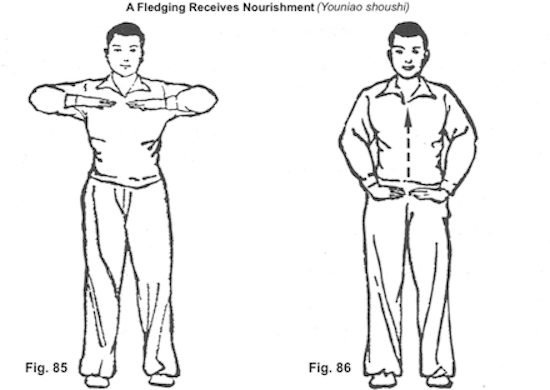
[Preparation]Similarly, in nataraja yoga, a practitioner "should strive to unite your awareness, the movement and breath" during a stream of spontaneous movements.Straighten both legs, and let the arms hang naturally at your sides.
[Movement]
1. While inhaling, raise both elbows as you lift both arms such that the lower arms are almost parallel to the ground, the hands are held in front of the chest about an inch apart, and the palms are facing down (Fig. 85).
2. While exhaling, press down with the palms until the hands come to just slightly below waist level, keeping the hands parallel to the ground and slightly bending the knees (Fig. 86).
When raising the elbows, relax the shoulders and do not let them rise up. Also when doing this exercise, you should strive to unite your awareness, the movement, and the breath. This is a Taoist breathing technique that will help you to utilize the exercise as a method of training to promote the joining of motion and stillness.
Repeat 3-5 times.
A Preparation Pose (Qi shi) is performed at the start of many exercises:
Stand erect with feet about shoulders' width apart. Hold your arms at your side, but raise the hand slightly. [] Relax and drop the shoulders and chest (rounding them), and look straight ahead; keep your mouth closed, with the teeth slightly touching and the tip of the tongue lightly touching the upper palate. Place your attention upon the dantian, or lower abdomen, and gently contract the anal sphincter.Special Breathing Exercises concentrate on internal feelings. "As you exhale through the mouth, imagine your Qi sinking down to the Huyin point (on the perineum, at the base of your torso) ... Then lead the Qi down further, directing it through the thighs, the knees, the ankles and all the way down [to near the toes]." (Id. at 113.)
A beginner's Warming-Up exercise is Pressing Down Your Qi (Ya dantain). (Id. at 24-25.) Breath, Qi and dantian oscillate together in full body movements.
Return to the Preparation Pose. When you have relaxed and calmed the mind, suddenly extend the knees and raise both arms up high so that the palms face each other and the fingers point up to the sky. As you do this, inhale slowly but deeply, completely filling first the lower abdomen and then the chest, and inhaling through the nose. Keep the back as straight as possible, and bend the head so that your looking up. Reach up high, and as you do, allow the heels to come up off the ground slightly. [] While holding this position, allow the stretch on the abdomen to pull the lower abdomen in, and keep your anal sphincter contracted, imagining Qi rising from the toes to the hands and from the base of the spine up to the head. Hold your breath for about 3-5 seconds.Kuei & Comee provide instructions for many other exercises, including Everyday Stretching Qigong ("among the best known in China"), Life-Prolonging Qigong ("restored to its original form and developed by the famous proponent of Qigong, Dr. Wang Ziping") and The Thirteen Grand Preservers ("founded on an ancient system of Taoist breathing exercises ... Dr. Wang Ziping, passed the secret teachings of the form to a few people starting in about 1965"). The final Grand Preserver, titled Brandish a Weapon and Split a Stone is a series of 8 complex movements involving multiple body parts coordinated with 4 inhalations and 4 exhalations. (Id. at 104-109.)Then, as you slowly exhale through the mouth, lower the arms, keeping them bent with the hands placed in front of and to each side of the waist. As you do this, lower the heels back on the ground, bend the knees, and sink into a squatting pose, making sure to keep the back perfectly straight and the head erect. [] As you do this, imagine the Qi being pulled into your body and visualize it sinking down into the dantian, being pressed down by your hands. When all breath has been expelled, stop breathing for 3-5 seconds. Relax the whole body—including the anal sphincter— after you have done this.
Repeat 3-5 times.
One of the Life-Prolonging exercises, A Talkative Man, a Sleeping Dog, is useful to develop coordination of breathing movements and pelvic movements. I see it as a step up in energy level from the swinging exercises of Feldenkrais.
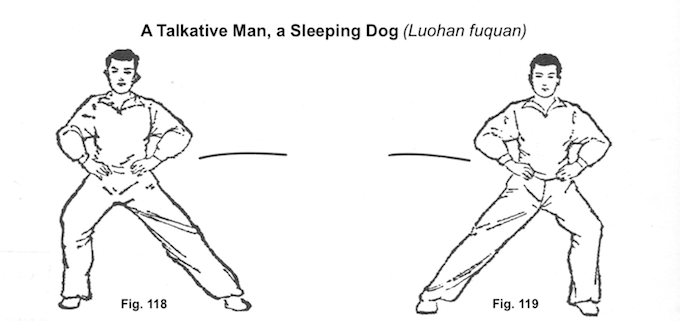
[Preparation]A fluid quality is manifest when qigong exercises develop into tai chi exercises. The Harvard medical school guide to tai chi: 12 weeks to a healthy body, strong heart, and sharp mind (2013) by Peter Wayne, Ph.D. with Mark Fuerst teaches that a cosmic principle of alternating yin and yang appears in flowing movements of animals and human beings. "The yin-yang symbol, now a very popular symbol in the West as well, depicts two complementary polar opposites that, together, create a dynamic, balanced, integrated, and inter-dependent whole."Straighten both legs, face forward, and place your hands on your waist at both sides. This time, stand with the feet about 2 shoulders' width apart.
[Movement]
1. While inhaling, bend the right knee, and keep the left leg straight, shifting your weight to the right (Fig. 118). While exhaling, return to the preparation position.
2. While inhaling, bend the left knee and keep the right leg straight, shifting your weight to the left (Fig. 119). While exhaling, return to the preparation position.
This represents one repetition. Repeat 3-5 times.
A fluid quality is developed by a Pouring Exercise.
The very simple exercise of Pouring, or shifting the body from side to side with awareness, illustrates the connection of cognitive, active ingredients of Tai Chi. They play a key role in all Tai Chi movements and related exercises-heightened body awareness, focused attention and greater integration of mind and body.Step by Step Tai Chi (1994) by Master Lam Kam Chuen with drawings by Gordon Munro teaches 18 "Fundamental Movements," 18 exercises for "Strength and Motion," 8 exercises for "Balance and Movement" and 15 positions and movements that make up a "Small Circle Form" of Tai Chi. A useful example is the Fundamental Movement titled "Painting the Wall." It recalls "Paint the Fence" scenes in the movie The Karate Kid (1984).. . . FOLDING INTENTION INTO TAI CHI POURINGIn the Tai Chi Pouring exercise, once students settle into, become aware of, and make contact with the entire body, I add intention to the awareness. I might enrich or elaborate with various images or simple metaphors.
. . . I suggest sensing body movement more as a pouring, wave-like phenomenon rather than as a solid object changing shape or position. Tai Chi Pouring also exemplifies the genius of Tai Chi, which is that slow, conscious movement (in comparison with stillness) helps you to become aware, sense, and feel what is happening within your body in the present moment. Often, I'll start with a focus on the dynamic sensations in the soles of the feet. "Begin to pour your weight gently from side to side, and notice the sensations in the soles of the feet. As you shift and pour your weight from side to side, tune in to your liquid nature or inner ocean. How juicy do the soles of your feet feel? Does one foot feel juicier than the other does? Is the arch or toe region more sensitive or aware of being bathed by this inner ocean than the heel? Are there parts of your feet where you do not feel any juiciness at all?"After dwelling in the feet for a minute or so, we move to other parts of the body, using the subtle movements generated by Tai Chi Pouring to sense and explore the ankles, knees, hips, abdomen, spine, neck, head, and arms. This initial exercise serves as a kind of scanning or inventorying of the whole body, like an internal roll call.
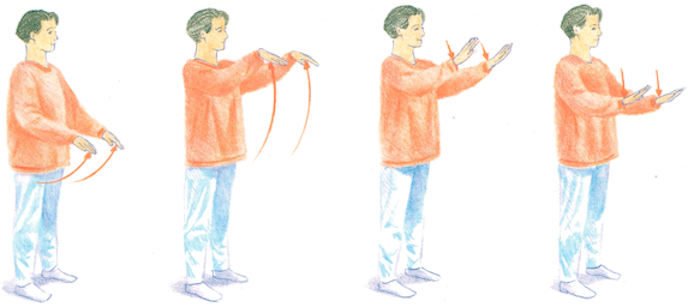
1. Stay in the relaxed standing position with your feet facing forward, shoulder-width apart. Imagine that your hands are paint brushes that are held by your wrists and that your fingers are the bristles of the brushes. Start to raise your hands.2. Raise your hands gently up as if you were painting a wall in front of you with long vertical strokes. Your hands move smoothly, like brushes. Keep your shoulder relaxed as your arms move. As you brush up breathe in gently.
3. The upward stroke is complete when your hands are at head height. Then start to lower your wrists so that your hands are like paint brushes, are tilted upward ready to begin brushing back down.
4. Brush back down the wall, finishing at about waist level. As your arms come down, breathe out. Your fingers and wrists should be as flexible as possible. Complete six raising and lowering movements of the arms. Then stand still for a second or two at the end of the exercise.
1. Breathing exercises are a chief common feature. Ordinary breathing occurs without awareness or conscious control. In Buddhist mindfulness, "Bare Attention is the clear and single-minded awareness" of breath but without conscious control. Prana yoga develops awareness into mental control of breath. Feldenkrais and qigong teach multiple breathing exercises, some that resemble Bare Attention and others that are mentally controlled. In connection with brain anatomy discussed in § 6 of part A (actual life), I attribute awareness to the residential nervous system in the spine, brain stem and cerebellum and suggest that awareness of breathing is due to heightened activity in the residential nervous system. I suggest that breathing originally occurs on its own in the residential system and sometimes appears in awareness, e.g., during heavy breathing after strenuous exertion. We are aware of heavy breathing in such an event but do not try to control it, while the body restores itself to readiness.
I attribute conscious observation and control to the remote nervous system in the cerebrum. I suggest that Bare Attention is a practice of bodily consciousness that observes breathing that occurs in awareness. Functions of consciousness that start and control movements are inoperative during a practice of Bare Attention. When mental controls are imposed, as in prana yoga, awareness of breath becomes an instrument of mind control and is developed for greater sensitivity and versatility.
2. Major classes of movements correspond to levels of activation set forth in Table 1 where four levels of activations are assigned: stationary positioning activations, steady activations, saccadic activations and shimmering activations. Lower activation levels are classified according to stationary, steady and saccadic classes of movements. Mental energy levels are classified according to kinds of freedom, with holistic improvisational freedom at the apex. This project focuses on movements with low bodily energy (stationary and steady) which can be adapted for improvisational nataraja yoga. Qigong exercises extend into saccadic movements, e.g., the instruction to "suddenly extend the knees and raise both arms up high" in Pressing Down Your Qi. Kicking and punching exercises developed in qigong and gongfu are neglected here.
Long-range goals of development include investigations of shimmering activations. Possible means of investigation include continuously wobbly or fluttery movements that can shift in multiple directions and that perform continuing adjustments according to sensations and other inputs. Such movements include techniques of tremolo and vibrato in playing the violin. (Part D, Music practice and performance, § 1.) Some sculptors, painters and writers become obsessive polishers, continually touching up the work. In anticipated investigations into the actual lives of animals (part A), predatory stalking appears to be a likely application for such shimmering movements, e.g., in a watery domain.
At the low-energy end of Table I, movements began with stationary positioning movements of asana yoga. I suggest that the remote nervous system can produce stationary postures according to intention by specifying muscular forces. This suggestion is modeled by Wriggler I, an engineered organism (part C). In contrast, adjustments in stationary postures to relieve stress or fatigue fit into the residential class. A conflict is created when mind imposes a rigid posture and bodily feelings of pain urge relief through relaxation. Moment by moment, the conflict persists and mind prevails — until suddenly things change and collapse occurs.
Steady movements are produced by steady forces in cyclical applications. Steady forces under mental control are chief subjects of practices in this project, appearing in prana yoga, Feldenkrais, qigong and tai chi. Primal applications also include residential movements in animals, e.g., wavy locomotion movements of eels.
Saccadic movements are sudden and tend to concentrate power at the commencement. Saccadic movements include kicks and punches and also common movements of eyes. Some saccadic movements use maximum power. Others, as in Wriggler I, modulate power so that the movement comes to rest at a desired end point.
3. Closely connected to breathing exercises and levels of activation are feelings of energies that flow in the body. Prana is an energy applicable to feelings generated in stationary positions. Qi is applicable to feelings generated during multiple kinds of movement, e.g., gongfu. Anticipated investigations of saccadic movements suggest another kind of energy, which I call Kiai, adapting the name of a yell or shout uttered by a sudden attacker in karate and similar combat sports.
In qigong and tai chi, many exercises mimic natural movements of animals and movements of people who are engaged in common activities of agriculture and labor. Such movement are said to be a source of Qi. It is taught that, prior to mental intervention, human and animal bodies perform optimal movements out of their own nature.
Qigong and tai chi practices develop mental imagery for energy. Instructions for Pressing Down Your Qi (above) include "imagining Qi rising from the toes to the hands and from the base of the spine up to the head" and suggesting that you "imagine the Qi being pulled into your body and visualize it sinking down into the dantian, being pressed down by your hands." The Harvard medical school guide liquefies Qi and folds intention into Tai Chi Pouring, asking "Does one foot feel juicier than the other does? ... Are there parts of your feet where you do not feel any juiciness at all?" The student is instructed to use "the subtle movements generated by Tai Chi Pouring to sense and explore the ankles, knees, hips, abdomen, spine, neck, head, and arms."
4. Stationary practices of qigong and tai chi include crouching stances with variable levels of activation. The lowest level of activation appears in erect stances of Preparation Poses of Kuei & Comee and the "relaxed standing position" of Master Lam's Painting the Wall. Master Lam teaches higher levels of crouching stances, namely, the Wu Chi (wuji) position and the Horse Riding Stance. In moving from an erect stance to a Wu Chi position, the focal movement is: "Slowly bend your knees so that you lower yourself by about 2 inches (5 cm)." (page 42.) The Horse Riding Stance begins in the Wu Chi position. "Gradually bend your knees, lowering your backside as if you were sitting down on a chair. Lower yourself about 4 inches (10 cm). If you cannot go that low to begin with, then gradually work toward that goal." (page 68.) Serious practitioners of Qi development spend long periods of time in a stationary Horse Riding Stance, strengthening muscles of thighs, back and abdomen. Storehouses of Qi are enlarged and filled, ready for action.
Klein writes of The Body as a Spring rooted to the earth through breath. (Movements of Magic at 10-12.)
"Before you can develop internal energy, you must learn to take your breath from the ground—to breathe from the earth. It feels as though the breath is absorbed up from the earth, through the feet and into the body." "A spring is able to absorb and use force by compressing and expanding. ... Rather than being damaged, the spring merely stores the force that hits it, to be released later." "Push Hands ... is the ultimate art of playing with another person's energy. There is very little that can phase a Push Hands player. The T'ai Chi temperament has often been likened to a large ocean wave. It is gentle and soft, but who can stop it?"Thus, with adjustable crouching stances and breathing practices, levels of readiness and internal flows of energy are shifted up and down to adapt to circumstances. Another technique of intensification is taught by instructions in Kuei & Commee to "gently contract the anal sphincter" and to "keep your anal sphincter contracted."
Anal movements and imagery are closely connected in human bodies with anger and aggression; and anal contraction exercises may tend to amplify such tendencies. Some people renounce anger and aggression altogether but many others incorporate in their personalities some readiness to manifest anger and aggression in postures and gestural expressions. Acquisition of skills in adjusting such postures and expressions to momentary circumstances requires substantial practice. Push Hands and competitive sports and games provide means of practice.
... Index to part E
7. In nataraja yoga, the body produces slow fluid movements that are first defined by a formal routine and then improvised in three synchronous cycles: slow deep breathing movements; variable steady pelvic movements; and variable wavy movements of shoulders, arms and hands. Synchronized and improvised movements also appear as internal imagery of the whole body exercising freedom in a mental theater of bodily awareness.
a. nataraja yoga: a conscious dance of freedomb. a tree metaphor
c. improvisation
d. constructing movements of nataraja yoga
e. accompanying music provides structure for a practice session
f. imagery of nataraja yoga
Many people exercise freedom while dancing at parties and in clubs. The body moves spontaneously in response to the beat of the music and the moods of people on the floor. Some people enjoy freedom so much that they dance themselves into exhaustion. The mind may or may not direct dance movements, apparently wandering away from many dancers. Perhaps wandering minds account for the neglect of party dancing in discussions of "free will."
|
In a fully realized dance of nataraja yoga, movements are produced and controlled by multiple means, chiefly, habit, invention and intention. Habits and inventions occur in the body guided by feelings; intentional control is limited to whole-body supervision, maintenance of deep breathing and occasional direction from an observing mind.
Dancing in nataraja yoga resembles performance by a pianist of a work of counterpoint. Multiple lines of movement are produced simultaneously. Each line is distinct; but many shared and overlapping features lead to momentary emphases and adjustments. The dancer becomes absorbed in the practice. Multiple fluid movements are continually changing. Some movements take the lead and others follow; and then the lead is taken over by fresh impulses. |
Siva Nataraja
Lord of the Dance 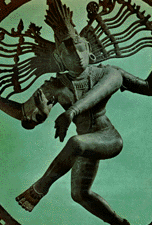
12th century bronze figure [from Hermann Goetz, India: Five Thousand Years of Indian Art (1959).] |
Multiple kinds of movements and imagery are unified through synchronous cycles into imagery of the whole body, including moving parts and momenta. Observed by mind, the whole body and all of its parts unite in a single self that is full of feelings, self awareness and consciousness of the integrity of freedom.
A tree is rooted in the earth and appears above the ground in separate, interacting parts, namely: unitary trunk; splitting into limbs; ramifications into branches; and sprouting of twigs and leaves. Development in this project has followed a similar plan and the construction is arranged in the shape of a tree, suggesting a metaphorical organism. The metaphorical aim of the construction is observation of the leaves of the tree waving collectively in the breezes of freedom.
The ground of such a metaphorical tree is actual life, the foundation of all that grows. Hatha yoga practices, like a tree trunk, provide a solid, unitary first step, defining domains of mind control in which the body obeys instructions. A scale of energy levels starts with savasana. Body parts are organized in maps (yoga nidra) and in practiced stationary positions (asanas). Prana yoga practices of breath control train the body to maintain purposeful movements guided by feelings.
Distinctions appear during practice of Buddhist mindfulness, where the mind ceases to control the body and is detached from movements of the body. Breathing movements revert to the uncontrolled mode. Uncontrolled breath movements are naturally minimized by the body, in contrast to controlled breathing with exertion.
In the construction, a split occurs between mind control practices of yoga and mindfulness practices of Buddhism: the former is mind-centered and the latter is body centered. There are now two kinds of practices. Nataraja yoga adapts and combines features of both kinds of practices, with mind controlling some movements and detaching from others (which then occur on their own).
Additional complexity occurs when Feldenkrais exercises are added to the construction. Movements of legs, pelvis, abdomen, chest, arms, hands, neck and eyes are like different branches of a tree that also move together. Breathing movements remain fundamental and are coordinated with skeletal movements. The practitioner produces and brings into consciousness qualities of movement (e.g., easy, light, reversible) that guide further development. Investigations lead to a quality of leading that organizes complex coordinated movements.
In the final level of the metaphor, qigong and tai chi practices, like twigs and leaves, grow in all possible directions, with details that adapt to circumstances, yielding under cultivation a multitude of exercises and a vast repertoire of energy conversions.
As discussed above, Feldenkrais stated that a "good upright posture is that from which a minimum muscular effort will move the body with equal ease in any desired direction." Qigong and tai chi exercises develop such a capacity for free and easy movements. Invoking concepts of energy, I introduce a definition: movements that can be produced in such an ideal posture make up a repertoire that is equipotential in the sense that the body can produce any movement in the repertoire with ease. The body is ready to make any such movement.
An equipotential posture is a basis for improvisation, especially if the body can easily return to an equipotential posture at the end of each movement. The body selects easy movements from the repertoire, first moving in one way and then moving in another way and so forth. For example, successive musical tones produced by a practiced singer or instrumentalist are easily made; they connect to each other, creating phrases of melody in a song. Movements of musicians improvising variations in melodies suggest other kinds of improvised movements.
Here, the practitioner starts with floor exercises on hands and knees and attains an equipotential posture that enables the pelvis to move with freedom in multiple ways, e.g., side-to-side, back-and-forth and in circles. Movements are slow and easy. In this posture, improvisation is simple to produce and observe.
I start with traditional yoga postures. Other paths of development – e.g., vinyasas and vinyasa flow – also start with such postures. Many vinyasa practitioners explore improvisation. However, vinyasa movements require athletic abilities and stamina that are unnecessary for nataraja yoga and an easier path is taken here.
Development begins with the fact that important traditional yoga postures are not equipotential. Rather, a yoga practitioner relaxes into a traditional posture; effort is required in many cases to move out of the traditional posture and attain an equipotential posture where multiple movements are possible. An example is the child's pose shown below. The focus is different here and readiness replaces relaxation, requiring a higher level of activation. Readiness in nataraja yoga resembles that of qigong exercises and tai chi exercises.
The images below are copied from pocketyoga.com, which provides apps and teaching for yoga practitioners. They show traditional yoga poses that will be modified for purposes of this construction and developed into an easy and mobile equipotential posture that has large repertoires of possible movements. The pocketyoga site provides detailed instructions for performing the poses below.
The tabletop pose is the most mobile of the poses shown and is the starting point for modifications that lead to the desired equipotential posture. Initial repertoiresof movement based in this pose include (1) side-to-side tilting (stiff limbs, knees alternately lifting, pelvis tilting so one hip goes up); (2) side-to-side shifting (weight is on both knees and the pelvis moves parallel to the floor); and (3) sitting (the pelvis moves towards and/or away from the feet). Hands and knees move no more than slightly during these movements.
I avoid stresses on my wrists and modify the tabletop pose by forming my hands into fists, lightly closed and distributing weight over large finger bones, with arms and hands held straight so that forces run from my shoulders through arms, wrists, stiff hands and finger bones to a cushiony mat without twisting or bending. I adjust my pelvis to reduce the weight on the hands.
Cushions or pillows under my shins is another technique for stress reduction. Weight is distributed over the whole lower leg rather than concentrating at the knee and the foot. The foot dangles down at the back of the cushion.
Tabletop Pose
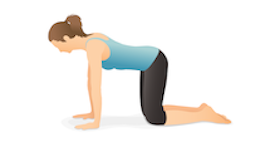
|
Sphinx Pose
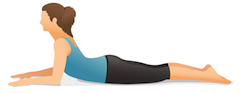
|
Extended Puppy Pose
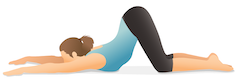
|
Child's Pose

|
The cushioned back half of the body and the lowered front half of the body lead to a back bend. An extreme back bend is shown in the extended puppy pose. The desired equipotential posture is easier than the extended puppy pose; the pelvis is pulled back so that the upper half of the body and the arms are nearly mobile. Also, the elbows are pulled in closer to the torso so that the hands and forearms can be pressed against the floor and provide light and controlling forces.
The purpose of an equipotential posture is to maintain a large repertoire of slow, easy movements. Experiments with arm placement, etc. will lead to such a posture. As with other practices, regular sessions, sensitivity and diligence lead to progress in feeling, expanding and controlling the repertoire of movements.
Another method of development uses imagery. Imagine that an idealized goal of the exercise is to produce movements of the pelvis that resemble those of a hawk or airplane pilot exploring a terrain by flying over it in various patterns, e.g., up and down, right and left, clockwise and counter-clockwise, diving and soaring and maybe also twisting and bending. Many movements and variations are possible.
For development of imagery, feelings of the pelvis are brought into consciousness, especially feelings of pelvic parts that are at the highest elevation in this exercise, feelings that are based in the buttocks and that are called the butt. Slow large movements help to objectify feelings of the butt; a mental image moves with the butt, following and observing repetitive movements. Or images lead movements of the butt according to a free will based in the cerebrum, with its list of up and down, right and left, etc. First circle clockwise and then circle counter-clockwise.
Let breath movements lead butt movements. Slow large movements and slow deep breathing have been practiced in previous exercises, showing that conscious deep breathing easily synchronizes with slow repetitive movements. Use the beginning of inhalation as a trigger to start movement of the butt and likewise for the beginning of exhalation. Slow the butt's movements so that exhalation and inhalation are complete before the butt comes to rest.
Position the butt at the point of highest elevation, called "the peak." With the butt at the peak, inhale fully. Then, as exhalation starts, push the butt delicately towards the left, still at high elevation. Reach the extreme point of the motion at the same time as exhalation is complete. Smoothly reverse, returning the butt to the peak as inhalation finishes. Then mirror the movements to the right. Practice deep breathing in coordination with various slow movements in the repertoire.
The butt is not the only moving body part. Consciousness can expand to include the whole body and all of its parts, from delicate but controlling movements of the hands, forearms and lower legs, through the torso and on up to the butt.
For purposes of improvisation, I use a musical accompaniment. A current favorite is the slow movement from Bach's Violin Concerto No. 1 in A minor. After many practice sessions, the butt knows the beat in this music and moves on its own. Long musical phrases take many beats; slow butt movements imitate the phrases; matching is not forced and the butt follows its own phrasings. Movements wander through the repertoire perhaps with occasional reminders from a list in the mind.
While inhaling, bend the right knee, and keep the left leg straight, shifting your weight to the right. While exhaling, return to the preparation position.I modify the Man/Dog form into a primal elemental movement of nataraja yoga. It becomes an equipotential movement that extends the concept of equipotential posture introduced above. An equipotential movement can be shaped and developed into multiple variations that change easily into each another.Next, produce a mirror movement to the left.
For example, the Man/Dog exercise coordinates breath and movement with a form that states: "inhale while moving away from center, exhale while returning to center." It is easy to change the form. Stop the movement at an extreme position, exhale without moving; then inhale while returning to center. The form is now: "exhale while moving away from center, inhale while returning to center."
To start my practice, I stand near a table that I can hold on to for support if needed. In a simple preparation pose, I practice deep breathing and relieve residual air hunger. Soon breathing slows and air hunger is only barely discernible. To heighten the energy activation, I introduce crouching, lowering the dantian while exhaling and lifting the dantian while inhaling.
Then I change over to performance of a modified Man/Dog. Slow skeletal movements synchronized with deep breathing movements help to sustain bodily feelings and raise them into consciousness.
The Man/Dog stance is narrowed for modified movements. To set the new stance, I stand on my right leg so that nearly all the weight is carried by the right leg; the right thigh, knee and foot pretty much line up perpendicular to the floor. In the modified position, the left foot remains parallel to the right foot and rests lightly on the floor; it is barely mobile — or can be made mobile by a slight shift of weight. The feet thus define the stance (subject to adjustments).
In a mirroring movement, when I pass through the centered position and then stand on my left leg, the right foot becomes almost or barely mobile. The feet stay on the floor during cyclical movements while the body shifts from standing on one leg to standing on the other leg.
With a narrow stance, an outward movement need not stop when the weighted leg is perpendicular; the hip can press further out while the body bends and the torso tilts towards the center. Extended hip movements are a source of variations.
The mobility of the un-weighted foot is another source of variations, allowing for foot rotations and for stepping to one side or forward or back. During Man/Dog movements, the pelvis faces directly ahead; twisting is another source of variations. While standing on the right leg, a practitioner easily twists the pelvis through an angular range, especially with support from the left foot resting on a rotating heel and, perhaps, from a hand on the table. More complex patterns alternate and combine Man/Dog shifting movements and twisting movements. Following the general principle, a breath cycle should be coordinated with a movement cycle.
A different variation adds crouching to the position at the center of the Man/Dog cycle; both knees are bent to a variable extent that generates noticeable sensation but that is also easily maintained. Positions at the end of the range of movements continue to have one straight knee. The dantian is lower in the center and higher at the ends of a full movement. During the movement, Qi moves up and down.
Coordinated "vertical" movements of breath and arms/hands are practiced in the qigong exercise A Fledgling Receives Nourishment discussed in § 6. I start with the traditional form and then vary it by gradually deepening my breath and extending the upward hand movements until the arms reach towards the ceiling and fingertips are touching each other at the maximum elevation. During exhalation movements, I slowly return my hands to my sides and to the original preparation pose. Exhalation movements of arms and hands are easily varied, perhaps dropping close together near the torso, perhaps reaching maximum distances from the torso on either side with sweeping outward arm movements.
Other vertical movements are practiced in Painting the Wall, discussed in § 6. It is easy to interweave movements from the two kinds of vertical movements. The conclusion of a downward movement is carried through to the beginning of an upward movement even if the upward movement is different. A playful mind can construct a variety of patterns of different vertical movements.
In the following two exercises from the book by Master Lam and artist Gordon Munro, the hands hold to equipotential positions and to "horizontal" equipotential movements. It is very easy to shift from one set of horizontal movements to the other, to reverse movements and to combine pieces of different movements to construct a variety of patterns.
Combining pieces of vertical movements and pieces of horizontal movements leads to more variations.
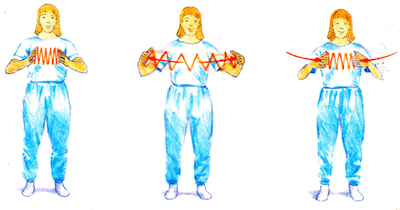
1. [Preparation.] Raise your hands gently up in front of your chest as if you were about to start playing the accordion.2. Move your arms gently outward as if you were opening the bellows of an accordion. Breathe in as you do this.
3. Bring your arms gently back in as if you were closing the bellow. Breathe out as you do this. . . .
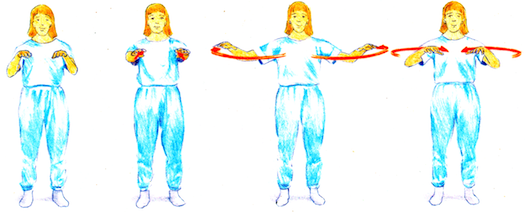
1. [Preparation.] Raise your hands gently up to chest height as if you were about to begin to swim using the breast stroke. Breathe in.2. Extend your arms forward as if you were moving ahead in the water. Keep your movement very smooth and calm. As your arms move forward, breathe out.
3. As in the breast stroke, your arms move apart from each other after they extend forward.
4. Complete the breast stroke movement by bringing both hands back toward your chest in gentle circles. Breathe in . . .
In nataraja yoga, the first practice is breath and pelvic movements; the second practice is breath and arm movements. Fitting together is achieved by means of synchronous movements led by breathing. The mind supervises the breath and the pelvis and arms follow along in habitual ways, at least prior to improvisation. Unity of movement is achieved by the unified body/mind.
My practice begins with habitual movements that combine deep breathing movements under mental control, modified Man/Dog movements and full-range Fledgling movements with outward sweeping arm movements on exhalation. In the next stage, arms and hands maintain steady Fledgling movements, which follow leading breath movements. Mind progressively detaches from pelvic movements; the pelvis exercise freedom on its own with improvisations such as those previously described and is then constrained by the leading breath.
Next, arms and hands exercise freedom. Pelvic movements return to the modified Man/Dog form. Mind gradually detaches from arm movements while maintaining supervisory control over cycling breath movements and pelvic movements. Perhaps arms move horizontally with frequent changes and combinations; perhaps vertical movements and circling movements are introduced. Perhaps arms and hands flutter to the sides. Additional movements can be learned from books and teachers. Personal invention can find something new.
Finally, all three movements participate in equal shares. To start, deep breathing movements set the slow pace and provide clear endpoints for synchronization of movements. Pelvic movements start with modified Man/Dog movements but are ready for multiple kinds of improvisation. Pelvic movements are smooth and steady, repetitively shifting from one side to the other, perhaps guided by feelings of Tai Chi pouring discussed above.
Movements of arms and hands start by waving up and down, or back and forth, or horizontally or in circles. Soon they follow the beat set by breath and pelvis. As movements repeat, variations appear spontaneously. Impulses arise in the pelvis and reach to the fingertips. A heightened energy activation sustains an initial impulse and carries it to the limit of a range of motion. A reversed movement allows for repetition or for another variation. Movements continue moment-to-moment and breath-by-breath. Mind progressively detaches and the whole body and all of its parts move together in a unified exercise of freedom.
Musical beats are incorporated in later stages of the session; and particular music is used to define three stages and their distinct characters. Here, the music is Rag Madhuvanti by Shivkumar Sharma on santur and Zakir Hussain on tabla, Nimbus Records NI 5110 (1988), discussed in § 5 of part D (Music Practice and Performance). The santur is a percussive string instrument in the class of box zithers; tone-producing strings resemble those in a piano or harpsichord and the performer strikes them with small handheld metal hammers. Shivkumar's music, expressed in the improvisatory Raga form, has great speed and fluidity.
In the first stage of Rag Madhuvanti, the santur performs solo, with a background of tambura drones that define the harmonic scale. The santur performs without a beat for the first 6' 30". Correspondingly, the first stage of the nataraja yoga session involves the progressive incorporation, under mental control, of deep breathing movements, pelvic movements and arm movements (which include movements produced by torso, shoulders, arms, hands and fingers).
At 6' 30", the santur begins to produce a beat, starting the second stage of the practice session and initiating a process of progressive detachment of mind from movements. The butt quickly picks up the beat and begins to move on its own in various ways that are detached from the mind. Perhaps the butt wants to party; however, intentional leading with the breath restrains butt movements while improvised movements take over the brachial domain. Then, improvised movements spread to both butt and brachial domains, while mental control continues to monitor and deepen breathing movements, which slow down the other movements. Finally, mental control monitors and occasionally touches all three kinds of movements while habit and improvisation exercise freedom of the body.
The tabla (drummer) appears in the third stage of the raga, entering at 14' 50". The tabla often controls the beat thereafter. Perhaps butt movements follow the tabla beat and brachial movements follow the santur. New bodily movements appear spontaneously and then repeat a few times before being replaced. Sometimes mind suggests replacements or modifications of movements (e.g,, "add some pelvic twisting"). Occasionally, tabla and santur trade the lead back and forth; and then butt and arms make similar trades.
Nataraja yoga combines movements that have origins in various practices and that have been modified and adapted for new purposes. Diverse kinds of movement are unified in a dance of the whole body. Different kinds of imagery are also unified. Unification of imagery occurs in a central nervous system that is absorbed in producing multiple kinds of bodily movements, all synchronized around a breath cycle. The conscious effort to slow and synchronize movements sharpens awareness and adds a layer of objectification.
Images appearing at the lowest levels of the construction are sharpened during the practice of savasana. Parts of the stationary body become objects of consciousness that the practitioner aligns according to a form set forth in words. Bodily tensions also become objects of consciousness and are released when so noticed. Following instructions, relaxation of tension extends over the front of the body, the back of the body and the entire body. Acquiring the art of relaxation, the body follows instructions from the mind and then relaxes on its own. A savasana practitioner aims for serenity and tranquility, quieting also the mind.
Imagery of body parts is more sharply articulated during the practice of yoga nidra. Although the body maintains a whole-body condition of relaxation, a mental focus shifts from one body part to another body part, carrying a readiness for movement that first attaches to a body part and is then released when the mental focus shifts. Two kinds of practice investigate concepts of will. In traditional yoga nidra, the instructor's will shifts the mental focus while the practitioner's will enters into a passive hynogagic state. In a practice adapted for nataraja yoga, the practitioner's will becomes active, turns off the instructor and carries out the mental shifting on its own, repeating the sequence of shifts taught by the instructor or improvising.
Asanas generate actual bodily feelings. Feelings appear to be secondary in traditional asana practice while the arrangement of body parts is primary. In the asana practice modified for nataraja yoga, slight feelings of stretch are of central importance while bending is adjusted to control the feelings. Increasingly, this project focuses on bodily feelings. Another departure from traditional asanas is the introduction of small movements around a position, called "wobbles." Intentional wobbles are based on feelings and are used to further investigate "free will."
Movements and feelings of breath make up the next level. Skills of breath control developed in prana yoga apply to all practices and are of central importance in nataraja yoga. Prana yoga practice in this project revolves around a feeling of air hunger, which arises during each breath cycle as a cue for a fresh inhalation. Mind is continually required to attend to air hunger. A more general intention is to deepen and slow the breath cycle, aiming for a full breath in three distinct stages (belly, chest and shoulders). A concept of prana suggests an energy that is moving through the spine and the body; and feelings of moving energy guide the practice
Buddhist mindfulness practice opens up a new perspective. Activity of mind is restricted to observing uncontrolled breathing movements and walking movements, which occur through material processes and habits. Mind detaches from movements of breathing and walking that occur on their own.
Feldenkrais exercises investigate certain bodily movements with observational methods similar to those of Buddhist mindfulness but adapted to mechanical and thermodynamic principles of efficiency and smoothness. Investigations focus on slow and reversible movements of skeletal muscles coordinated with breath. Training revolves around development of sensitivity of feeling and delicacy in action. During an advanced exercise of self-image with eyes closed, "you can observe all your members during the movement without stopping at the beginning or the end of the swing." A concept of leading is developed for variable control of complex movements involving many body parts. Such movements are easily changed; and variations are explored by changing the body part that is leading a coordinated movement.
Repertoires of movements expand enormously when qigong exercises are added to the construction. Various practices aim for disparate religious, medical or martial-arts applications. Imagery is based on flows and stores of Qi, e.g., storing Qi in the dantian. Tai chi practices introduce a concept of pouring that connects successive movements, an advance from the repetitive form of qigong exercises. Other practices based on Qi (push hands and gongfu) provide useful perspectives although outside the present domain of investigation.
Thus, movements in nataraja yoga carry with them clouds of imagery with multiple layers that can be distinguished by the detached mind and that include feelings arising from body parts and their movements, feelings associated with energy flows, the grooves of habits, intentions, readiness, mental control, mental forms and holistic experiencing. Different sources of imagery have variable influences on movements that change spontaneously every few cycles. The resulting imagery is unique and non-reproducible.
Slow controlled breath movements lead and synchronize spontaneous pelvic and arm movements in whole-body flows. Muscular movements carry clouds of imagery that merge with movements into a single flow.
Each of the practices investigated in this project has overall goals and aims, such as release from the cycle of re-births, relief from bodily tension, mental serenity, better health, personal growth, stronger body, stronger mind or more fighting power. Goals and aims of this project are to investigate exercises of freedom in practices of bodily consciousness. I suggest that nataraja yoga manifests freedom of a person moving with a fully integrated body and mind.
... sitemap (organized list of prior projects)