An Ear for Pythagorean Harmonics:
Brain Models Built From Timing Devices

"Timing devices" is a new approach to brain science, based on a new technology.

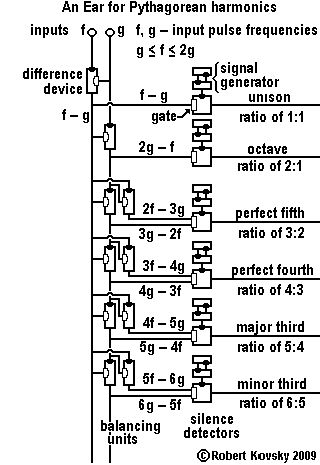
An Ear for Pythagorean harmonics is a device design that shows how timing devices can model brains and imitate brain functions. The design for the Ear is shown in the adjacent image and explained on this page.

In operation, the Ear detects when two input signals f and g, "pure tones" musically, are in a relationship that is known as a "Pythagorean harmonic" (octave, perfect fifth, major third, etc.). As a result, a signal appears on the output line bearing the name of the harmonic. A frequency combination shown on an internal line, e.g., 3g – 2f, is operative when the relationship is close to the associated Pythagorean harmonic, e.g., close to 3g – 2f = 0 or f = (3/2) g, which is the "perfect fifth" relationship.

The timing devices system has many resemblances to "standard electronic circuits" built from resistances, capacitances, transistors, etc. In both technologies, components belong to a "kit of parts" and are assembled to perform specific functions. However, timing device components are different from standard electronic circuit components and the signals are also different.

Timing devices also resemble neurons. Timing device signals are like the signals that travel on nerves -- a stream of "spikes" or "action potentials," which are instantaneous packets of energy -- called "pulses" in the timing devices system.


The complete Timing Devices paper is available for download, a .pdf file, 460 kB. Another web page presents the Abstract of the paper and the listing of Contents.

"Ears for Pythagorean Harmonics Used to Investigate a Procrustean Group of Harmonies (2010)" is the most recent development. (link). The design for the Ear that is described here goes through further developments and more advanced uses.

This page offers a reduced and simplified presentation of the Ear and the timing devices system. Some text materials and numbered figures are copied from the paper.


Contents of this page:

...  Signals in Timing Device Systems
...  Timing Device Components and Units Used in the Ear for Pythagorean harmonics
...  Primal Timing Device
...  Signal Generator
...  Gate Timing Device
...  Silence Detector
...  Difference Device
...  Balancing Unit
...  The Pythagorean Harmonics and Operations of the Ear

...  Author

...  Links to Related Works by the Author

Your comments and suggestions are welcome.
Please write to the adjacent email address (shown in an image to minimize spam).


Copyright © 2009 Robert Kovsky


Signals in Timing Device Systems

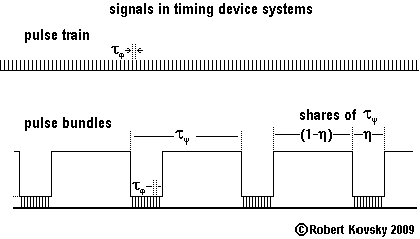
Signals in timing device systems are made up of pulses and pulse patterns. There are also "periods between pulses," where a period is the amount of time from one pulse to the next.

A "pulse" is an idealized version of an "action potential" or "neuronal spike" seen in nerve cells.

The two chief types of signals in timing device systems are shown in the adjacent image: uniform pulse train and pulse bundles.

Pulse bundles resemble "bursts of action potentials" seen in nerves.

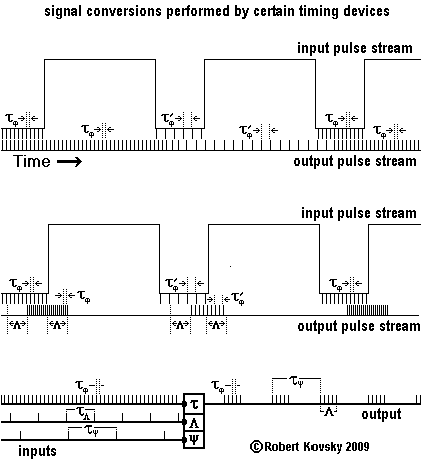
Some timing devices operate with pulse trains and other timing devices operate with pulse bundles. Certain timing devices convert signals from one form to another. The adjacent image shows three examples of conversion. The top two images show inputs and outputs of two kinds of "streaming devices" and the bottom image shows inputs and output of a "pulse bundle generator." (Please see Figures 26, 28 and 29, respectively, in the technical Timing Devices paper.)
Return to contents.


Timing Device Components and Units Used in the Ear

Primal Timing Device

The "primal timing device" models a very simple brain cell (neuron) and is the point of origin for development of more complex timing devices. Operations of the primal timing device are minimal. The arrival of a pulse at the primal timing device starts a process that leads to the discharge of a pulse from the primal timing device, after a period of time. After discharing the pulse, the primal timing device is unresponsive for another period of time.

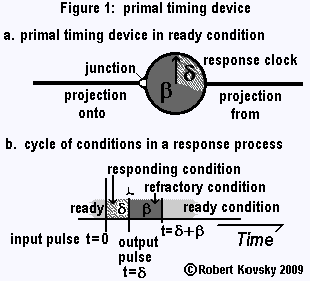
The primal timing device has a "response clock" that is like a stopwatch used in sports contests, shown in Figure 1.a as a circular clock dial. Two projections connect the primal timing device to other timing devices and a junction connects the "projection onto" to the response clock. A pulse arriving at the junction through the projection onto starts the "response process," which runs through a cycle of conditions, during which the primal timing device discharges a pulse through the "projection from."

As shown in Fig. 1.b, a primal timing device has a "ready condition," a "responding condition" and a "refractory condition." The device responds to an arriving input pulse only when it is in the ready condition. Suppose an input pulse reaches a ready device at time t = 0, initiating the response process. The response clock starts and the device enters into the responding condition. At t = δ, the device discharges an output pulse through the projection from; and the device enters into the refractory condition, which continues until t = δ + β, when the device enters into the ready condition, completing the response process.

Return to contents.


Signal Generator

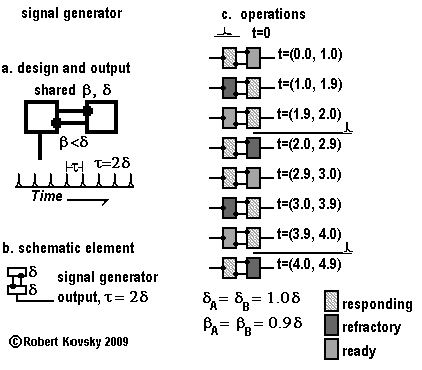
Two inter-connected primal timing devices function as a signal generator, as shown in the adjacent images. Image a shows the design and output of the signal generator. The design resembles that of a multivibrator in standard electronic circuits. Image b shows a schematic element that is used in the design of the Ear for Pythagorean harmonics.

Image c shows the signal generator in operation. An initiating pulse arrives at time t=0. Thereafter, the assembly goes through changes in an orderly way, represented by a sequence of momentary images, like frames in a video. Conditions of timing devices last for a specified period of time stated as t=(a, b) in each momentary image. In the idealized operations of timing devices, conditions change instantaneously. The images show conditions "before" and "after" each change; but the changes themselves are not shown. However, the discharging of pulses is pictured as taking place during changes that occur at t=2δ and t=4δ.
Return to contents.


Gate Timing Device

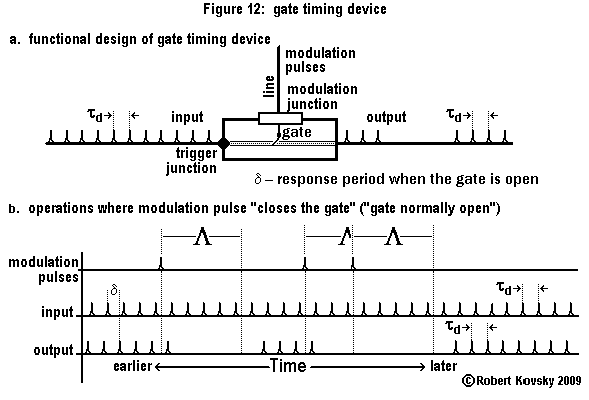
Figure 12 shows a "gate timing device." It has functional parallels to conventional electrical and electronic circuit components that have the nature of "gates" or "valves" - e.g., electrical relays, vacuum tube triodes and "npn" transistors - but with a new kind of signal and operations.

As shown in Fig. 12.a, a gate timing device has two different junctions. The "input" projection onto and the "trigger junction" have the same function and operations as in the primal timing device. In addition, a second projection onto the timing device, called the "line" in Figure 12, attaches through a different kind of junction, called a "modulation junction." "Modulation pulses" are carried through the line onto the modulation junction.

Figure 12.b shows the operations of the "gate normally open" gate timing device. An input pulse leads to a primal, delayed output pulse when "the gate is open" but the output is silent when "the gate is closed." A modulation pulse closes the gate for a period of Λ, the "modulation period." The gate is closed as to input pulses arriving after the arrival of the modulation pulse; there is no interruption of a response process initiated prior to the arrival of the modulation pulse.

If a modulation pulse arrives while the gate is closed, the gate will remain closed for Λ additional seconds, or longer, if more modulation pulses arrive. If modulation pulses arrive at a frequency greater than 1/Λ, the gate will be maintained in a closed condition.

Return to contents.


Silence Detector

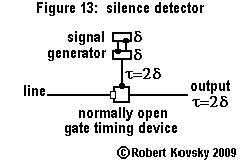
Figure 13.a shows the design for the silence detector that is used in the Ear for Pythagorean harmonics. The silence detector is assembled from a signal generator and a normally-open gate timing device.

In the silence detector, the normal condition of the gate timing device corresponds to silence on the line to the gate. When there is such silence, the gate is open and the signal from the signal generator passes through to the output.

On the other hand, when pulses arrive regularly through the line onto the modulation junction of the gate, the gate will stay closed. Then there is no output.

In brief: a signal on the line means a silent output. Silence on the line means that a signal from the signal generator appears as the output of the silence detector.

In idealized operations, inputs to the Ear are very long pulse trains, each pulse train specified by the period between any two pulses. The value of Λ in the gate timing device is also very large so that many pulses from the signal generator are blocked off by each modulation pulse and the modulation pulse frequency needed to keep the output silent is relatively small.

Return to contents.


Difference Device

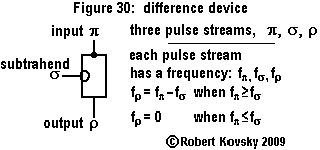
Figure 30 shows the design element for the difference device and its operations as a frequency subtraction device.

There are three signals: pulse streams π, σ and ρ. Pulse stream π is the input to the difference device. Pulse stream σ - called the "subtrahend" - resembles the stream of modulation pulses to the gate timing device but with somewhat different effect. Here, each pulse in the subtrahend stream cancels one pulse from the input stream. Pulse stream ρ is the resulting output stream.

Operations require that "defined" pulse streams arrive through the input and subtrahend lines. A defined pulse stream need not be perfectly uniform; it is sufficient if a specific pulse frequency can be assigned and if irregularities  –  "holes" resulting from cancellations  –  are smoothly distributed. These requirements are met for operations of the Ear for Pythagorean harmonics.

A defined pulse stream has a specific frequency and the following relations describe the operations of the device.

fρ = fπ – fσ when fπ > fσ
fρ = 0 when fπ < fσ.
Return to contents.


Balancing Unit

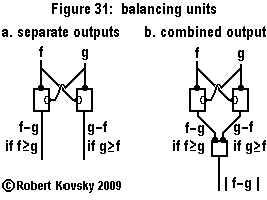
Figure 31 shows an important use of the difference device, in two versions of "balancing units." In each version, two difference devices are hooked up to two pulse streams (f and g) that serve as input and subtrahend, one each to each difference device. For two defined input pulse streams, no more than one difference device will be operatating at any given moment and its output line will be carrying a signal; the other difference device will be silent. If the two pulse streams are identical (or nearly so), both lines will be silent.

Figure 31.a shows a balancing unit with separate outputs.

In the balancing unit shown in Figure 31.b, the outputs from the two difference devices are inputs to a simple timing device. At any moment during controlled operations, no more than one difference device generates input to the simple timing device and the simple timing device responds like a primal timing device. The possibilities are combined in the formulation | f–g |, denoting the absolute value of f–g. The same principles apply to output of a balancing unit combined at the gate of a gate timing device, shown in the design of an Ear for Pythagorean harmonics.
Return to contents.


The Pythagorean Harmonics and Operations of the Ear

The Pythagorean Harmonics

Two different musical tones heard together can produce in the listener a pleasant sensation additional to that felt when the two tones are heard separately. Such pleasant sensations, called "harmonies" or "consonances," are a foundation of music. Another pair of tones heard together might give rise to an unpleasant sensation, called "dissonance," which is experienced as a kind of tension.

In a mathematical approach to music, each tone is described by a frequency, sometimes called a "pitch"  –  namely, a certain number of "cycles per second" or Hertz (Hz). A pitch of 440 Hz denotes the sound of a conventionally-tuned violin playing an open A string.

The ancient sage Pythagoras first discovered that consonance between tones can be identified by simple ratios of whole numbers, such as "3:2." Expressed in the modern language of frequencies: when the frequencies of two tones define a simple whole number ratio, the pair of tones gives rise to a pleasant sensation or consonance. A musical scale consists of tones that, taken in pairs, define certain ratios with respect to one another. Simple ratios identify pleasant pairs and complex ratios identify tense pairs. Pleasure and tension are thus identified with ratios (also known as "pitch relations") and ordered accorded to numbers, on the one hand, and a musical scale, on the other hand.

Without doubt or dispute, the fundamental coupling is 1:1 or unison. The most pleasant ratio is 2:1, or the octave. Then, ratios are found to be pleasant in order according to a scheme: 3:2 (perfect fifth or dominant); 4:3 (perfect fourth or subdominant); 5:4 (major third or mediant). These five notes and relations make up the essence of a scale. In the Ear for Pythagorean Harmonics, the scale is extended to the ratio 6:5, a minor third.

A chief feature of musical experience is that much the "same" pleasure is aroused by any two tones that are in a specific pitch relation, such as 3:2, regardless of the absolute pitch. E.g., two tones of 600 Hz and 400 Hz, heard together, will arouse much the same experience as 660 Hz and 440 Hz, heard together. Accordingly, a musician can "transpose" one set of pitches in one "key" (tonic and subordinate tones) to another set of pitches in another key and yet reproduce musical feelings of pleasure and tension almost exactly.

"An Ear for Pythagorean harmonics," assembled out of timing devices, suggests a basis for these facts of experience.


Operations of the Ear at the limit points of its range

The full design for the Ear is at the
top of the page. In images below, the Ear is reduced to the essential features.

Operations of the Ear depend only on ratios; therefore, it is possible to construct examples with convenient numbers. For examples here, the foundational tone, g, is set equal to 60 Hz, or, simply, g=60.

The operating range of the Ear is defined as: g < f < 2g. For g=60, this means that f can range from f=60 to f=120.

 
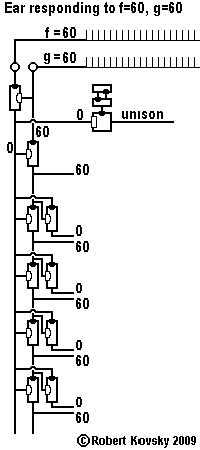
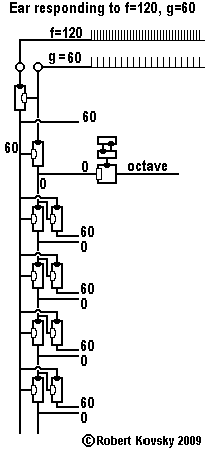
The adjacent images show the Ear operating at the limit points of its range of operations. At one limit point of the range of operations, when f=60 and g=60 and the two inputs are "in unison," the Ear detects that fact and a signal appears on the "unison" output line but on no other output line. The image for f=60, g=60 shows only the single silence detector where the gate is open. Its modulation line is silent; the frequency of the signal to the modulation junction is 0.

The other image shows operations at the limit point that is the polar opposite of the first, that is, when f=120 and g=60 and the relationship is "octave." Again, that fact is similarly detected and a signal appears on the "octave" output line but on no other output line.

In each image, the frequencies of the paired outputs of the balancing units at levels below the octave all have the same values. The frequencies of those paired outputs when the inputs are f=60, g=60 are reversed from the pairs when the inputs are f=120, g=60. As f traverses its range, moving from 60 to 120, the paired frequencies shift in an orderly but complex fashion from one extreme to the other.


Operations of the Ear at intermediate points in its range

 
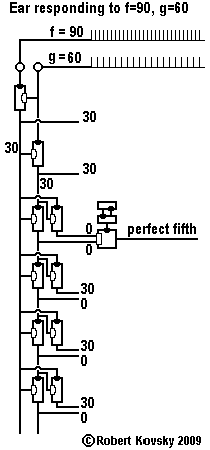
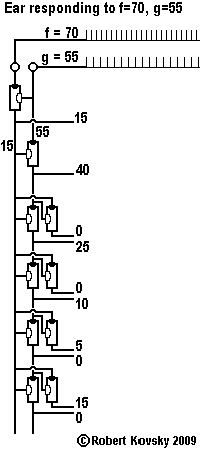
The adjacent images show operations of the Ear at intermediate points in its range of operations.

When f=90, g=60, the relationship between the input tones is that of a "perfect fifth," as detected by the Ear. Both inputs to the perfect fifth silence detector are silent. The ratio is f = (3/2)g.

When f=70, g=55, the relationship between the input tones is not a simple ratio. Rather, the ratio is 14:11. None of the balancing units produces a pair of silences and none of the outputs of the Ear carries a signal. This is an unmusical relationship between a perfect fourth and a major third.

For each of the consonant relations that is shown in the images — unison, octave and perfect fifth — only a single active frequency appears on the internal lines of the Ear. When f=70, g=55, on the other hand, every internal pair is different and many frequencies appear. The principles of the Ear suggest that the many internal frequencies in the latter case identify a source of tension or dissonance in human musical perception, in contrast to conditions during consonance.


Remarks

  1. The Ear is presented as a feature detector and not as a general system of audition (hearing). Presumably, other feature detectors can be constructed on the basis of additional or different principles. Whether feature detectors operate harmoniously together depends on the subject matter that is being processed and the skill of the designer. Facts of human audition suggest that feature detectors operate harmoniously together under some circumstances but that other circumstances present problems that may be difficult to manage, e.g., when the Bach choir tries to perform in a subway station.

  2. I am not a scholar of neuroscience and I do not attempt to review professional brain research. Publications accessible online show that professional researchers consider the Pythagorean harmonics in the context of other features and that no general theory addresses all the features. Various theories are advanced, some of which involve ratios. None of the theories is embodied in devices, such as the Ear for Pythagorean harmonics. Please see:

    McDermott, J. H., Oxenham, A. J. Music perception, pitch, and the auditory system, Published in final edited form as: Curr Opin Neurobiol. 2008 August; 18(4): 452–463. Published online 2008 October 2. doi: 10.1016/j.conb.2008.09.005. link.

    Lots, I. S., Stone, L., Perception of musical consonance and dissonance: an outcome of neural synchronization, doi: J. R. Soc. Interface 2008 5, 1429-1434, 10.1098/rsif.2008.0143, link.

    Fishman, et. al., Consonance and Dissonance of Musical Chords: Neural Correlates in Auditory Cortex of Monkeys and Humans, J Neurophysiol 86: 2761-2788, 2001; link.

  3. As noted above, the complete Timing Devices paper is available for download, a .pdf file, 460 kB. Another web page presents the Abstract of the paper and the listing of Contents. This page offers only a reduced and simplified presentation of the Ear and the timing devices system.
Return to contents.


Copyright © 2009 Robert Kovsky


Author

Celebrating nephew Steve's birthday.

An example of "family resemblances."
 
Robert Kovsky. B.S.E.E., MIT, 1968, Tau Beta Pi. M.A., Physics/Materials Science, UC Berkeley, 1971. J.D., UC Berkeley, 1974.

I am an amateur in brain science, without institutional affiliation, grateful for the Internet as a publishing medium. My employment as an attorney includes recent representation of BitTorrent developers in copyright litigation adverse to Movie Studios (link to .pdf file at Electronic Frontier Foundation -- 789 kB.) and in privacy litigation adverse to the Motion Picture Association of America (MPAA) (link to .pdf file at Electronic Privacy Information Center -- 832 kB).

My alternative approach to brain science had its inception in 1970 and was based on my graduate school research into phase changes in glassy metal alloys and their potential uses in associative memory systems -- which had its origins in pioneering work by Sanford R. Ovshinky. (My approach was distinctly different.)

While at MIT, I encountered the proposition that "brains are computers." Previously, I had built a computer out of pinball machine relays saved from law enforcement incinerators by my high school science teacher, Frank Gasper. I had also studied programming for mainframe IBM machines and I had a pretty good idea about how computers work.

My immediate response was that the proposition "brains are computers" was false, absurd and unworkable. My views on this subject have never changed but have developed in several ways. The proposition is contrary to the working of the Spirit that I experience directly as freedom. Factually, the proposition "brains are computers" has not led to any substantial intellectual development despite more than 60 years of intensive research. Notwithstanding uses of computers, e.g., in medical procedures, I do not know of any substantial practical benefits that have been developed from the proposition itself. I hold that the proposition is not only false, it is seriously injurious to human beings and to Western civilization. The proposition would deny freedom and squeeze freedom out of our activities, substituting a culture of meaningless mechanisms, continual distractions and unreal imagery for the authentic lives of persons.

An Ear for Pythagorean harmonics and my other publications provide different answers to questions that are supposedly answered by the proposition "brains are computers."

Your comments and suggestions are welcome.
Please write to the adjacent email address (shown in an image to minimize spam).

Return to contents.


Related Works by the Author

An Ear for Pythagorean Harmonics is part of the my larger work, where device designs for brains are the basis of a psychological model and the psychological model is used to investigate institutional activities, including physics and natural science, the laws of the courts and the Christian religion. The focus of interest in the larger work is personal freedom, especially as expressed through choices and selections made by persons in institutional situations. Of course, we exercise freedom in wilderness too, but institutional situations are more susceptible to analysis.

The engineering and scientific works set forth principles of device design that can be developed in several directions. Writings about psychological, philosophical, institutional, personal and spiritual matters are more tentative and even sketchy  – but they provide long-range motivation and have suggested particular inventions and pathways of development. For example, the design of the Ear for Pythagorean harmonics had its inception in my personal auditory investigations into "Duo Seraphim" by Claudio Monteverdi, discussed on the Shimmering Silences website, linked below.

I.    Engineering and Scientific Works
Quad Nets (2006)-- Quad Nets is the chief engineering and scientific presentation of my "device models of brains." Timing Devices, discussed here, began as a simplified version of the Quad Net Model.

Quad Nets website -- separately organized

web page on the full paper titled Quad Nets: Material Foundations for Thermal Device Models of Brains

download Quad Nets paper. (.pdf format, 1.1 Mb)
Timing Devices (2007-2009) has developed from a simplified version of the Quad Net Model into an independent area of investigation. The course of development includes possible future projects.

The complete paper Timing Devices paper, titled "An Ear for Pythagorean Harmonics: Mathematical Processing in Brain Models Built From "Timing Devices", is available for download, a .pdf file, 460 kB. Another web page presents the Abstract of the paper and the listing of Contents.

"Ears for Pythagorean Harmonics Used to Investigate a Procrustean Group of Harmonies (2010)" is the most recent development. (link). A series of advanced device designs begins with the original Ear for Pythagorean harmonics and proceeds to sharpens its perceptions, to augment and extend its range, to give it voice, to join it with similar devices and to use the resulting assembly to investigate the mathematics of harmonic structure.

The separate website, link, Shimmering Silences in Beautiful Music (2009) presented initial investigations and original constructions that developed into the present Ear for Pythagorean Harmonics, along with an earlier version of the Timing Devices paper, titled An Ear for Pythagorean Harmonics: Mathematical Processing in Brain Models Built From "Timing Devices," (2009), a .pdf file 212 kB.

The separate web page, "Timing Devices or Why Brains Are Not Computers," link, is now the setting for the first, 2007, version of the Timing Devices paper, .pdf file, 363 kB.

The separate web page, Dancer - Shimmering Gaits of a Six-Legged Engineered Organism link, contains a proposed series of projects for construction of systems for engineered organisms (artificial animals) to be built from timing devices and Quad Net assemblies, starting with a "Utricle" that detects the orientation of an organism with respect to gravity and progressively leading upwards to a six-legged organism that uses a variety of coordination patterns ("gaits") in attempts to navigate a broken and obstructed terrain.

See also "Advanced Note: Convolution Timing Devices," a .pdf file (68 kB) link, preparatory for the present Timing Devices paper.

II.    Philosophy of Science
"Brains are computers" is part of a belief system that I call the Mechanical Cosmology and that includes other propositions: "all things are made of atoms" and "the Universe is governed by laws of physics, like the law of conservation of energy."

Beliefs about atoms and laws of physics have been developmentally productive and wonderfully fruitful in practical ways  – in contrast to "brains are computers"  – but they are also false and misleading. There are no "atoms." Atoms are mental constructions and they do not appear in reality. It is possible to buy materials, such as minerals, metals, refined chemical reagents, vegetable materials, animal materials and synthetic materials; but it is not possible to buy "atoms." The material that is closest to "atoms," refined helium, shows complex, collective, "non-atomic" properties when the temperature gets very low and the helium liquifies.

Energy is never "conserved." "Conservation of energy" is an ideal that is never attained, although billiard tables, vaccuum chambers and ball bearings rather approach it and make exact calculations possible under some circumstances.

Physicists believe that all of reality is made up of particles and laws of physics. Some parts of reality are well modeled by methods based on this belief but other parts of reality  – e.g., the reality of persons and the reality of conflicting principles of social organization  – cannot even be recognized. The physicists' belief is formed through study of imaginary conservative systems of atoms that can never be realized and that do not apply at all to situations that are most important to persons living their lives.

My works on these subjects are not as compactly organized as my engineering and scientific works and the themes run through many diverse works

Works related to Philosophy of Science

Please see a separate web page, "Facts About Snowflakes," about the generation of snowflakes from gaseous water vapor. Snowflakes can be beautifully symmetrical. Physicists are unable to account for this phenomenon because the proposed atomic processes are independent of one another and distant from each spatially. I argue that the attempt to explain the phenomenon by means of atomic processes is a failure. This failure is exemplary of the failures of physics to explain classes of phenomena of phase changes, of which the change from water to ice is the most familiar. I hold that important brain activities are phase changes and outside the reach of the Mechanical Cosmology.

A Patchwork of Limits: Physics Viewed From an Indirect Approach (2000), a .pdf file (157 kB), is discussed on a separate web page The paper is a statement of my "alternative view of physics" that includes technical analysis of the thermodynamic critical state, the conceptual basis of Quad Nets.

A broad statement of my alternative view accessible to the lay reader, with a critical analysis of conventional physics, is in § 6 of "An Objective Kind of Freedom," an archival paper in the form of a .pdf file (618 kB.). The paper was published online in January of 2005 and the first six sections were foundational of my development of Quad Nets later in the year.

"On Cosmological Principles in Natural Science," a .pdf file (23 kB), link, is suggestive of future approaches.
(return to top of page).


III.    Large-scale Works

Testimony of Freedom
A separate website, under development, that establishes scientific and engineering foundations for investigations into social and spiritual matters.

Embodiment of Freedom
A separate website that was a prior stage of development, now superseded in large part by Testimony of Freedom. This site contains the Archive of my work that was done prior to May of 2005 and that led up to Quad Nets.


Copyright © 2009, 2010 Robert Kovsky